
Solving number regions where every neighbour is forbidden
The full set of rules behind the number-in-every-block puzzle, how the diagonal restriction changes everything, which squares to fill first, and a walkthrough of the reasoning that cracks a board open without guessing.
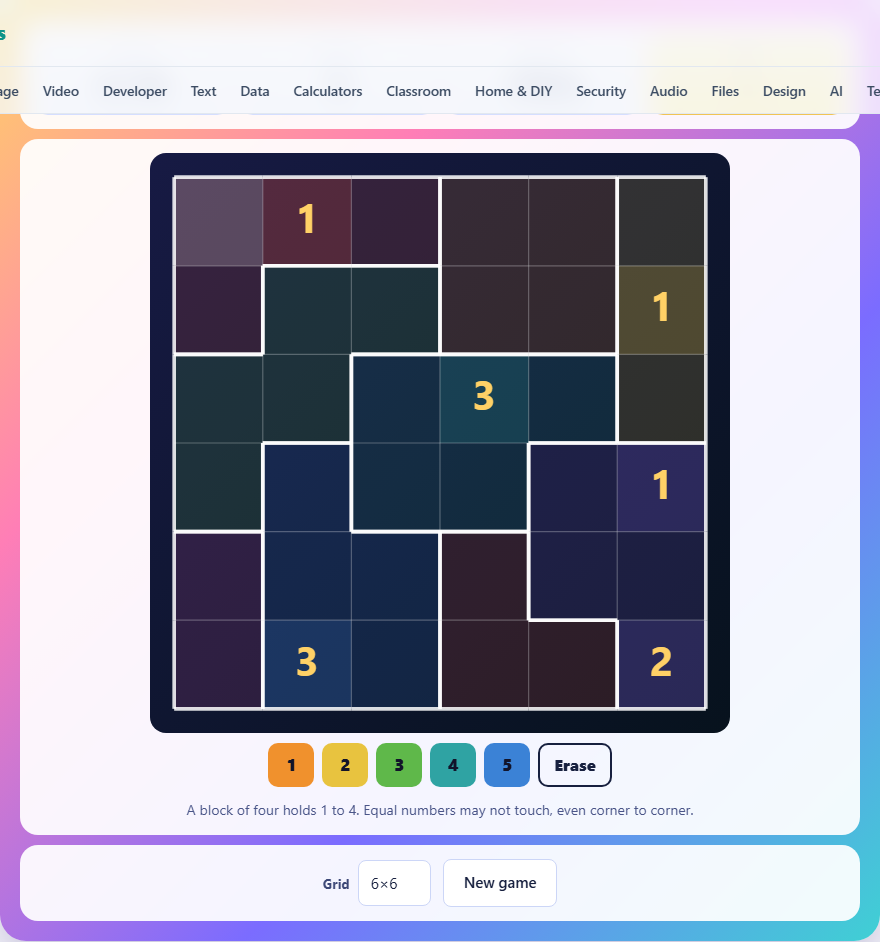
The two rules that drive the whole puzzle
The grid is sliced into irregular blocks of different sizes, drawn with thick white borders. A block of three squares must hold the numbers 1, 2 and 3, one in each square. A block of five holds 1 through 5. That is the first rule: every block contains exactly one of each number up to its size.
The second rule is what makes the puzzle hard. No two squares holding the same number may touch each other, and touching includes diagonals. A number in the middle of the board has eight neighbours - the four sides plus the four corners - and none of those eight may hold the same value. This diagonal restriction is far more aggressive than a row-and-column rule. One placed number can eliminate possibilities in three or four different blocks at once.
How the controls work
Tap or click any empty square to select it. A highlight appears on the chosen cell. Then tap one of the number buttons below the grid to write that number into the square. The Erase button removes what you wrote. The yellow numbers were printed on the grid when it was generated, and those cannot be changed.
If you try to place a number that is too large for the block - say a 4 in a block of three - the cell flashes red and a message tells you the block only holds numbers up to its size. This is not a penalty, just a nudge to look at the block borders more carefully.
Three grid sizes are available. The 5 by 5 grid gives you 150 seconds. The 6 by 6 gives 180 seconds. The 7 by 7 gives 210 seconds. When the clock runs out the game ends, so speed matters, but accuracy matters more. Filling the grid with a contradiction wastes the time you spent placing those numbers.
How the board is built and why it has one answer
The generator first carves the grid into blocks by growing each one from a free square, aiming for sizes between two and five. Any single square left over gets folded into a neighbour so that no block has only one cell. The blocks are then filled with a valid solution using backtracking, and finally the clues are removed one at a time in a shuffled order. After each removal the generator counts how many ways the remaining clues can be completed. If the count goes above one, the clue is put back.
This means every board is guaranteed to have exactly one solution. If you can prove a number belongs in a square by logic alone, you can trust that proof. There is never a point where you must guess between two options and hope for the best.
Start with the smallest blocks
A block of two squares holds only a 1 and a 2. There are exactly two arrangements, and most of the time a neighbouring clue eliminates one of them. Once you place both numbers, every square touching that pair - up to ten squares across the two cells when you count diagonals - is barred from holding a 1 and also barred from holding a 2. That single pair of numbers can propagate outward and settle half a dozen cells in surrounding blocks.
Blocks of three are the next easiest. They hold 1, 2 and 3, and the 3 in particular is useful because it is a relatively rare number in the grid. A 3 placed anywhere creates a ring of eight cells that cannot hold a 3, and since only blocks of size three or larger even contain a 3, there are not many candidate squares for it. Place the 3 first and the 1 and 2 often follow immediately.
Using the ring to eliminate candidates
Think of every placed number as radiating a force field one square outward in all directions, including corners. When two of these rings overlap on the same cell, that cell loses two candidate values at once. A square surrounded by several placed numbers may have only one possibility left, even before you consider which block it belongs to.
Here is a concrete example. Suppose a blank cell sits at the corner where four blocks meet. One block to the upper left contains a 2 in the next cell diagonally. Another block to the lower right has a 3 one step away. The blank cell belongs to a block of three, so it can hold 1, 2 or 3. The neighbouring 2 rules out 2. The neighbouring 3 rules out 3. Only 1 is left, so you can place it with certainty.
This kind of reasoning is the core technique. Every time you place a number, scan the eight cells around it and ask whether any of them now have only one option. When a placement triggers a second placement that triggers a third, the board opens up fast.
The biggest number is the rarest
On a 6 by 6 board, a 5 can only appear in blocks of size five or larger. There may be only one or two such blocks on the entire grid. That makes the 5 an anchor: it has very few legal squares, and placing it early narrows the field for every surrounding block.
The same logic applies in reverse. The number 1 appears in every block regardless of size, so there are many 1s on the board. A 1 is easy to place but it does not constrain much on its own. The rare numbers constrain heavily. When you are stuck, look at the biggest numbers first and ask where they can go. Often there is only one cell that works.
What to do when the grid is almost full
As you fill the last few cells, mistakes become visible. The game checks the board only when every square is filled, and if two identical numbers are touching somewhere, it tells you something is wrong but not where. At that point you need to scan the board yourself.
The fastest scan is to look at each number in isolation. Pick the 1s first. Run your eye across every 1 on the board and check that none of them touch another 1, including diagonals. Then do the same for the 2s, the 3s, and so on. The clash will usually be between the last two or three numbers you placed, so start your scan in the area where you worked most recently.
Timing strategy for the clock
Your final score is the number of seconds left on the clock when you complete the grid, so faster solves earn more. But placing wrong numbers and erasing them costs more time than pausing to think. Spend a few seconds at the start identifying the smallest blocks and the given numbers near the centre. Those are the most constrained cells, and placing them correctly on the first try saves far more time than rushing through the board and backtracking.
If the timer is running low and you still have several blank cells, focus on the cells that are most constrained - those with the fewest legal values. Each correct placement may trigger a chain of forced placements that finishes the board in a rush.
How this differs from a standard row-column puzzle
In a row-column number puzzle, placing a 3 in one cell eliminates 3 from an entire row and an entire column. That gives a wide, linear exclusion zone. Here the exclusion zone is small but dense. A 3 only blocks the eight cells directly around it, but it blocks all eight directions. The result is a more local style of reasoning. You do not scan a long row for repeats. Instead you focus on a small neighbourhood and count what can still fit.
The irregular block shapes add another layer. No two boards use the same block pattern, so you cannot memorise layouts. Each new game forces you to read the borders and reason from the shapes themselves.
Nothing leaves this page
The grid is generated inside your browser the moment you press New game. No puzzle data is sent to any server, and no account is needed. Your best time is saved in local storage on this device only - it will not appear if you open the game on a different computer or a different browser. Once the page has loaded, it works offline with no connection needed at all.