
Building chains that clear the board in a single cascade
How the falling pairs work, why four blobs pop regardless of shape, how the scoring doubles with every chain step, and how to plan a stack that collapses all at once instead of clearing one tidy group at a time.
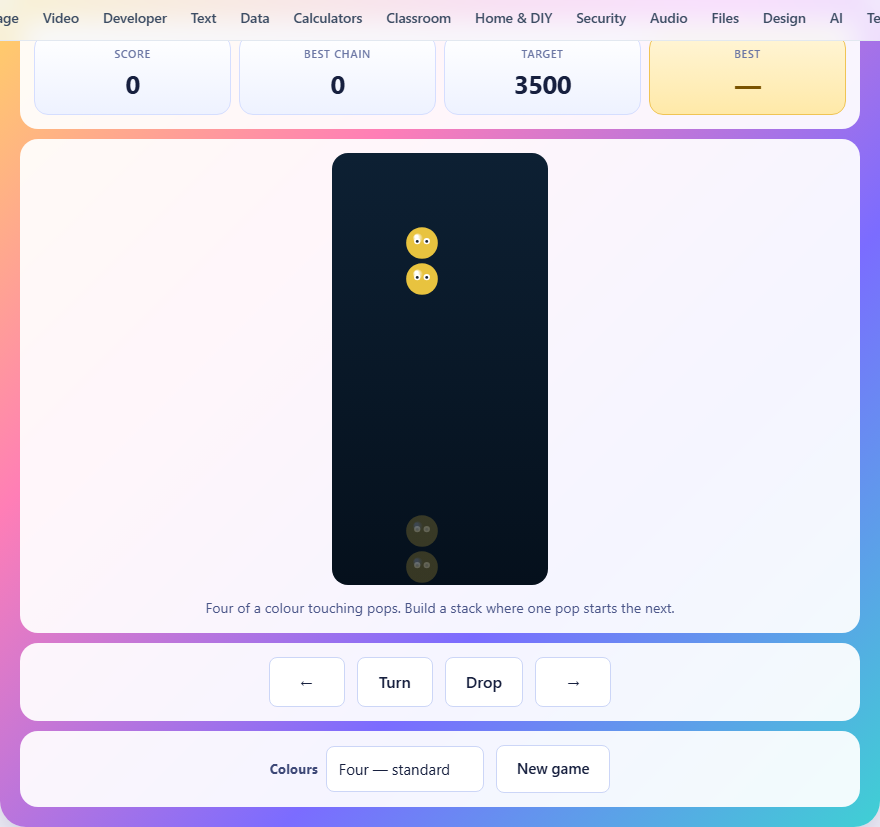
What falls and what stays
Two blobs drop from the top of a six-column, twelve-row board. They are always a pair - one pivot blob and one satellite - and they share a single colour each, picked at random from three, four or five colours depending on the difficulty you chose. The pair falls steadily, one row at a time, until it lands on the floor or on top of something already sitting there.
Once the pair stops it becomes part of the stack and a new pair appears at the top. If the new pair has nowhere to fit because the stack has reached the ceiling, the game is over. There is also a target score, and reaching it means you win.
Moving and turning the pair
On a keyboard, the left and right arrows slide the pair sideways one column at a time. The up arrow rotates the satellite around the pivot, cycling through four positions: above, to the right, below, and to the left. The down arrow nudges the pair one row closer to the floor and resets the fall timer, giving you a little more time to think after each nudge.
On a phone or tablet, swipe left or right to slide and swipe up to turn. A downward swipe sends the pair all the way to the bottom at once, skipping every row in between. The on-screen buttons work the same way: left, right, turn, and drop.
Turning near the wall does not simply fail. If the satellite would end up inside the wall, the whole pair shifts one column away from the edge so the turn still works. This wall kick matters most when you need to slot a blob into the last column and the satellite is on the wrong side.
How popping works
When four or more blobs of the same colour are touching each other side by side, the whole group vanishes. Diagonals do not count. The connection is checked by flood fill, which means the four do not need to form a straight line. An L shape, a T shape, or an S shape all pop exactly the same way. This is the rule that makes chain reactions possible, because you can tuck groups into odd corners and still connect them.
After a group pops, everything above it falls down. Gravity is applied column by column, so each column settles independently. If the falling blobs happen to complete another group of four, that group pops too, and the process repeats until nothing else matches.
Scoring and why chains matter
Every blob that pops is worth ten points, multiplied by a chain bonus. The first pop in a sequence is chain one, worth ten per blob. If the gravity after that pop causes a second pop, that is chain two, and each blob is worth twenty. Chain three pays forty per blob. Chain four pays eighty. The multiplier keeps doubling as long as the cascade continues.
This steep curve is the entire design of the game. Suppose you pop four blobs cleanly five separate times. That scores 5 times 40, which is 200 points. Now suppose you build one cascade that pops four blobs at each of four steps. The first step pays 40, the second 80, the third 160, the fourth 320. That single cascade earns 600 points. One good chain is worth more than a dozen tidy clears.
The three difficulty levels
Gentle uses three colours, drops a new row every 620 milliseconds, and asks for 2,000 points to win. Standard uses four colours, drops faster at 500 milliseconds, and the target is 3,500. Hard uses five colours at 390 milliseconds per row, and you need 5,000 points.
Fewer colours makes chains much easier to set up because the blobs you need appear more often. Five colours is a real fight - the board fills quickly with scattered colours that refuse to form groups, and the faster fall speed leaves less time to plan each placement.
Planning a cascade from the bottom up
The strongest approach is to build groups of three, not four. A group of three sits harmlessly in the stack, waiting. When you place a fourth blob to complete the top group, it pops, the blobs above drop, and the exposed group of three underneath gains a fourth blob from whatever was sitting on top of it. That second group pops, drops more blobs, and the process continues downward.
Picture this. In the bottom-left corner you have three red blobs touching each other. On top of those you stack three blue blobs with one green blob resting over them. Above the green you have three more red blobs. Now you drop a red blob to complete the top group. The top reds pop. The green blob falls onto the blue group - but it is the wrong colour, so nothing happens yet. Wait, the three reds at the bottom now have the green above and the blues are still intact. This example shows why planning the exact column matters. The blobs that fall must land exactly where they complete the next group.
A good chain needs the groups stacked so that each pop feeds the one below. That means you must decide where each colour goes before the board fills up, and you must resist the urge to pop groups early just because they are ready.
Keep one column empty
Reserve one column - usually one of the outer two - as a dump. When a pair arrives with a colour you cannot use right now, drop it into the dump column so it does not interfere with the chain you are building. This buys time and keeps the working columns clean.
The dump column will eventually fill up, so it is not a permanent solution. But it extends the game long enough to finish your cascade, which is all you need. On hard difficulty you might use two dump columns because five colours produce far more waste.
Mistakes that end the game early
- Popping groups the moment they form. Every early pop is points you could have multiplied by building a longer chain instead.
- Ignoring the ghost. A faint outline of the pair shows where it will land. If you drop without checking the ghost, a blob can land one column off and ruin the chain you were building.
- Piling everything in the middle. The middle columns are the hardest to dig out because blobs have nowhere to fall sideways. Build your chains against a wall where the structure is easier to control.
- Forgetting the wall kick. If you think you cannot turn near the edge, you will avoid the outer columns, which wastes board space. The pair does shift to make room for the turn.
- Stacking four of the same colour by accident. If a group pops before you planned it to, the cascade above it fires too early and may fizzle out halfway through.
Reading the board when things go wrong
Sometimes the cascade misfires and you are left with a half-cleared board and a score well short of the target. Do not panic and start dropping randomly. Look at what is left. If two groups of three are still sitting near each other, you can often rescue a two-step chain from the wreckage.
Count the blobs of each colour in the top half of the board. If one colour dominates, aim to consolidate those blobs into a single connected group. Even a flat five-blob pop at chain one is 50 points, and it clears room for the next pair. Remember that bent shapes count. Three reds in an L need only one more red touching any side of the L, not necessarily extending the line. That flexibility often saves a messy board.
Everything stays on your machine
The game runs entirely in your browser. No data is sent to any server while you play. The board, the score, and the pairs are all computed locally on your own device. You can disconnect from the internet after the page loads and everything still works exactly the same way, because there is no server involved at any point. Close the tab and nothing is stored anywhere else.