
Winning the sealed bid auction game
Bidder is a strategy game where you and the computer bid blind for a series of lots. Each lot has a face value, and the higher bid wins it while the loser pays nothing. The catch is that both players start with the same purse and both purses are visible, so the game is about spending wisely rather than spending most. This guide covers every rule, every control, and the thinking that beats the computer more often than not.
The sum the opponent does before each lot
Every sale is built the moment you press New game. Each lot gets a value of 1 plus a random whole number, and the cap comes from the Sale menu. Small deals 5 lots worth 1 to 6 and hands each side 20 coins. Medium deals 7 lots worth 1 to 8 with 26 coins each. Large deals 9 lots worth 1 to 9 with 32 coins each. No lot is ever worth nothing, and each value is drawn on its own, so three big lots in a row is perfectly possible.
The opponent then picks its bid in four steps, and your slider is not one of the inputs. It adds the value of the current lot to the value of every lot still to come. It divides the current value by that total, which gives a share. Next it measures the score gap: their value minus yours, divided by the first lot's value times the number of lots. Then it takes its own purse, multiplies by the share, and multiplies again by 1.15 minus half that gap figure. The 1.15 makes it aim a shade above a plain fair share. The gap part lifts the bid when it is behind and lowers it when it is in front. Finally it adds a random amount between minus one and plus one, rounds to a whole coin, and trims the answer so it lands between nothing and all it holds.
Try it with a Medium sale of 5, 3, 8, 2, 6, 4 and 7. Those add up to 35. On the opening lot the share is 5 in 35, or one seventh. Both scores are zero, so the gap is zero and the multiplier stays at 1.15. The bid is 26 times one seventh times 1.15, which is 4 and a quarter. The random nudge spreads that from 3 and a quarter up to 5 and a quarter. So the opponent bids 3, 4 or 5. It writes 4 about half the time, 5 a bit more than a third of the time, and 3 only now and then.
Now jump to the fifth lot of that same sale. Say you took the first three and they took the 2. You hold 16 in value against their 2, and their purse is down to 23. The lots left are 6, 4 and 7, so the share is 6 in 17. The gap is 2 minus 16, divided by 5 times 7, which is minus 0.4. The multiplier climbs to 1.35. Work it through and 23 times 6 in 17 times 1.35 comes to just under 11. They bid about 11 coins for a lot worth 6, which is nearly half of what they have left. That is the catch-up term at work, and it is your cue to stand aside.
The last lot is the one the formula turns brutal. Nothing else is left to come, so the share is exactly 1. An opponent that is level on value works out 1.15 times its entire purse, which is more than it owns, and the trim pulls it back to every coin it has. Reach the final lot level with 11 coins in their purse and they bid all 11. You need 12 to beat that. Arriving at the last round with more money than them is not a small edge. It is the game.
- Small sale: 5 lots, values 1 to 6, 20 coins each.
- Medium sale: 7 lots, values 1 to 8, 26 coins each.
- Large sale: 9 lots, values 1 to 9, 32 coins each.
- Base multiplier 1.15, so it always aims a little above its share.
- Catch-up term: half the score gap, measured against the first lot's value times the lot count.
- Random nudge: anywhere between minus one and plus one coin, added before rounding.
- Trim: never less than nothing, never more than its purse.
Where this sale room is rough, and what it leaves out
Everything is counted in whole coins. The slider moves in ones, and the opponent rounds its sum to the nearest coin before writing it down. That rounding is why two fairly different sums can end as the same bid, and why a lot is often won by a single coin. The random nudge is a flat one coin either way, not a percentage. With purses in the twenties it barely shows. With two or three coins left it can double a bid or wipe it out.
The catch-up term uses an odd yardstick. It divides the score gap by the first lot's value times the number of lots, and the first lot is simply whichever number happened to come up. A Medium sale that opened with a 5 has a yardstick of 35. One that opened with a 1 has a yardstick of 7. The same lead therefore reads as five times larger in the second sale. It can even drive the multiplier below zero. Take the sale 1, 8, 7, 6, 5, 4, 3, with the opponent 18 ahead on value, 20 coins in hand, and lot six worth 4. The multiplier lands at minus 0.14, the sum goes negative, and the trim sets the bid to nothing. An opponent that far in front stops bidding and hands you the tail of the sale. That is a side effect of the yardstick, not a plan.
Only four things feed the opponent's choice: the lot values, how far through the sale it is, its own purse, and the two value totals. Your purse is not among them. It will not squeeze you with a one coin bid when you are broke, and it never notices that you can outbid anything it writes. It keeps no record of your earlier bids either. There is no model of you in the code at all, so it plays the same way against a beginner and against someone who has read this page twice.
Three rules bite harder than they look. A bid of nothing can never take a lot, because the winner needs a strictly higher number, and nothing can only tie nothing. The cheapest a lot can truly be bought for is one coin, and only when the other side wrote nothing. A tie removes the lot from the sale for both of you, so a fat lot can vanish with neither side scoring it. And coins left over count for zero at the end. The game compares the values of the lots you took and nothing else, so a full purse at the close is a wasted purse. Your slider also resets to zero after every lot, so leaving it alone means bidding nothing.
This is not a model of a real auction. The winner pays its own bid in full, which is the first price rule, rather than paying the loser's bid instead. There is no reserve price, no buyer's fee, no interest on money you keep, and no borrowing. The running order is fixed and shown from the start, so nothing is hidden and nothing is withdrawn. A drawn game counts as a loss on the record: your best result is only written when you win, and it stores the value you collected. Treat Bidder as a budget puzzle with a stubborn opponent, not as practice for a real sale room.
How a round works
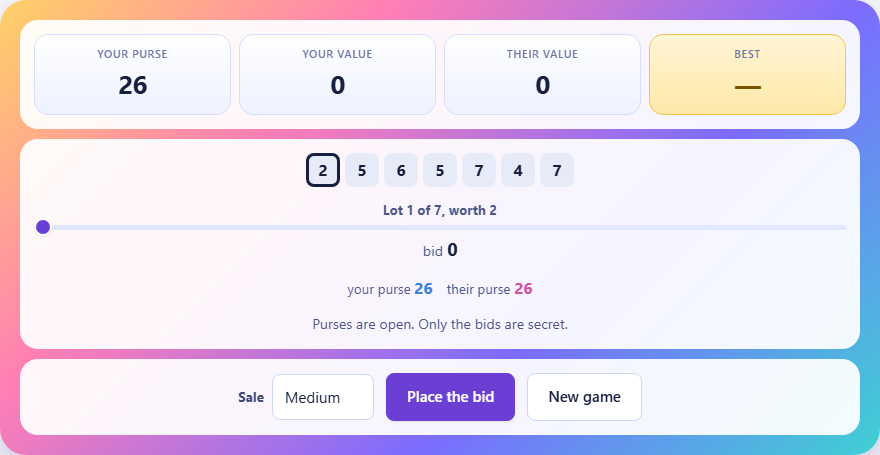
Lots come up one at a time. Each lot shows a number, which is its value. The row of lots above the board shows every value in the sale, so you always know what is coming before you spend. You and the computer both start with the same purse of coins.
For each lot, you set a bid using the slider. The slider will not let you bid more than you currently hold. Press the Place the bid button to lock in your choice. The computer writes its bid at the same time without seeing yours, and both bids are revealed together. The higher bid takes the lot and pays what it wrote. The loser keeps all of its coins. If both bids are the same, nobody takes the lot and nobody pays. After the last lot, the player with the higher total value of won lots wins the game.
What the board shows you
The board shows three things at all times. The row of lots displays the full sale, with each lot's value printed on it. Lots that have already been sold are marked so you can see what is left. Both purses are shown openly, yours and the computer's, so you always know how much each player can spend. The only secret is the bid itself.
After each round, the result appears briefly. You see both bids side by side and which player won the lot. Your running total of lot values and the computer's total are tracked in the stats bar. This lets you compare not just who has more coins left but who has collected more value.
Controls and sale sizes
The Sale menu lets you choose between three sizes. Small gives a short sale with fewer lots, making each bid count heavily. Medium is the standard length. Large adds many lots and a bigger purse, which rewards patience and planning across a longer horizon.
The Place the bid button submits your current slider position. The New game button starts a fresh sale with a new set of lot values. There is no undo once a bid is placed, which is part of the tension. Think carefully before pressing the button each time.
How the computer bids
The computer does not cheat and never sees your bid before choosing its own. Its strategy works by looking at what the current lot is worth as a share of the total value still remaining in the sale. It then spends roughly that fraction of its purse. When it is behind on total value, it leans higher to catch up. When it is ahead, it leans lower to save coins for later.
A small random amount is added on top of this calculation so that no fixed counter-strategy beats it every time. The computer is not easy to read because of this noise, but its overall pattern is predictable. It spends in proportion to value and adjusts for the score. Everything runs on your device.
Strategy: spend late rather than early
The biggest mistake in a sealed bid game is winning the first lot at a high price. You feel good about getting something, but the computer can see your depleted purse and knows it can take later lots cheaply. The last few lots are almost always where the sale is decided, because the player with more coins left has total control.
A better approach is to bid very low on the early lots, even zero. If the computer also bids low, you might pick something up for almost nothing. If it bids high, it wins the lot but drains its purse while yours stays full. Either way, you enter the late rounds in a strong position. The tail of the sale matters more than the head. Think of the early rounds as scouting. You are learning how the computer spends and saving your coins for the lots where spending will actually decide the final score.
Strategy: know when a lot is worth fighting for
Not all lots are equal. A lot worth eight points is worth far more than a lot worth two, but both cost whatever you bid. The right move is to let low-value lots go cheaply and save your coins for the expensive ones. Bidding one coin on a lot worth two means you either win it for almost nothing or you lose nothing at all. Either outcome is fine.
The high-value lots are where you should concentrate your spending. If a lot is worth ten and there are three lots left with a combined value of fifteen, that single lot is two-thirds of the remaining game. Spending heavily on it makes sense because winning it almost guarantees a higher total value at the end. Always compare the current lot to what is still coming before choosing your bid.
Strategy: watch the other purse
Both purses are open, which means you know exactly what the computer can spend. If its purse is nearly empty, a bid of one takes the next lot because the computer cannot outbid you. If its purse is full and yours is low, you need to pick your battles and let most lots go.
The most powerful moment in the game is when the computer runs out of coins entirely. Everything remaining in the sale goes to you for a single coin each. Never be the player who empties their purse first while good lots are still on the table. Keeping a small reserve is almost always better than winning one more lot now. Even five or six coins left in your purse means you can still compete for the final lot, while an empty purse hands away everything that follows.
Strategy: tied bids are free
When both bids are the same, nobody wins the lot and nobody pays. This is not a disaster. It is a lot that left the sale without costing either player anything. If you suspect the computer will bid a certain amount and you match it, you have wasted nothing. The lot simply disappears.
On low-value lots, matching the computer's likely bid is a reasonable gamble. You either tie and pay nothing, or you miss by a coin in either direction and the outcome barely matters. The risk of a tie is zero, so there is no penalty for guessing close.
Common mistakes new players make
The first mistake is bidding too high on the first lot because it looks valuable. The first lot might be worth a lot, but so are later lots, and you only have one purse to cover all of them. Overbidding early is the single fastest way to lose.
The second mistake is counting lots instead of value. Winning four lots worth two each gives you eight points. Losing those four and winning one lot worth ten gives you ten. The number of lots you win does not matter. Only the total value counts.
The third mistake is ignoring what is left in the sale. The row of remaining lots tells you exactly what is coming. If every remaining lot is low-value, you can relax and bid small. If a big lot is next, you need to plan your spending around it. Forgetting to check the upcoming lots means bidding blind when you do not have to. Before every bid, glance at the full row and ask yourself what the rest of the sale is worth. That number decides how much the current lot deserves.
Privacy and how the game runs
The game runs entirely inside your browser. Nothing is sent to a server, there is no account, and nothing leaves your device. The computer opponent is built into the page itself. Your best result is stored in local browser storage on this device only. Once the page has loaded, the game works fully offline.