
Placing speakers so the right people hear the music
Bandstand is a puzzle built on wave interference. Two speakers sit in a park playing the same note, and the sound they produce creates a pattern of loud and quiet bands across the grid. Some squares hold listeners who want to hear the music. Others hold sleepers who want silence. Your job is to move the two speakers until every listener sits in a loud band and every sleeper sits in a quiet one. The puzzle is gentle enough for anyone to pick up, but the physics behind it is the same arithmetic that proved light is a wave. This guide explains how the bands form, how to read the grid, and how to find the right placement quickly.
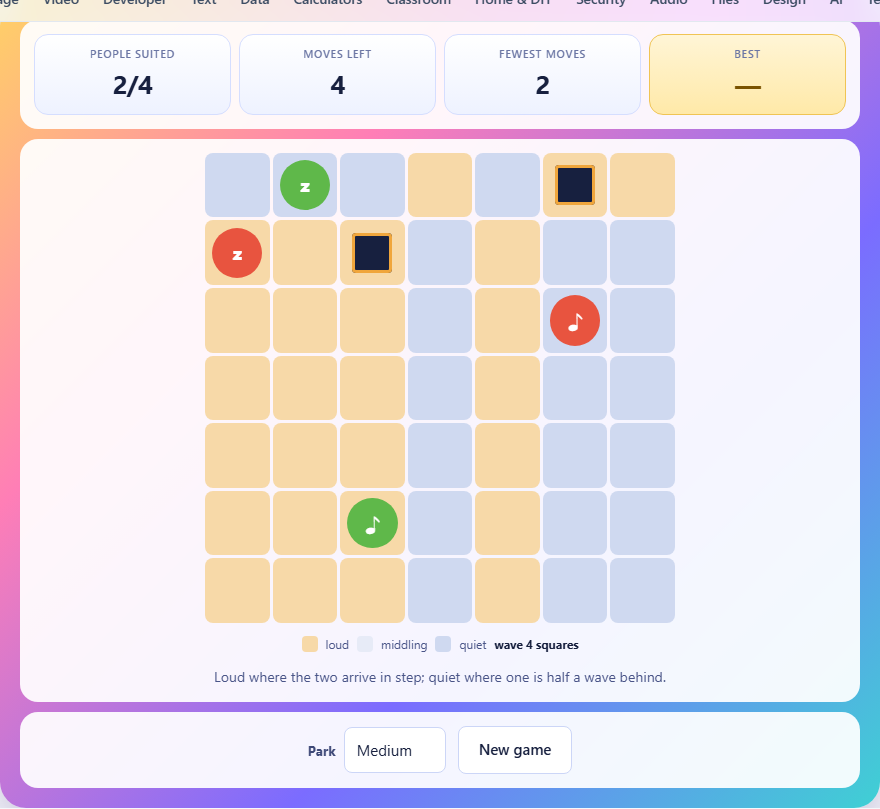
What the grid shows you
The park is a square grid of cells. Two dark squares mark the speakers. The rest of the cells are shaded to show how the two sound waves interact at that spot. Bright cells are loud, where the two waves arrive in step and add together. Dark or pale cells are quiet, where the waves arrive half a step apart and cancel each other out. Cells shaded somewhere in between are middling, where the waves partly add and partly cancel.
Scattered across the grid are two kinds of markers. A note symbol marks a listener who wants to hear the music and needs to sit in a loud cell. A letter z marks a sleeper who wants quiet and needs to sit in a quiet cell. You solve the puzzle when every note symbol is on a loud cell and every z is on a quiet cell. Middling cells do not count for either side.
How the loud and quiet bands are made
Each speaker sends out a wave. The wave travels across the grid, and at every cell the sound from speaker one arrives at some point in its cycle. The sound from speaker two also arrives, but it has travelled a different distance, so it may be at a different point in its cycle. If both sounds are at the same point in their cycle, they add up and the cell is loud. If one sound is exactly half a wave behind the other, they cancel and the cell is quiet.
What matters is not the absolute distance from each speaker, but the difference between the two distances. A cell that is five squares from speaker one and five from speaker two has a path difference of zero. The two waves arrive perfectly in step, so the cell is loud. A cell that is five from one and seven from the other has a path difference of two. Whether that is loud or quiet depends on the wavelength.
Wavelength and what the number means
Each puzzle tells you the wavelength: how many squares one full wave cycle takes. If the wavelength is four, a complete cycle covers four grid squares. Quiet happens where the path difference is exactly half the wavelength. With a wavelength of four, quiet is at a path difference of two. With a wavelength of six, quiet is at three.
Loud happens where the path difference is zero, or a full wavelength, or any whole multiple of the wavelength. So with a wavelength of four, path differences of zero, four, eight, and so on are all loud. Quiet happens at two, six, ten, and so on. Everything in between is middling. The key mental shortcut is simple: divide the wavelength by two and remember that number. Any cell whose path difference is that number, or that number plus the wavelength, is quiet.
How distance is counted on the grid
Distance is measured by counting squares along the grid, horizontally and vertically. It is the Manhattan distance, not the straight-line distance. A cell three squares to the right and two squares up from a speaker is five squares away, not the square root of thirteen. This grid-based counting is what keeps every path length as a whole number, which makes the pattern of bands neat and predictable.
Because distance is counted in whole squares, the pattern of loud and quiet cells lines up cleanly with the grid. You can trace the loud bands by eye once you know the wavelength. The band exactly between the two speakers, where both are the same distance away, is always loud. As you move sideways from that centre line, the path difference grows by one square for each step, and the bands alternate between loud and quiet at the rate the wavelength dictates.
Controls on the page
Tap one of the speaker squares to pick it up, then tap any empty cell to place it there. Speakers cannot sit on the same cell and cannot sit on a person. After each placement the grid redraws to show the new pattern of bands. The Park selector offers three sizes. Small parks have few people and short wavelengths, which makes the bands wide and easy to read. Medium parks add more people and tighter bands. Large parks have many people and long wavelengths, so the spacing between bands is narrow and getting every marker right takes careful work.
Press New game to get a fresh puzzle at the current size. The game tracks how many moves you make, and a par figure shows the fewest moves needed to solve the puzzle, since the game tested every possible speaker position before presenting it to you.
The centre line is always loud
No matter where the two speakers are, the line that runs exactly between them is always loud. Every cell on that line is the same distance from both speakers, so the path difference is zero and the waves are always in step. This gives you a free piece of information on every puzzle: any listener on the perpendicular midline between the speakers is already satisfied without you doing anything.
Use this by placing the speakers so that the midline passes through as many listeners as possible. If three listeners sit in a rough line, try to get the speakers equidistant from all three. That takes care of the easy group, and then you only need to worry about the remaining listeners and the sleepers.
Spacing the speakers to control the bands
Moving the speakers closer together makes the bands wider. Moving them further apart makes the bands narrower and packs more of them into the park. This is the main lever you have. If a sleeper and a listener are very close together, you need narrow bands so that one falls in a quiet stripe and the other in a loud stripe only a couple of squares away. That means the speakers need to be far apart.
If the people are spread out with lots of space between them, wider bands may work better, because you can fit each person into the right part of one broad stripe. Try a few positions and watch how the whole pattern shifts. Moving one speaker a single square can sweep every band across the park, turning loud cells quiet and quiet cells loud. A small nudge often fixes one person while keeping the others in place.
Common traps and how to avoid them
The biggest trap is middling cells. A cell that is close to loud but not quite there does not count as loud. The sound has to arrive properly in step, not almost in step. Check every listener after you move a speaker. A shade that looks bright on screen but is marked middling by the game means that cell's path difference is off by one.
Another trap is moving a speaker one square and watching the entire park go flat. This happens because a single step can shift every path difference from even to odd. If the wavelength is four, quiet needs a difference of two, which is even. Moving a speaker one square can make every difference odd, and odd differences at wavelength four produce middling cells everywhere. The fix is to move in steps of two, or to move the other speaker instead.
A third mistake is trying to fix one person at a time. Because every person's result depends on both speakers, adjusting for one person changes every other person's status. Work from the global pattern first and fine-tune individual cases last.
The physics behind the puzzle
The pattern you see on the grid is wave interference, the same effect that produces the coloured bands in a soap bubble and the noise-cancelling silence in a pair of headphones. When two identical waves meet, their peaks add up and their troughs add up. If one wave's peak arrives at the same time as the other's trough, they cancel and you get quiet. The pattern of constructive and destructive meeting depends only on the difference in path length, which is why the bands on the grid are so regular.
In 1801, Thomas Young shone light through two narrow slits and saw the same bright and dark bands on the wall behind them. That experiment proved that light is a wave rather than a stream of particles, because particles would simply have made two bright patches. The maths behind this puzzle is the same maths Young used.
Privacy and how the game runs
The entire puzzle runs inside your browser on your own device. No moves are sent to a server, there is no account to create, and nothing is uploaded at any point. Your progress is stored in local storage on this device and will not follow you to a different machine. Once the page has loaded you can disconnect from the internet and keep playing without any change.