
Loading a barge without tipping it over
Ballast is a puzzle about balance. You have a row of holds on a barge and a stack of crates on the quay. Every crate must go aboard, no hold may be over its weight limit, and the barge must sit perfectly level. The catch is leverage: a crate placed far from the middle pulls harder than the same crate placed near it. Getting everything loaded is not difficult; getting everything loaded while the barge stays flat is the real problem. This guide explains every rule, walks through the controls, and shares the thinking that makes the big barges manageable.
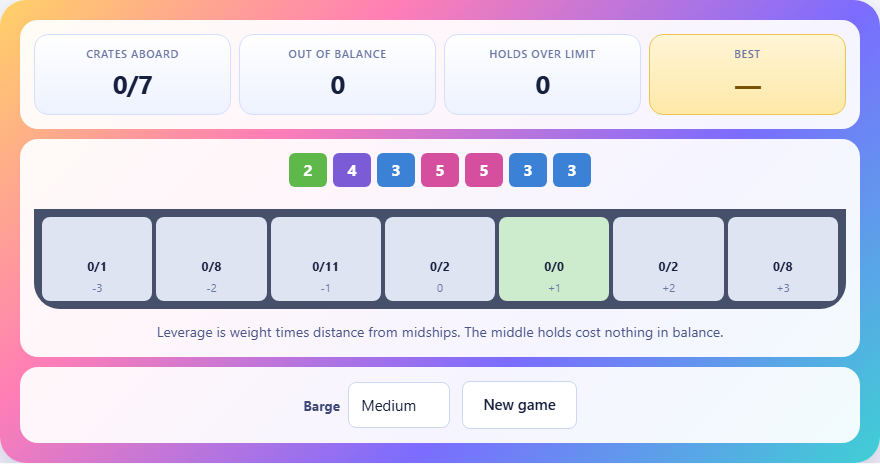
What the barge looks like and what the numbers mean
The barge is shown as a row of holds, each one a labelled box. Every hold has two numbers that matter. The first is its distance from midships, shown as a positive or negative figure. Holds forward of centre are negative, holds aft are positive, and a hold right at the centre sits at zero. The second number is the hold's weight limit, which is the most weight it can take.
Above the barge you see the crates waiting on the quay. Each crate shows its weight in tonnes. Below the barge, two readings tell you how the loading is going. One shows the tilt, which is how far out of balance the barge is. You need that number to reach exactly zero. The other shows how many holds are over their limit. That must also be zero. When both readings sit at zero and no crate is left on the quay, the barge sails and you win.
How leverage works in the puzzle
Leverage is the heart of the game. A crate's pull on the barge is its weight multiplied by the distance of the hold it sits in. A three-tonne crate in a hold at distance two produces a turning force of six. The same crate in a hold at distance one produces only three. In a hold at the centre, distance zero, it produces nothing at all.
Forward holds are counted as negative and aft holds as positive. The tilt is the total of all the turning forces added together. If the forward crates pull a total of minus eighteen and the aft crates pull plus twenty, the tilt is plus two and the barge leans aft. You fix it by moving weight forward or by shifting something from an outer hold to a hold closer to the centre. The goal is a net pull of exactly zero.
The two conditions you must satisfy at once
Beginners quickly discover that balance and capacity are separate problems. You can have a perfectly balanced barge where one hold is overloaded. You can have every hold within its limit while the barge tilts badly. Both conditions must be true at the same time, and fixing one often breaks the other.
This is where the puzzle gets interesting. Moving a heavy crate from an overloaded hold to a lighter one may fix the capacity, but if the lighter hold is on the opposite side of the barge, the tilt swings the other way. You end up juggling crates between holds, trying to find an arrangement that satisfies both rules. The trick is to think about balance and capacity together from the start rather than fixing one and then discovering the other is broken.
Controls on the page
Tap a crate on the quay to pick it up. It lifts slightly to show it is selected. Then tap a hold to drop it in. If you change your mind, tap a crate that is already inside a hold and it goes back to the quay. You can rearrange as many times as you like, and nothing is final until the last crate goes aboard and both readings hit zero.
The Barge selector offers three sizes. Small gives you a short barge with few holds and a handful of crates, which is a good way to learn how leverage works. Medium adds more holds and more crates, so the arithmetic gets harder to do in your head. Large is a serious challenge with many crates and tight limits. Press New game at any time to get a fresh puzzle at the current size.
Start from the ends and work inward
The most reliable way to solve a Ballast puzzle is to load the outermost holds first. Look at the heaviest crates and the holds at the greatest distance from the centre. A heavy crate at distance three creates a large turning force, so you need an equally heavy crate at the same distance on the opposite side. Pair your biggest crates and put one on each end, then check the tilt.
Once the ends are loaded and roughly balanced, move to the next pair of holds inward. Each pair is closer to the centre, so the turning force per tonne is smaller, and fine adjustments become easier. By the time you reach the centre hold, you may only need to drop in whatever is left, because a centre hold at distance zero adds no turning force at all. Its only constraint is its capacity.
Using the centre hold wisely
The centre hold is the most valuable slot on the barge because anything you put there costs nothing in balance. It has zero distance from midships, so weight times zero is zero, and the tilt does not change. That makes it tempting to dump everything there, but the centre hold has a limited capacity just like every other hold, and often a tighter one.
Save the centre hold for crates that are hard to pair. If you have one odd-weight crate that does not match anything on the opposite side, dropping it in the centre keeps it out of the balance equation entirely. If you waste the centre capacity on crates that could easily go in an outer hold as part of a matched pair, you may find yourself stuck later with a leftover crate and nowhere balanced to put it.
What to do when the tilt is stuck at a small number
Sometimes the tilt sits at plus or minus one and no swap between symmetric holds will fix it. This happens when the remaining imbalance cannot be corrected by a simple mirror swap. The solution is to move a crate to a hold at a different distance from the centre. For example, moving a one-tonne crate from distance two to distance one reduces its turning force by exactly one.
Think of it as changing the lever arm rather than the weight. If swapping sides does not work, changing distance will. Look for a crate whose weight times the difference in hold distances equals the tilt you need to remove. A two-tonne crate moved one step closer removes two from the tilt. A one-tonne crate moved one step closer removes one. Mix and match until the number reaches zero.
How the puzzles are built and why a solution always exists
Every barge you see was packed before you saw it. The game places crates into random holds, keeps only the arrangements that happen to sit level, and then reads off the hold capacities from that successful arrangement with a little headroom added. This guarantees that at least one correct loading exists and that the limits are not impossibly tight.
The game does not check whether you found the same arrangement it used. Any loading that brings the tilt to zero and keeps every hold within its limit is accepted. That means many puzzles have more than one solution. Mirrored arrangements often work, and so do creative swaps that the original random packing never tried. If you find a solution that feels different from the obvious one, it is still correct.
Common mistakes that trip people up
The most frequent error is treating total weight as the problem. New players add up all the crate weights, check that the barge can hold the total, and assume they are fine. But total capacity means nothing if the weight is in the wrong places. A barge can be well under its overall limit and still capsize on paper because all the heavy crates are on one side.
Another common mistake is loading the centre hold first with the biggest crates. It feels safe because the tilt stays at zero, but you burn through the centre capacity quickly and leave the hard pairing work for last. Load the extremes first, pair them, and save the centre for the awkward remainders.
Forgetting that every crate must go aboard is a third trap. You cannot leave a difficult crate on the quay and call it done. The puzzle only clears when the quay is empty, the tilt is zero, and no hold is over its limit.
Privacy and how the game runs
The entire puzzle runs inside your browser on your own device. No crate placements are sent to a server, there is no account to create, and nothing is uploaded at any point. Your progress is stored in local storage on this device and will not follow you to another machine. Once the page has loaded you can disconnect from the internet and keep solving puzzles without any change.