
Tigers and goats: the asymmetric board game from Nepal
Tigers and Goats is one of the few board games where the two sides play by completely different rules. One player commands twenty goats that cannot capture anything. The other controls four tigers that jump and eat. The goats win by surrounding every tiger so none can move. The tigers win by eating five goats. That tension between numbers and power makes the game feel unlike anything else on a five-by-five grid. This guide covers the full rules, the controls on the page, and the tactics that separate a careful goat player from one who feeds the tigers.
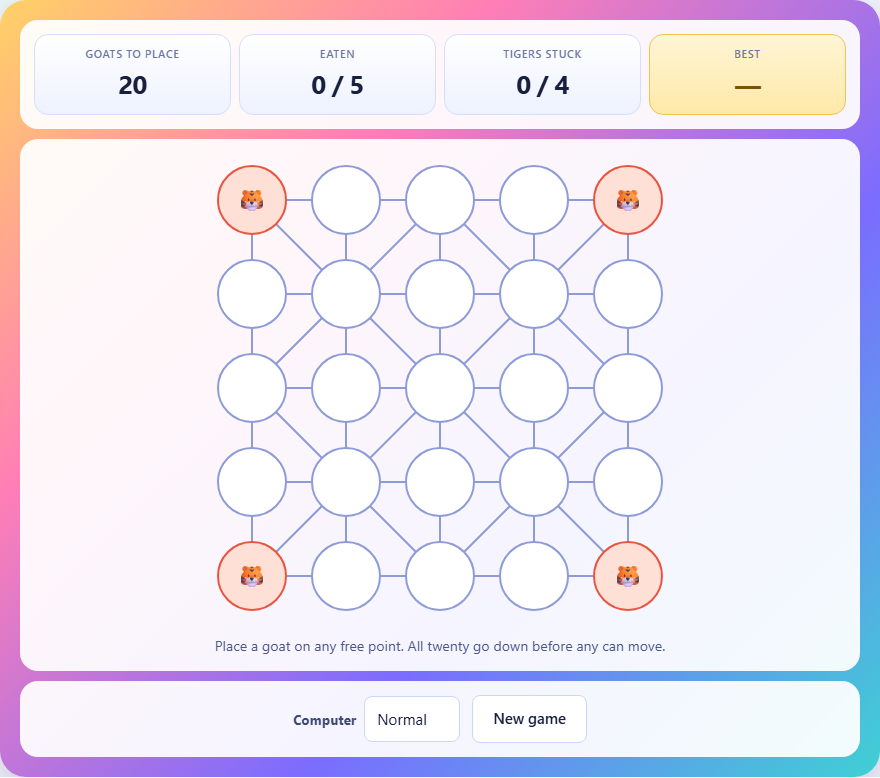
The board and the pieces
The board is a five-by-five grid of twenty-five points, connected by horizontal, vertical, and diagonal lines. The four tigers start on the four corner points. The goats start off the board entirely and enter one at a time. Movement follows the lines, so a piece can only reach a point that shares a drawn line with the one it sits on. Diagonals exist on some squares but not all, which means some points have more connections than others. The centre point, for example, connects to all eight neighbours, while an edge point in the middle of a side might connect to only three or four.
This uneven connectivity is important. A tiger sitting on a point with many lines has many escape routes. A tiger sitting on one with few connections is easier to pin down. The corners where the tigers begin have only two or three lines out, which is part of why herding a tiger back into a corner is one of the best strategies the goats have.
Placement phase: the first twenty moves
The game begins with a placement phase. On each turn the goat player taps an empty point to place one goat. The goats cannot move during this phase; only new placements happen. The tigers, however, can move and capture from the very first turn. Each time the goat player places one goat, the tigers get a turn to slide one tiger along a line to a neighbouring empty point, or to jump over a goat and capture it.
This asymmetry makes placement the most important part of the game. Every goat you put down is a permanent commitment. You cannot slide it somewhere better until all twenty are placed, so a badly positioned goat may sit useless for the rest of the game. Meanwhile, the tigers are free to react, moving toward weak spots and picking off any goat that lands next to a gap.
How tigers capture
A tiger captures by jumping in a straight line over one adjacent goat and landing on the empty point directly beyond it. The jump must follow a line drawn on the board, and the landing point must be empty. If either condition fails, the tiger cannot make that capture. The captured goat is removed from play permanently.
Unlike some games where pieces can chain multiple jumps in one turn, a tiger gets only one jump per turn. It also does not have to capture if a jump is available; it may choose to slide to a neighbouring point instead. This means a tiger with several possible jumps will pick the one that does the most damage to the goat formation, so the goat player needs to watch every line around every tiger, not just the obvious ones.
Movement phase: after all twenty goats are placed
Once all twenty goats are on the board, the movement phase begins. Now goats can slide one point along any connecting line to an empty neighbour, just as the tigers do. Goats still cannot capture or jump. They can only move and block.
In practice, the movement phase is often shorter than the placement phase. If the goat player placed well, the tigers may already be pinned or nearly so. If the placement was careless, the tigers will have eaten several goats already and the remaining ones struggle to form a tight enough net. Most games are decided during placement, and the movement phase either confirms the result or lets a slightly loose net be tightened.
Win and loss conditions
The goats win when every tiger has no legal move. That means every point adjacent to each tiger along every line is either occupied by a goat or by another tiger. A tiger does not have to be in a corner for this to work; it simply needs to be surrounded. However, completely surrounding a tiger in the open centre requires many more goats than trapping one in a corner, which is why good goat players drive the tigers toward edges and corners.
The tigers win when they capture five goats. Since the goat player starts with twenty, losing five is a quarter of the force, and it is usually enough to make the remaining fifteen too few to cover every tiger. In practice, once four goats are gone, the goat player is in serious trouble, and losing a fifth is rarely far behind.
Controls on the page
The Computer selector sets the strength of the tiger player. Easy makes short-sighted moves and rarely sets up double threats. Normal looks further ahead and will punish obvious gaps. Hard plays tight defensive moves and aggressive captures alike, and beating it requires genuine care. Choose a level, then press New game to start fresh.
On a touchscreen, tap any empty point to place a goat during the placement phase. During the movement phase, tap a goat first, then tap the point where it should slide to. Only legal moves are accepted, so if nothing happens when you tap, the move breaks a rule. The game status tells you whose turn it is and how many goats remain to be placed or have been captured.
Goat strategy: placement patterns that work
The strongest opening approach is to place goats in solid lines, moving from one side of the board toward the centre. A line of goats side by side has no gaps for a tiger to jump through. If you scatter goats around the board instead, each one sits alone with empty points on both sides, and a tiger can jump over any of them.
Think of the placement as building a wall that advances. Start along one edge and fill it in before expanding to the next row. The tigers will try to stay away from your wall, which naturally pushes them into a smaller and smaller area. Once two or three tigers are clustered together, a few more goats close off their remaining exits.
You can afford to lose up to four goats. That means a deliberate sacrifice is sometimes a real tactic. Offering one goat to lure a tiger into a corner and then blocking the exit with three more goats is a fair trade. What you cannot afford is an accidental loss where the goat dies and nothing strategic comes of it.
Watching the far side of every placement
The single most common beginner mistake is placing a goat next to a tiger without checking the point on the opposite side. The tiger needs exactly one thing to capture: an adjacent goat with an empty point beyond it along the same line. Before you tap a point, look at each tiger that shares a line with that point and see whether the square behind your proposed placement is empty. If it is, you are handing the tiger a free meal.
This check takes only a second per placement, but it saves games. Many beginners lose their first three or four goats in the placement phase simply because they forget to look behind. Once you build the habit, the number of goats you lose during placement drops to near zero, and the movement phase becomes much easier with a full army.
Tiger behaviour you can predict
A tiger almost always moves toward the biggest open area on the board. If one corner is already walled off, the tiger runs to the opposite side. Use this to your advantage by closing off two sides early. Once only one escape route remains, the tiger has to go there, and you can meet it with a wall of goats.
Tigers also prefer captures over slides when both are possible. If a tiger has a jump available, it will usually take it, even if sliding to a safer point would be better long term. This means you can sometimes set a trap: leave one goat in a position where the tiger's capture lands it in a dead end. The tiger eats one goat but ends up pinned, which is a net win for you.
Privacy and how the game runs
The entire game runs inside your browser on your own device. No moves are sent to a server, there is no account to create, and nothing is uploaded at any point. Your best score is stored in local storage on this device and will not follow you to a different computer. Once the page has loaded, you can disconnect from the internet and keep playing without any change.