
How to win at backgammon against the computer
Backgammon is one of the oldest board games still played today, and its mix of dice luck and real decision-making is what has kept it alive. You race fifteen checkers around the board and off the other end before your opponent does the same going the other way. Every roll forces a choice, and the difference between a good player and a bad one is what they do with the same numbers. This guide walks through the rules in full, explains every control on the page, and shares the thinking that turns a hopeful run into a reliable win.
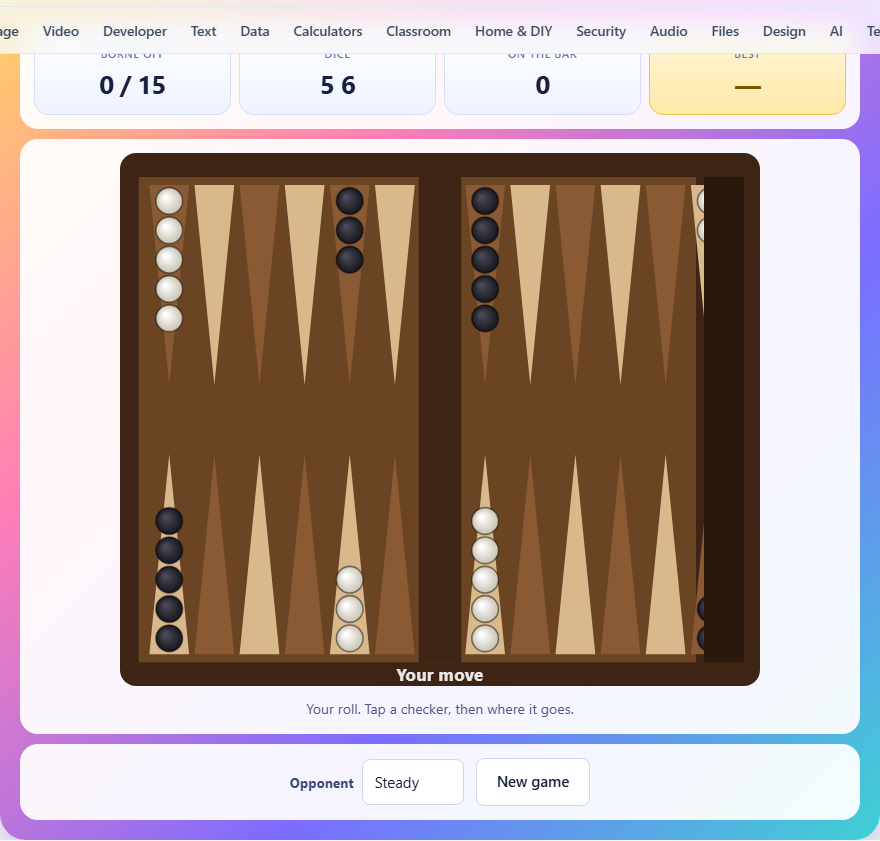
The board and the starting position
The board has twenty-four narrow triangles called points, numbered from one to twenty-four. Your checkers move from the higher numbers towards point one, which is your home board. The opponent's checkers run the other way. At the start, neither side has all its pieces in one place. Five sit on your six point, three on your eight, five on the opponent's twelve, and two way back on the opponent's twenty-four. The opponent has the mirror of that layout. This scattered start is what makes the opening interesting, because you have pieces to bring home from opposite ends of the board.
A thin raised strip runs down the middle of the board. That is the bar. Any checker that gets hit lands there and has to re-enter the game from the far end before anything else can move. A tray beside the board holds checkers you have borne off. When all fifteen sit in that tray, you win.
How movement works
Each turn begins with a roll of two dice. Every die gives you one move. If you roll a four and a two, you move one checker four spaces and another checker two spaces, or you move one checker a total of six by taking the four first and then the two, as long as the midway point is also legal. A double is special: rolling two threes gives you four moves of three rather than two, which is why a well-timed double can swing a game.
A checker may land on any point that is empty, holds your own checkers, or holds exactly one of the opponent's checkers. A point with two or more of the opponent's pieces is closed to you. If you cannot use a die because every landing is blocked, that part of the roll is lost. If you can use one die but not both, you must use the higher one when only one fits.
Hitting, the bar, and re-entry
A point with just one checker on it is called a blot. When you land on a blot belonging to the opponent, that checker is picked up and placed on the bar. This is a hit, and it is the single most powerful thing you can do in a turn, because the hit checker has to travel the entire length of the board again.
A checker on the bar must re-enter in the opponent's home board using a die value that matches an open point there. While any of your checkers sit on the bar, nothing else may move. If the opponent has built a wall of closed points in their home board, your checker can sit on the bar for several turns, which is often how a losing position turns into a winning one.
Bearing off
Once all fifteen of your checkers are in your home board, points one through six, you begin bearing off. Each die lets you remove a checker from the point that matches the number. A roll of five takes one off the five point. If there is no checker on the matching point, you must move a checker from a higher point instead. When no checker sits on a higher point either, you may bear off from the highest occupied point even if the die number is larger than that point. For instance, a six can take a piece off the four point when the five and six points are both empty.
There is one trap beginners fall into during bearing off. If one of your checkers gets hit while others have already left the board, it goes back to the bar and must travel the full board again. You cannot bear off any more pieces until that straggler returns to your home board. For this reason, keeping your home board closed even while bearing off is important.
Controls on the page
The Opponent selector offers three levels. Careless plays quickly and leaves blots everywhere, which is a good way to learn the flow of the game without pressure. Steady plays a sensible game and rarely hands you a free hit. Ruthless looks further ahead and will punish every loose checker it can reach. Switch levels any time by choosing a setting and pressing New game.
On a phone or tablet, tap a checker to pick it up, then tap the point where you want it to land. The game only accepts legal moves. If you try to drop a checker somewhere it cannot go, nothing happens and you can try another point. Bearing off works the same way: tap a checker in your home board, then tap the tray on the right side of the board.
Building a wall and why it matters
Two checkers on a point make it closed. The opponent cannot land there at all. If you line up several closed points in a row, you create a wall that the opponent's checkers cannot pass. A wall of six consecutive points is called a prime, and any checker behind it is completely stuck until you break the wall by moving one of those pairs forward.
Building walls is almost always more valuable than racing. Suppose you have a checker far ahead and a chance to either sprint it further or bring two checkers together on a point near the opponent. Making the point usually wins more games in the long run, because a wall slows down every one of the opponent's pieces, not just one. The points to fight for first are the five point and the four point in your home board, because they block re-entry from the bar.
When to hit and when to hold
Hitting is not always the right play. A hit is strongest when the opponent's home board is still open, so the checker you send back can re-enter easily but has the whole board to cross. Hitting early costs the opponent more pips than hitting late. Against a well-built home board of your own, a hit can trap the opponent on the bar for several turns, which is devastating.
On the other hand, hitting a blot in your own home board can be risky if it spreads your checkers thin. Every time you leave a single checker exposed, there is a chance the dice give the opponent a direct shot at it. Count the number of dice combinations that would let the opponent hit you back. If fewer than six combinations reach your blot, the risk is usually worth taking. If more than eleven reach it, think twice.
Running versus blocking: reading the race
Every game eventually becomes a race, but the question is when to start running. If you are ahead in the pip count, meaning your checkers have fewer total spaces left to travel, running makes sense because contact only gives the opponent a chance to catch up. If you are behind, you want to keep things tangled. Hold points deep in the opponent's board and look for hits that set them back.
A simple way to check the race is to count pips. Multiply each checker's position by the number of checkers there and add them all up. The lower total is ahead. When you trail by more than about fifteen pips, pure running is unlikely to work without a lucky double, so focus on blocking and hitting to close the gap first.
Common mistakes that beginners make
The most frequent mistake is stacking too many checkers on one point. A pile of five on the six point does nothing more than a pile of two, because either way the point is closed. Those extra three checkers would be far more useful making other points. Spread them to build a wider wall.
Another mistake is ignoring the back checkers. The two checkers that start deep in the opponent's territory need to escape early, before the opponent walls them in. If you wait too long, those checkers get trapped and you end up behind in the race with no way to catch up. Moving them out in the first few turns, even at the cost of leaving a temporary blot, is usually correct.
Beginners also bear off too aggressively. Once you start bearing off, it feels right to remove a piece on every roll, but sometimes using a die to fill a gap in your home board is safer. If the opponent still has a checker on the bar or racing through your home board area, leaving empty points in your home board gives them a place to land and start hitting you back.
Privacy and how the game runs
The entire game runs inside your browser. No moves are sent to a server, no data leaves your device, and there is no account to create. Your win count is saved in your browser's local storage on this device only, so it will not follow you to a different machine. Once the page has finished loading, you can switch off your internet connection and the game will keep working without any change.