
Hiring the best when you cannot go back
Audition puts you in front of a line of candidates. They walk in one at a time, and for each one you must either hire them on the spot or send them away forever. You never see a score. All you know is how the current candidate compares with the ones you have already seen. Hire the very best candidate across several rounds to win. The twist is that the best strategy is not to trust your instincts but to follow a simple counting rule that has been proven to work better than anything else.
The rules in full
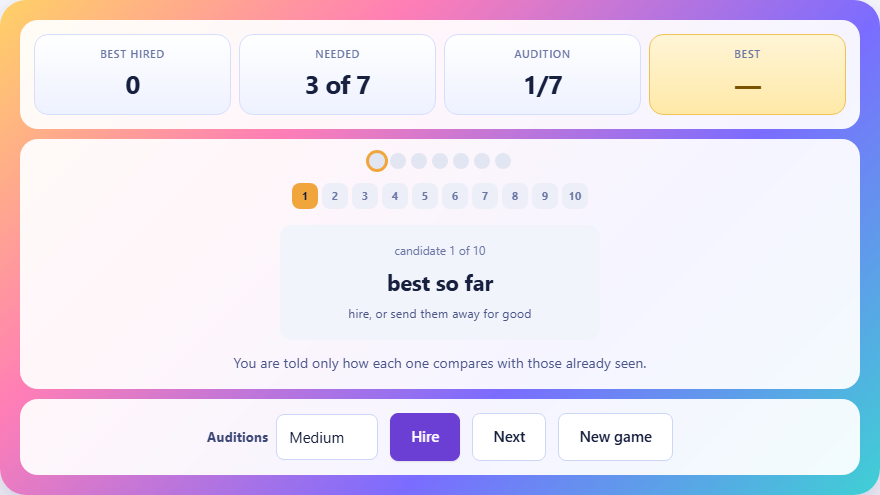
Candidates arrive in a random order, one at a time. When a candidate appears, the board shows their relative ranking among those you have already seen. You might see something like best so far or third best so far. You never learn an absolute score, only a comparison.
For each candidate you press one of two buttons. Hire takes that candidate and ends the current audition. Next sends them away permanently. There is no going back. If you reject every candidate, you are forced to take the last one, no matter how they compare. The goal is to hire the single best candidate in the entire lineup. Second best does not count. The game runs several auditions in a row so that luck evens out and your method is what matters.
Controls on the page
The Auditions dropdown controls the size of the game: Small, Medium or Large. A larger setting means more candidates per audition and more auditions in the set. The Hire button accepts the current candidate and ends the round. The Next button rejects them and brings in the next person. The New game button restarts the entire set of auditions from scratch.
During each audition a counter tracks which candidate you are looking at out of the total. The board also flags when a candidate is the best you have seen so far, which is the key signal the optimal strategy relies on. When an audition ends, you are told whether you hired the very best candidate or not.
The optimal strategy explained
The best approach is a two-phase method. In the first phase, reject every candidate regardless of how good they look. You are not hiring yet. You are sampling, learning what the field looks like by watching a few walk by. In the second phase, hire the first candidate who is the best you have seen so far, meaning better than everyone in both the sampling phase and the hiring phase up to that point.
How long should the sampling phase be? For a lineup of eight, reject the first three. For ten, reject the first three as well. For twelve, reject the first four. The exact number comes from a formula involving one over e, the mathematical constant approximately equal to two point seven one eight. For long queues the fraction to reject settles at about thirty-seven per cent. For the short queues in this game it is slightly higher, and the exact cutoffs are built into the advice the game offers.
Why this strategy works
The sampling phase establishes a benchmark. By watching the first few candidates without hiring, you learn how high the bar can go. If the best of the rejected candidates was very strong, your benchmark is high and you will only accept someone truly outstanding in the second phase. If the rejected candidates were weak, your benchmark is low and you might accept someone who merely seems decent, but that person has a good chance of actually being the best because the field turned out to be weak.
The mathematics behind this are well studied. The chance of hiring the very best candidate, when you follow this rule, is about thirty-seven per cent for a long queue and around forty per cent for the shorter queues in this game. That might sound low, but no other strategy can do better without more information. Random guessing gives you a one in ten chance with ten candidates. The sampling rule nearly quadruples that. It is provably the best you can do.
Strategy: only best so far matters
During the hiring phase, only candidates flagged as best so far are worth considering. A candidate who is the second or third best you have seen cannot possibly be the best in the entire lineup, because at least one person you already saw was better. Since you cannot go back, that better person is gone and the second-best candidate can never finish first.
This means most of the hiring phase is spent pressing Next. You are waiting for one specific signal: the first candidate who beats everyone who came before. When that signal appears, press Hire immediately. Do not wait to see if someone even better shows up. The mathematics says that waiting longer lowers your odds, because the truly best candidate is more likely to have appeared early in the hiring window than late.
Strategy: accept that failure is normal
Even with perfect play, you will fail more often than you succeed. Roughly three auditions in five end with someone other than the best candidate getting hired or being forced on you at the end. This is not a flaw in the method. It is the nature of the problem. You are making a decision with incomplete information and no ability to revisit past choices.
The game runs several auditions specifically so that this variance evens out. Over ten or twenty rounds, a player following the rule will pick the best candidate around forty per cent of the time. A player guessing at random will manage about ten per cent. The difference is clear over a longer run even though any single audition can go either way. Trust the process and watch the long-term numbers rather than getting discouraged by one bad round.
Strategy: do not extend the sampling phase
The most common temptation is to keep sampling longer than the rule says. It feels safe to watch more candidates before committing, but the mathematics work against you. The longer you sample, the more likely it is that the best candidate walked through the door during your sampling phase and was turned away. Past the halfway point, the odds of success drop sharply because the pool of remaining candidates is small and unlikely to contain the overall best.
Going the other way and cutting the sampling phase short is also costly, though less dramatically. With too short a sample your benchmark is unreliable. You might hire the first decent person you see, only to find that the field had much stronger candidates later on. The recommended cutoff is the balance point between these two risks, and moving away from it in either direction makes things worse.
Common beginner mistakes
The biggest mistake is hiring during the sampling phase. A new player sees a candidate flagged as best so far early on and grabs them. That might work once by luck, but over many rounds it underperforms the rule badly because you had no benchmark to judge by.
The second mistake is waiting too long. A player who rejects everyone until the very end is forced to take the last candidate, who is random. That is the worst possible outcome, because you gave up all your power of choice. The rule exists precisely to avoid both extremes: hiring too early and waiting too late.
A third error is thinking about absolute quality. The board never shows an absolute score, only a relative rank among those seen. Some players imagine that a candidate ranked best so far early in the lineup must be weak because the sample is small. That intuition is wrong here. The ranking is all the information you have, and the strategy uses it correctly. Do not add assumptions the data does not support.
Everything runs in your browser
The candidate order, the scoring and the outcome tracking all happen on your own device. Nothing about your choices, your results or your session history is sent to any server. You can load the page, disconnect from the internet and play as many auditions as you like without any change in behavior. There is no account, no signup and no data leaving your machine at any point during or after the game.