
Finding the false coin with nothing but a balance
Assay is the classic counterfeit coin puzzle turned into an interactive game. A tray of coins sits in front of you, and one of them is false. You do not know which coin is the fake, and you do not know whether it is lighter or heavier than a real one. All you have is a two-pan balance and a limited number of weighings. Place coins on the pans, press Weigh, and use what the balance tells you to narrow the answer down to exactly one coin and one direction, light or heavy.
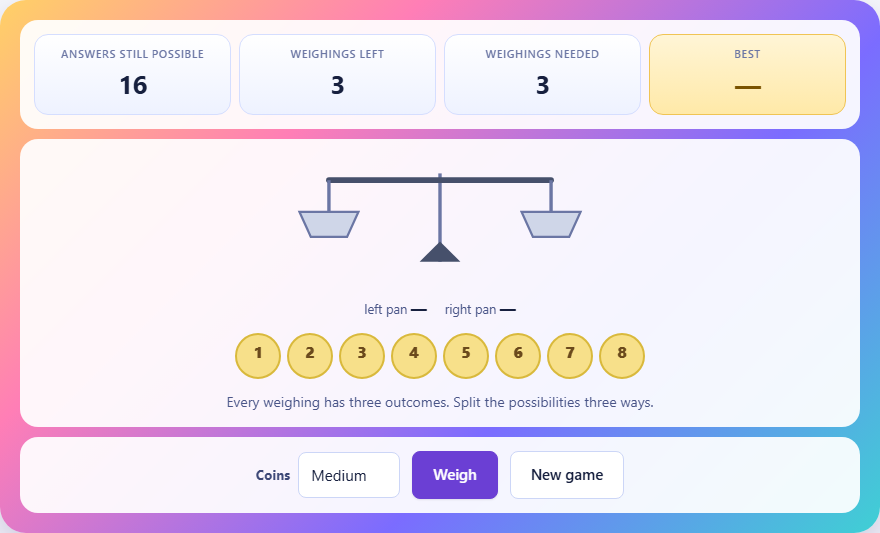
The rules explained
Tap a coin once to place it on the left pan. Tap the same coin again and it moves to the right pan. Tap it a third time and it returns to the tray. Both pans must hold the same number of coins before you can weigh. Coins left in the tray are not on either pan and do not affect the result.
Press the Weigh button and the balance tips one of three ways. The left pan goes down, the right pan goes down, or they balance. Each outcome tells you something. If the left goes down, either one of the left coins is heavy or one of the right coins is light. If the pans balance, every coin on the scale is genuine and the fake is among the coins you left in the tray. The counter at the top of the board shows how many possible answers remain. An answer is a specific coin together with a direction, light or heavy. You win when the counter reaches one.
Why the answers are double the coins
With twelve coins, you might expect twelve possible answers. But the puzzle asks you to find two things: which coin is false and whether it is lighter or heavier than the rest. That doubles the count to twenty-four. Each weighing can split those answers into at most three groups, one for each outcome. Two weighings give you nine possible splits, which is not enough to separate twenty-four answers. Three weighings give you twenty-seven, which is just barely enough.
In fact, the real limit is a bit lower than three to the power of k. The first weighing cannot put every coin on the scale, and a coin left off the scale cannot tip it, so one of the first weighing's three outcomes is partly wasted. Working this through gives the formula: the most coins that k weighings can handle is three to the k, minus three, divided by two. That gives three coins for two weighings, twelve for three, and thirty-nine for four. This game always sits at that boundary, which is why there is no room for a wasted question.
Controls on the page
The Coins dropdown offers three sizes: Small, Medium and Large. A small set has fewer coins and fewer weighings, which makes the logic easier to follow while you learn. Medium is the default. Large gives you more coins and more weighings, but the ratio stays just as tight, so the difficulty does not drop with more room.
The Weigh button triggers the balance once your pans are loaded. The New game button resets the board with a fresh set of coins and a new hidden fake. After each weighing the counter updates, and the number of weighings you have left decreases by one. If you run out of weighings before narrowing the answer to one, you lose.
Strategy: aim to split three ways evenly
Each weighing has three possible outcomes, so the best possible weighing is one that splits the remaining answers into three roughly equal groups no matter which way the balance tips. If you achieve a perfect three-way split, each outcome cuts the answer space to a third of its previous size. After three such weighings you go from twenty-four answers to eight to about three to one.
In practice a perfect split is not always possible, but you should always try to get close. If a weighing eliminates only a few answers in one outcome and most in another, it was a weak question. Watch the counter after each weighing. If it barely moved, you asked the wrong thing and the remaining weighings may not be enough to finish.
Strategy: leaving coins in the tray is powerful
New players often try to put as many coins as possible on the pans, thinking that more information comes from weighing more. But leaving coins in the tray is often the better move. When the pans balance, every coin on the scale is cleared at a stroke. If you put six on each side and they balance, all twelve are proven genuine, and the fake is among whatever you left off.
This is especially useful on the first weighing. With twelve coins, a good opening is to put four on each side and leave four in the tray. If the pans tip, the fake is among the eight on the scale, and you know which side is heavy and which is light. If they balance, the fake is among the four in the tray, which is easy to handle in two more weighings. Either way, you have made the most of a single question.
Strategy: use known-good coins as ballast
After the first weighing, you usually have some coins that are proven genuine. These coins are valuable, because you can put them on a pan alongside suspects to make the numbers even without adding uncertainty. Suppose you need to weigh three suspects against three others, but you only have five suspects left and the rules demand equal pans. Add a known-good coin to the short side and the weighing works.
Known-good coins also help you interpret the result. If you put two suspects and one known-good on the left, and three suspects on the right, and the left goes down, you know the known-good coin contributed nothing unusual. The heavy side must contain a heavy suspect, or the light side must contain a light suspect, and you can narrow accordingly.
Strategy: tracking what each outcome means
After every weighing, update your mental list. A coin on the left pan that tipped down could be heavy. A coin on the right pan that tipped down could be light. A coin on a balanced pan is clean. Write this out if you need to. Some players find it helps to think of each suspect as carrying a tag: maybe heavy, maybe light, or cleared.
By the second weighing you should have a short list of suspects with known possible directions. The third weighing is then a simple comparison, often just two or three coins against known-good ones. If your tracking is clean, the last weighing feels almost trivial. If it feels impossible, something went wrong in an earlier step and you should review your notes.
Common beginner mistakes
The biggest mistake is weighing one coin against one on the first move. With a large tray, that leaves almost everything open if they balance. You have used a precious weighing and learned almost nothing. Start with larger groups to make each question earn its keep.
Another frequent error is forgetting that the fake could be either light or heavy. A player who assumes the fake is heavy will misread a balanced result, because they forget that a light fake on neither pan also produces balance. Always keep both directions in mind until one is ruled out.
A third trap is unequal pans. The game will not let you weigh with different numbers on each side, but some players waste time trying. A balance compares weight, and putting five coins against three tells you nothing meaningful. Always load the pans evenly. One more slip worth mentioning: rushing to weigh before thinking through what each possible outcome will tell you. Before you press the button, ask yourself what you will do if the left goes down, what you will do if the right goes down, and what you will do if they balance. If any of those plans is blank, rearrange the coins until all three outcomes lead somewhere useful.
Everything runs on your device
The entire puzzle, from generating the hidden fake to counting your remaining answers, runs inside your browser. No coin positions, no weighing results and no scores are sent anywhere. You can load the page and disconnect from the internet, and the game works exactly the same. There is no account, no login and no personal data involved.