
Angle, power and wind on a changing hillside
Artillery is a turn-based duel between two guns sitting on opposite ends of a hilly landscape. You set the angle and the power, allow for the wind, and fire. The shell follows a real ballistic arc, pulled down by gravity and pushed sideways by the wind the whole way. Every miss digs a crater that reshapes the ground, so the battlefield is different after every shot. Land enough hits on the other gun to win.
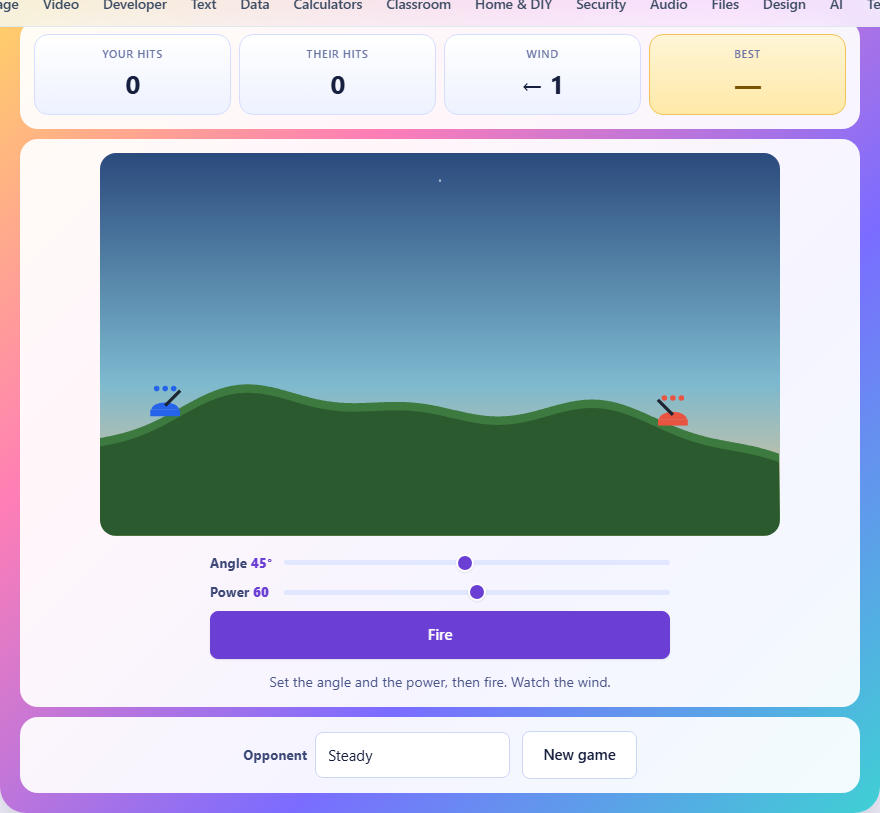
How a shot works
Each turn you choose two things: the angle of the barrel and the power behind the shell. The shell leaves the barrel at that angle, climbs until gravity wins, then falls back to earth. Wind pushes the shell sideways for the entire duration of the flight. A shot that spends a long time in the air drifts further than a fast, flat one, even when the wind speed is the same.
When the shell hits the ground, it blows a crater. If the impact is close enough to the other gun, it counts as a hit. The hit pips shown above each gun tell you how many more direct hits are needed before the gun is knocked out. On easier difficulty settings, three hits are needed. On the hardest setting, only two hits are required, but the wind blows harder and the computer opponent is more accurate.
The controls
Two sliders sit below the battlefield. The Angle slider runs from ten degrees to eighty-five degrees, with forty-five as the starting value. A small readout next to the label shows the current number. The Power slider runs from twenty to one hundred, starting at sixty. Again, a readout displays the exact value as you drag.
Press the Fire button to launch the shell. The shell arcs across the screen and you watch where it lands. After your shot, the computer takes its turn automatically. Below the sliders, the Opponent dropdown lets you choose difficulty: Ragged with light wind, Steady as the default, or Deadly with strong wind. The New game button resets the landscape, repositions both guns and starts a fresh duel.
The wind indicator
An arrow at the top of the screen shows the wind direction and strength. A long arrow pointing right means a strong wind blowing your shell to the right. A short arrow pointing left means a gentle push to the left. The wind stays the same for the duration of the game, so once you learn how much drift to expect, you can compensate for it on every shot.
Wind matters more than most beginners expect. A gentle breeze can shift a shell by a noticeable distance on a high, slow trajectory. A strong wind can push it wildly off course. The trick is to understand that the wind acts on the shell for the entire time it is in the air. A steep, high shot hangs in the air longer and drifts much further than a low, fast shot. When the wind is against you, use a flatter angle to cut the time the shell spends being pushed.
Why forty-five degrees goes furthest
In still air, the range of a shell depends on the sine of twice the launch angle. That function peaks at forty-five degrees, which is why forty-five is the classic answer for maximum range. Above that angle the shell goes higher but lands shorter. Below it the shell flies flatter but falls sooner. When you need to reach a distant target in calm conditions, forty-five is the starting point.
Wind changes that calculation. A headwind steals range, so you may need a flatter trajectory to cut through it. A tailwind adds range, so a steeper angle can work without falling short. The power slider also plays a role: range grows with the square of the power, which means a small increase in power makes a big difference at long range and a small difference at short range.
Strategy: bracketing the target
The single best technique is bracketing. Fire your first shot and note where it lands. If it was long, lower the angle or the power. If it was short, raise them. But do not guess from scratch every time. Instead, halve the error. If your shell landed fifty pixels past the target, adjust by roughly half of that, not the full amount.
Even better, deliberately fire one shot long and one short. Now you know the target is between those two impacts. Split the difference and your third shot will be very close. Professional gunners have used this method for centuries, and it works here for the same reason: each correction cuts the remaining error in half, so convergence is fast. Three well-chosen shots will almost always get you closer than six random guesses, and each hit you land sooner is one fewer turn for the opponent to find its range.
Strategy: reading the craters
Every miss carves a crater into the hillside, and craters do more than mark where the shot fell. If a crater opens under a gun, the gun drops into it. That changes the height the gun is sitting at, which changes the range needed to hit it. A target that was reachable at a certain angle and power may suddenly need a different setting after the ground shifts.
Your own gun is affected as well. If you blow a hole in the ground near yourself, your gun may drop and your angle relative to the horizon changes. Watch for this, because the adjustment might be small but enough to turn a direct hit into a near miss. Pay attention to the shape of the ground after every explosion, not just the location.
Strategy: respect the computer opponent
The computer opponent does not cheat. It works out a shot from the distance between the two guns, adds a deliberate random error, and then fires. When its shell misses, it measures how far off it was and corrects by a fraction of that error on the next shot. That is the same bracketing technique you should be using.
This means the computer's accuracy improves with every shot. Its first attempt may land far from you, but its second will be closer, and its third is usually dangerous. Do not assume you have plenty of time just because the first shot missed by a wide margin. You want to land your hit before the opponent zeros in. Speed matters as much as precision, especially on the Deadly setting where the computer corrects faster and the wind adds another layer of difficulty.
Common beginner mistakes
The most common error is ignoring the wind. A new player might nail the angle and power in calm air, then wonder why everything misses when a strong wind is blowing. Always read the wind arrow before setting your angle. Into a headwind, flatten the trajectory. With a tailwind, you can afford a higher arc.
Another mistake is making huge adjustments after each miss. If the shell landed just past the target, you do not need to drop the power by thirty. A small nudge is usually enough. Over-correction wastes shots and gives the opponent more turns to find you. The reverse is also true: under-correction is almost as bad. If the shell fell far short, a tiny increase will not help. Match the size of the correction to the size of the miss.
A third trap is not watching the craters. When the ground changes, the range equation changes with it. A correction that was perfect for the old terrain might be wrong for the new one. After any crater appears near either gun, reassess your angle and power instead of blindly repeating the last shot. Finally, some players stick with the same angle for every shot and only adjust power. That works in calm air, but once wind enters the picture you need to change both settings together. A flat angle into a headwind paired with high power is very different from a steep angle with the same power, even though both travel roughly the same horizontal distance.
Nothing leaves your device
The physics, the terrain and the computer opponent all run inside your browser. No shot data, no score and no replay is ever sent to a server. You can disconnect after the page loads and the game works exactly the same way. There is no account, no login, and no information collected about how you play.