
Filling tanks until every row and column adds up
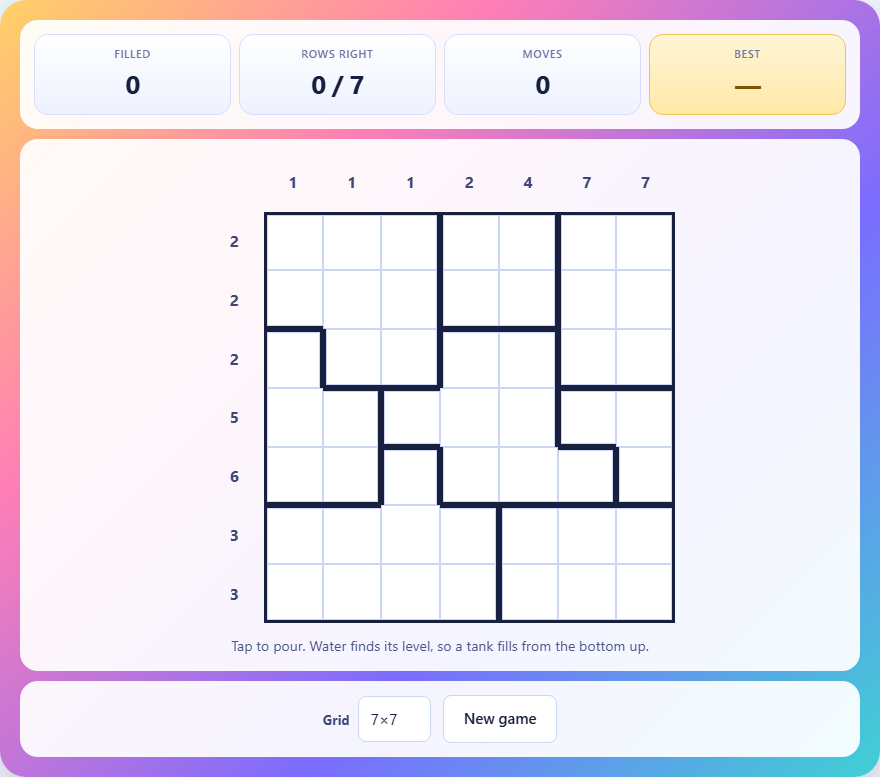
Aquarium is a logic puzzle about water. A grid is divided into irregularly shaped tanks, and numbers along the top and left side tell you how many squares in each column and row must end up filled. Water behaves the way water does: within a single tank it finds its own level, so filling one square means filling every square of that tank in the same row and everything below it. The challenge is to set the water level in each tank so that every clue is satisfied at once.
The rules in full
The grid is split into tanks by thick borders. Each tank is a connected group of squares, and every square belongs to exactly one tank. A number at the top of each column tells you how many squares in that column are wet when the puzzle is complete. A number at the left of each row tells you the same for that row.
Water inside a tank always finds its level. If you decide that a tank is filled to row four, then every square of that tank in row four is wet, and so is every square of that tank in rows five, six and below. No square in that tank above row four can be wet. This means a tank with five rows has exactly six possible states: completely dry, or filled to each of its five rows. You are choosing a level for each tank, not picking individual squares.
How filling and draining work
Tap any dry square inside a tank and the tank fills from that row downward. Every square of that tank in that row and below turns blue. Tapping a wet square empties that square and everything of the tank above it, so the surface drops to just below the square you touched. Tap the lowest wet square and the tank empties completely. Tap the highest wet row instead and the level falls by a single step. You can also tap a dry square higher than the current level to raise it.
This tap-to-fill, tap-to-drain system keeps the interaction fast. There is no need to drag or type anything. A single tap always changes the water level for the entire tank at once, which reinforces the key idea that a tank is not a set of independent squares. It is one choice, and the clues are what constrain that choice.
Controls on the page
The Grid dropdown offers three sizes: five by five, seven by seven and nine by nine. Five by five puzzles have fewer tanks and smaller clue numbers, so they are quick to solve and good for learning the method. Seven by seven is the default and offers a solid challenge. Nine by nine grids have many tanks and tight constraints, so they reward careful elimination.
The New game button generates a fresh puzzle at the chosen size. Every puzzle served is checked before it appears: the generator confirms that the clue set has exactly one valid filling, and any clue set that allows two different solutions is discarded. That guarantee means you never have to guess. Logic alone will always reach the answer.
Strategy: start with extreme clues
A row clued zero is entirely dry. No tank crossing that row can have water at or below that level. That single fact often fixes the level of several tanks at once, because any tank that reaches into a zero row must have its surface somewhere above it. Work through every zero row first and you will find that a large part of the grid is already settled.
The opposite extreme is just as useful. A row clued with its full width is entirely wet. Every tank crossing that row must be filled to at least that level, and often deeper. Between the zeros and the full rows you can usually narrow most tanks down to just two or three possible levels before you need to do any real counting.
Strategy: think in levels, not squares
The biggest mental shift in Aquarium is to stop thinking about individual squares and start thinking about tank levels. A tank with four rows has five possible states. Pick one and it settles every square in the tank at once. This is far fewer choices than treating each square as on or off, which is what makes the puzzle tractable even on a nine by nine grid.
When a tank spans several columns in one row, its contribution to those columns is all or nothing for that row. A wide tank reaching across six columns in row three will add six to that row the moment its level is set to row three or below. That large jump often settles a row outright and is a strong signal about where the level must sit. Look for the widest tanks first, because they carry the most information per decision.
Strategy: use the column clues as a second check
Many players focus on the row clues and treat columns as an afterthought, but the column clues are often the tighter constraint, especially for tanks that are tall and thin. A tank one square wide and five rows tall contributes exactly one to its column for every row it is filled. That means the column clue caps how deep the tank can go.
A strong routine is to work row by row to narrow the options, then sweep the columns to see which of the remaining options actually fit. If a column already has enough wet squares from other tanks, any tank still undecided in that column must be dry in those rows. Going back and forth between row constraints and column constraints is the fastest way to close out a puzzle without guessing. On a nine by nine grid this back-and-forth might take three or four passes, but each pass eliminates more options and the puzzle closes in quickly.
Strategy: look for forced tanks
Sometimes a row clue can only be met by one specific combination of tanks. If row five has a clue of three, and only one tank crosses row five with exactly three squares in it, then that tank must be filled to row five or deeper. No other tank can contribute to that row without exceeding the clue. Spotting these forced situations early saves a lot of trial and error.
The same logic works in columns. If a column has a clue of two and only one tank occupies two squares in that column, that tank must be filled through those squares. These forced deductions are the backbone of solving harder puzzles, because they give you certainty without any counting of possibilities.
Common beginner mistakes
The most frequent mistake is treating squares as independent. A new player might try to fill one square in the middle of a tank without filling the squares below it. The game does not allow this, because water does not float. If a square is dry, everything in that tank above it is dry as well. Keeping this gravity rule in mind avoids a lot of confusion.
Another common error is forgetting that different tanks can have different water levels. Two tanks sitting side by side are sealed from each other. One can be bone dry while the other is full to the top. The thick borders between them are walls, not open channels. Each tank is its own container, and each level is an independent decision.
A third trap is ignoring the column clues. Solving by rows alone might seem to work on small grids, but on larger ones it leaves too many options open. Always check the columns before you commit, because a level that satisfies a row clue might push a column past its limit. A related error is second-guessing a correct deduction and undoing it. If the logic was sound, the answer is sound. Undo a tank level only when you find a real contradiction, not just because the grid looks unfamiliar.
Everything stays on your device
The puzzle is generated and solved entirely in your browser. No grid state, no move and no timing data is transmitted anywhere. You can disconnect from the internet after the page loads and the game continues to work without any difference. There is no account to create, no data to share, and nothing stored beyond what your browser keeps locally for the current session. The page works just as well on a phone as on a desktop, because the tap interaction fits touch screens naturally.