
Beating metal into shape, one blow at a time
Anvil is a puzzle about moving things sideways without adding or removing any. A bar of metal sits on your screen as a row of columns, each stacked to a certain height. Tap a column and two units leave it, one sliding to the left neighbour and one to the right. Your job is to hammer that bar until every column matches a target height shown by a dashed line. The total metal never changes, and neither does the balance point, so the puzzle is really about finding the right sequence of blows.
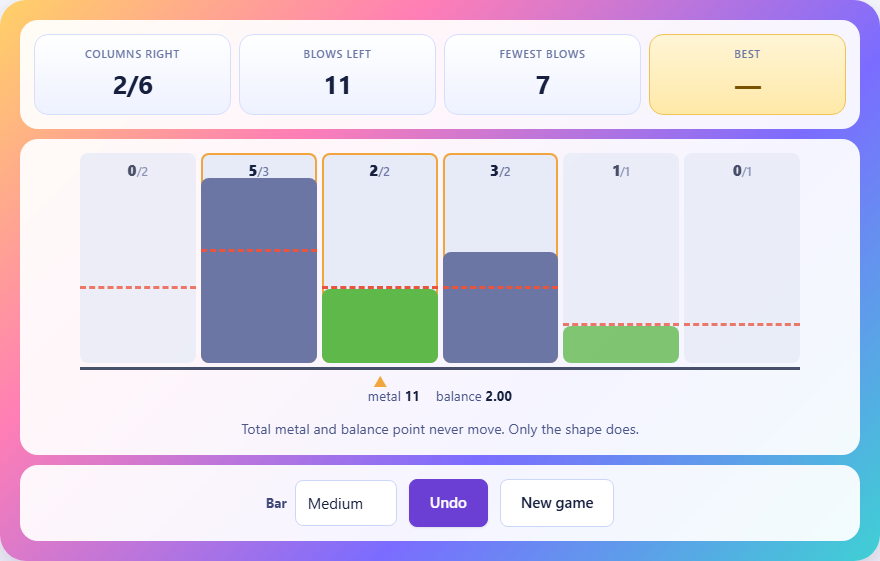
How each blow works
When you tap a column, exactly two units of metal are removed from it. One unit goes to the column on its left and one goes to the column on its right. That is the only move in the entire game. There is no way to add metal, no way to remove it, and no way to move it further than one step at a time. The bar stays the same total weight after every blow.
Two conditions must be met before a column can be struck. First, the column must hold at least two units. A column with one unit or none cannot lose two, so the game simply will not let you tap it. Second, the column must not be at either end of the bar. The reason for that rule is practical: an end column has a neighbour on only one side, so half the metal would have nowhere to go. Keeping the ends off limits is what makes the whole system conserve properly.
The two numbers that never move
Below the bar you will see two figures. One is the total amount of metal across every column. The other is the balance point, the position along the bar where it would sit level on a narrow wedge. Both numbers stay perfectly still no matter how many blows you land.
The total is preserved for an obvious reason: two units leave one place and one arrives in each of two places, so nothing is created or destroyed. The balance point is preserved for a less obvious reason. Taking two units from column i and placing one at column i minus one and one at column i plus one changes the weighted sum by minus two times i, plus i minus one, plus i plus one, which adds to zero. The target shape always shares both numbers with the starting shape, which is your first check that you are reading the dashes correctly.
Controls on the page
The Bar dropdown offers three sizes: Small, Medium and Large. A small bar has fewer columns and is a good place to start while you learn the mechanics. Medium is the default and gives a satisfying puzzle without being long. Large bars have more columns and more metal to move, so they take more thought.
The Undo button pulls the last blow back, returning the two units to the column you struck and taking one from each neighbour. However, the blow is still counted against your total. This means undo is not a free pass. It saves you from a mistake in the bar's shape, but the wasted swing still shows in your score. The New game button generates a fresh puzzle at the current size.
How scoring works
The game counts every blow you make, including any you later undo. When you reach the target shape, the game compares your count against par. Par is the smallest number of blows that can reach that target from the starting bar, found by searching every shape the bar can reach. If you match par, you solved it as cleanly as possible. If your count is higher, the extra blows were either unnecessary or were wasted on wrong moves that you later undid.
There is a hard limit on top of that. The bar comes with a few blows in hand beyond par, three on a small bar and five on a large one, and the Blows left figure counts them down. Undoing does not give one back. Strike without thinking and reverse course a few times and the metal goes cold before the shape is right, which ends the puzzle. The lesson the game is quietly teaching is to plan the whole route before you touch anything.
Strategy: count the blows on paper first
Here is the most important fact about this puzzle. The final shape depends only on how many times each column was struck, not on the order. Two blows in either order leave the bar identical. This means the puzzle splits into two separate questions. First, how many times does each column need to be hit? Second, in what order can those hits be carried out legally?
To answer the first question, look at each column and compare its current height with its target height. The columns at the ends can never be struck, so their height can only change when their neighbours are struck. Work outwards from the ends and the counts fall into place. For a bar of this kind there is always exactly one set of counts, so once you have them you have the whole answer in principle.
Strategy: finding a legal order
Knowing the counts is not the same as being able to carry them out. A column that needs to be struck three times must have at least two units in it each time you hit it. Early in the puzzle, some columns may not have enough metal yet. They need a neighbour to be struck first so that metal flows into them.
Start by looking for columns that are already tall enough to strike and that need to be struck. Hit those first. Each blow will push metal into the neighbours, which may bring a previously too-short column up to the threshold of two. Then strike that column, and the ripple continues. If you get stuck with no column tall enough to hit, you have either miscounted or are hitting in the wrong place. Step back, recount, and look for a different starting point.
Strategy: working from the peaks
The tallest columns are the place to begin looking. Any inside column already holding two units can be struck, but a peak holds the most and so can take several blows in a row. A column sitting at four or five units can absorb several blows before it drops below the threshold. Meanwhile, each blow pushes metal outward, building up shorter neighbours. On a large bar you might have two or three peaks separated by valleys. Work on the tallest peak first, because it has the most room before it drops below two.
Think of the bar as a landscape and the blows as erosion. Peaks flatten and valleys fill. If the target has a taller peak than the starting bar does, you are reading the shapes the wrong way round, because metal only ever spreads outwards. The target is always flatter than the start, and your job is to find the exact pattern of flattening that matches. A useful habit is to scan the target and the bar side by side, marking each column with the difference in height, before you touch anything.
Common beginner mistakes
The most frequent error is striking without a plan. Because undo does not erase the blow from your count, every wrong tap costs you. Players who tap hopefully and undo when it looks wrong will always finish well over par. The fix is simple: count on paper or in your head before touching the bar.
Another common slip is trying to strike an end column. The game will not allow it, but players sometimes forget why and waste time trying. End columns change height only when their immediate neighbour is struck, so they are passive receivers, never active targets. A third mistake is assuming the order does not matter at all. The counts are fixed, but the order still has to be legal. You cannot strike a column that holds fewer than two units, and ignoring that constraint leads to a dead end where no move is available even though work remains.
Finally, some players confuse the target dashes with extra decorations and ignore them entirely. Each dashed line marks the exact height that column must reach. Watch the dashes carefully before you plan your route, because misreading even one of them sends the whole solution off course. If you finish and one column is still wrong, check whether you read its target correctly before you assume your counting was bad.
Nothing leaves your browser
The entire puzzle runs in your browser on your own device. No puzzle state, no score and no move history is sent anywhere. You can load the page, turn off your connection and keep playing without any change in how the game behaves. There is no account, no login and no data collection beyond what you choose to allow in the cookie notice.