
Unscrambling words under pressure
Word Scramble gives you a set of jumbled letters and asks you to find the word they spell, twelve times, before a clock runs out. It sounds simple, and some words are. Others look like nothing at all until something clicks and the answer appears whole. This article covers how the game works, what each control does, how the scoring runs, and the mental habits that help you solve scrambles faster and with fewer hints.
How a round plays out
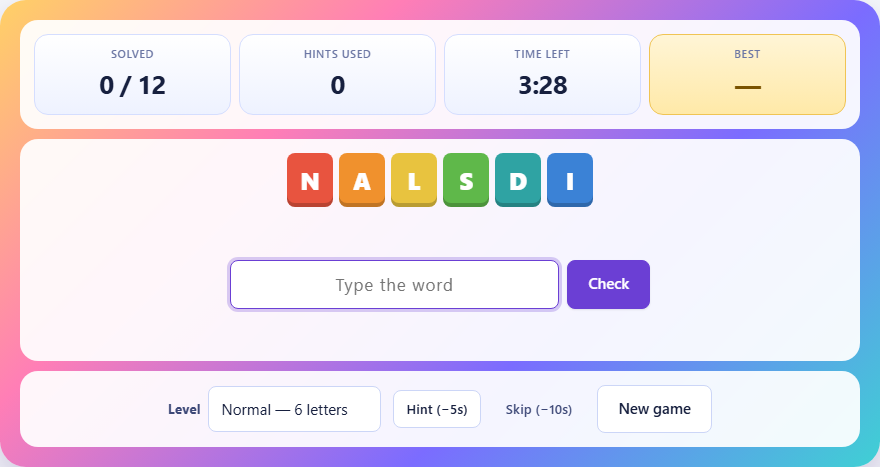
When you start a game, a word is chosen and its letters are shuffled into a random order. The jumbled letters appear on the screen in large type. A clock starts counting down. Your job is to type the original word and press Enter or tap the Check button.
If you get it right, the game moves to the next word immediately and a new jumble appears. If you get it wrong, the letters stay on the screen and you try again. There is no penalty for a wrong guess beyond the time it takes to type and check it. After twelve correct answers, the game is won. If the clock reaches zero before you solve all twelve, the game ends and you are shown how many you managed to get. The clock does not pause between words, so speed on the easy ones leaves more time for the ones that stump you.
Controls and what they cost
Below the letter display is a text field where you type your answer. Press Enter or tap Check to submit. The game is not case-sensitive, so upper and lower case both work.
Two extra buttons sit beside the input. The Hint button reveals the next letter of the word, starting from the beginning, and costs five seconds off the clock. You can press it more than once on the same word, but each press costs another five seconds. The Skip button gives up on the current word, shows you the answer, and costs ten seconds. The New game button starts a fresh round at any time.
Difficulty levels and word length
The Level dropdown offers three choices. Easy uses words of five letters. Normal uses words of six letters. Hard uses words of eight letters or more. The longer the word, the more possible arrangements its letters have, and the harder it is to see the answer just by looking at the jumble.
A five-letter word has a hundred and twenty possible arrangements. A six-letter word has seven hundred and twenty. An eight-letter word has over forty thousand. The jump from normal to hard is steep because of this, and many people find that the habits that work on short words need to change when the letters get longer. Hard mode rewards a different kind of thinking, one that works with patterns and word structure rather than brute recognition.
Look for the ending first
The fastest way to crack a scramble is to search for common word endings before you try to build the word from the front. If you spot the letters I, N, and G in the jumble, there is a good chance the word ends in ING, and that immediately tells you what the remaining letters have to do. The same works for endings like ED, ER, TION, MENT, NESS, and ABLE.
This is faster than trying every possible opening letter because it narrows the search from both ends at once. If you know the word ends in TION and is eight letters long, you only need to arrange four remaining letters into the first half. That is twenty-four combinations instead of forty thousand, which is a problem your brain can solve by feel rather than by exhaustive search.
Separate the vowels from the consonants
Another useful habit is to pull the vowels out of the jumble mentally and look at them on their own. Most English words alternate between consonants and vowels in patterns that your ear already knows, even if you cannot name the rule. A word with two vowels and four consonants has a different shape from a word with three vowels and three consonants.
Once you see the vowels, try placing them in the positions that feel natural. A single vowel between two consonants is the most common syllable shape in English, so arranging consonant-vowel-consonant groups and seeing what sounds right often triggers the answer faster than staring at the whole jumble at once.
Say the letters out loud
When looking at the jumble does not work, try saying the letters aloud. This is not a trick. Visual recognition and auditory recognition are handled by different parts of memory, and a word that refuses to appear when you look at the letters will sometimes pop into your mind the moment you hear them spoken.
You do not need to say them in order. Just read them off the screen, let the sounds overlap, and listen for something familiar. This works especially well for longer words where the visual jumble is too complex to take in at a glance. Many players find that hard-mode words yield to this approach more often than to any visual technique. The reason is that reading and listening use different memory pathways, and the word you cannot see might be one you can hear.
When to use a hint and when to skip
A hint reveals the first unknown letter of the word and costs five seconds. If you already have a strong sense of the word and just need confirmation of the opening letter, a single hint can save you more time than it costs. But if you have no idea at all, one letter rarely helps enough to justify the five seconds.
Skipping costs ten seconds and shows you the full answer. If you have been stuck for more than ten seconds already, skipping is usually the right call. The time you save by moving to the next word, which might be easier, outweighs the penalty. The worst outcome is spending twenty seconds staring at a word you were never going to solve, because that time is gone regardless.
Common mistakes that waste time
A few habits slow people down, and breaking them is worth more than any single solving trick.
- Trying to read the jumble as if it were a word. The letters are deliberately shuffled to not look like anything. Treat them as raw material, not as a near-miss spelling.
- Guessing whole words at random. Each wrong guess takes a second or two to type and check, and those seconds add up. Build from evidence, not from hope.
- Refusing to use hints or skips. They exist for a reason. A five-second hint that cracks the word is a net gain. A ten-second skip that frees you from a dead end is better than thirty seconds of staring.
- Starting from the first letter every time. The first letter of the jumble is not the first letter of the word. Working from endings, vowels, or sounds is almost always faster.
The shuffle is honest
The letters are genuinely shuffled at random, and the game checks the result. If the shuffle comes out as the original word or barely changed, the letters are shuffled again. This means you never see the answer staring back at you by accident, and every jumble is a real puzzle.
Every letter of the answer is present in the jumble, and no extra letters are added. What you see is exactly what you need to rearrange. Counting the letters can sometimes help: if you count seven letters and you are on hard mode, you know the word is seven letters long, and that alone can narrow the field. Knowing the exact letter count also tells you whether the word is likely to have one syllable, two, or three, which shapes how the consonants and vowels are likely to be arranged.
Everything stays on your device
The game runs entirely in your browser. Nothing is uploaded, there is no account, and your best score is stored in this browser only on this device. Once the page has loaded, it works offline. The word list, the shuffle, the timer, and the scoring all happen right here in the page.
There is no limit on how many games you play, no waiting between rounds, and no sign-up of any kind.