
Territory, arrows, and the game that only gets smaller
Amazons is a two-player territory game played on a board that shrinks by one square every single turn. Each side controls four queens. A turn has two steps: move one queen in a straight line, then shoot an arrow from her new position that burns a square for the rest of the game. Nothing is ever captured. The player who runs out of moves loses. This article covers the rules in full, the controls on this page, how the score is read, and the strategic thinking that separates a first attempt from a strong game.
The rules in detail
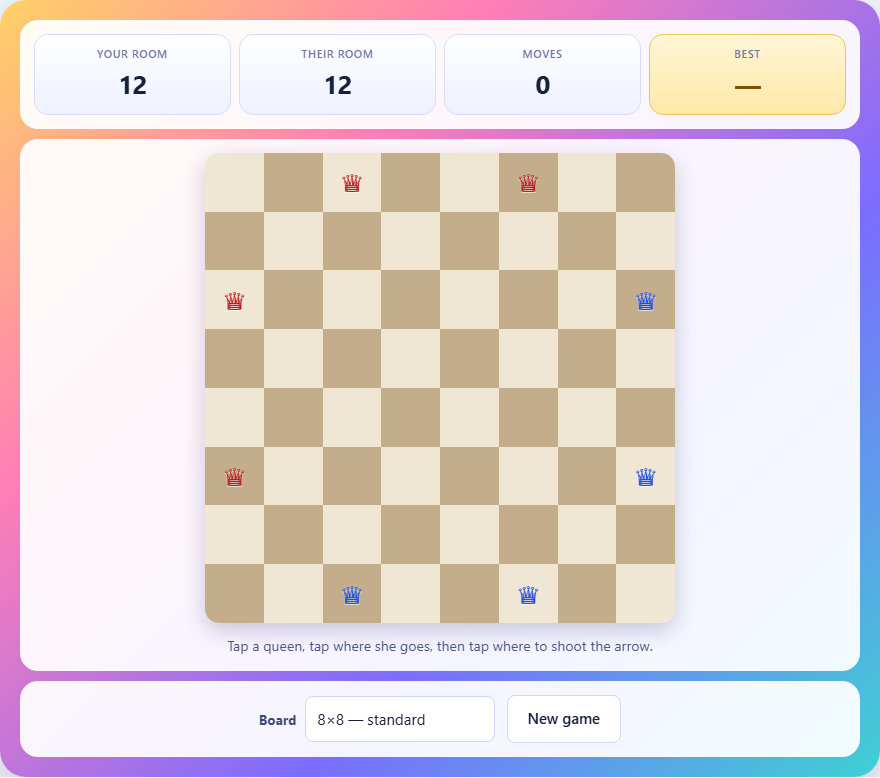
The board starts with each side's four queens placed on it and every other square empty. A queen moves exactly like a chess queen: any number of squares in a straight line, horizontally, vertically, or diagonally. She cannot jump over anything. Another queen, a burnt square, or the edge of the board all stop her.
After the queen lands on her new square, she must shoot an arrow. The arrow also travels in a straight line from the queen's new position, in any of the eight directions, and it also cannot jump over anything. The square the arrow lands on is burnt for the rest of the game. No piece, friendly or enemy, can move through it or land on it again.
A turn is always both parts: move and then shoot. You cannot skip the arrow. If a queen has somewhere to move but nowhere to shoot from that new position, that particular move is not legal. The game ends when one player has no legal move at all. That player loses.
Controls and board options
Tap a queen to select her. Her legal destination squares light up in all eight directions. Tap one of those squares to move her there. Then a second set of highlighted squares appears, showing where the arrow can go from her new position. Tap one to fire. The square turns into a burnt mark and your turn is complete.
The Board dropdown offers three settings. The quick option plays on a six by six board, which leads to short, sharp games that finish in a few minutes. The standard option uses the full eight by eight board, which gives more room to maneuver. The deeper search option also plays on eight by eight but gives the computer more time to think, making it a stronger opponent. A New game button resets the board at any time.
How the scoreboard works
The score shown during play counts how many empty squares each side can reach in fewer moves than the other. If you can get to a square in two moves and your opponent needs four, that square counts for you. If both sides can reach it in the same number of moves, neither scores it.
This territory count is the standard way of evaluating an Amazons position. When the board splits into separate regions, which it always does eventually, the territory count tells you exactly who will win. The side with more reachable squares in its own pockets finishes with moves left when the other side is stuck.
The arrow matters more than the queen
New players tend to focus on where the queen ends up and pick the arrow square as an afterthought. That is backwards. The queen is a piece that can move again later. The arrow is a permanent change to the board. Every arrow removes one square from the game forever, so the question you should ask first is: what does this arrow close off?
A well-placed arrow can seal a corridor, cut an opponent's queen off from a region, or protect a section of the board for your own side. A poorly placed arrow might block one of your own queens or waste a turn burning a square that was already unreachable. Before you decide where the queen goes, think about where you want the arrow to land and work backward.
Splitting the board into pockets
The endgame of Amazons is all about territory, and territory is decided by how the board breaks apart. As more squares burn, the open space separates into disconnected regions. Once a region is cut off, only the queens already inside it can use those squares. The side with more room in its own regions wins.
The strategic aim in the middle of the game is to split the board in your favor. Look for a line of burnt squares or an edge of the board that almost forms a wall. One well-aimed arrow might complete that wall and seal a large region for yourself while leaving your opponent crowded into a smaller one. Timing matters. If you cut the board too early, you might trap one of your own queens on the wrong side.
Spread your queens, do not crowd them
Two friendly queens in the same small region share the same set of squares. Every move one of them makes reduces the room available to the other. This is wasteful. Four queens spread across four regions have access to four times as many squares as four queens trapped in one.
In the opening, move your queens outward so they cover different parts of the board. Aim for a layout where each queen has room to move freely without bumping into a teammate. As the board gets smaller, this early spread pays off because each queen has its own territory to fill.
Count squares, not captures
Amazons has no captures at all. Nothing is ever taken off the board. This makes it very different from chess or checkers, where winning material is usually the path to victory. In Amazons, the only currency is space. A queen surrounded by empty squares is strong. A queen boxed in by burnt squares and board edges is weak, no matter how many queens she has around her.
When you evaluate a position, count the empty squares you can reach before your opponent can. That count is what the scoreboard shows, and it is the only number that determines who wins. A queen that controls twenty empty squares is worth more than three queens that share six between them.
Common mistakes and how to avoid them
Several patterns catch beginners and all of them are fixable once you know to look for them.
- Shooting the arrow at random. Every arrow is a permanent board change. Burning a useless square wastes your most powerful tool.
- Moving the queen first and choosing the arrow second. Think about the arrow's target first, then pick the queen move that reaches a good firing position.
- Clustering queens in the center. The center gets crowded fast as both players fire arrows into it. Queens on the outside often have more room.
- Ignoring small regions. Even a pocket of four or five squares matters when the board is tight. Losing those to an opponent's queen adds up quickly.
- Forgetting that arrows cannot jump over queens. Your own queens block your own arrows, so placing a queen between your firing position and your target removes that shot.
Why the computer plays on a smaller board
The traditional board for Amazons is ten by ten, but the game has an enormous number of legal moves in any position. On the full board, the opening can have over two thousand possible plays. Searching that many options deeply enough to play well takes far more time than a browser game can afford.
The versions here use six by six and eight by eight boards, where the computer can look several moves ahead in a reasonable time. On the deeper search setting, it takes longer per turn but plays a noticeably stronger game. Even on the smaller boards, the core strategy of territory, splitting, and arrow placement works the same way it does on the larger one.
Everything stays on your device
The game runs entirely in your browser. Nothing is uploaded, there is no account, and once the page has loaded it works offline. Your game state lives on this device only, and there is no limit on how many games you play. The computer opponent runs its search right here in the page, which is why you may notice a brief pause on the deeper setting while it thinks.
No personal information is collected or stored, and the game does not require any sign-up or registration.