
Winding the dials home in the fewest turns
Almanac is a number puzzle dressed as a calendar. Several dials sit on the screen, each counting a different cycle. Every lever you pull winds the whole calendar forward by a fixed number of days, moving every dial at the same time. Your task is to bring all the dials back to day zero, using as few winds as possible. The puzzle rests on a piece of mathematics that guarantees an answer always exists, but finding that answer and building it from the levers you have are two quite different problems.
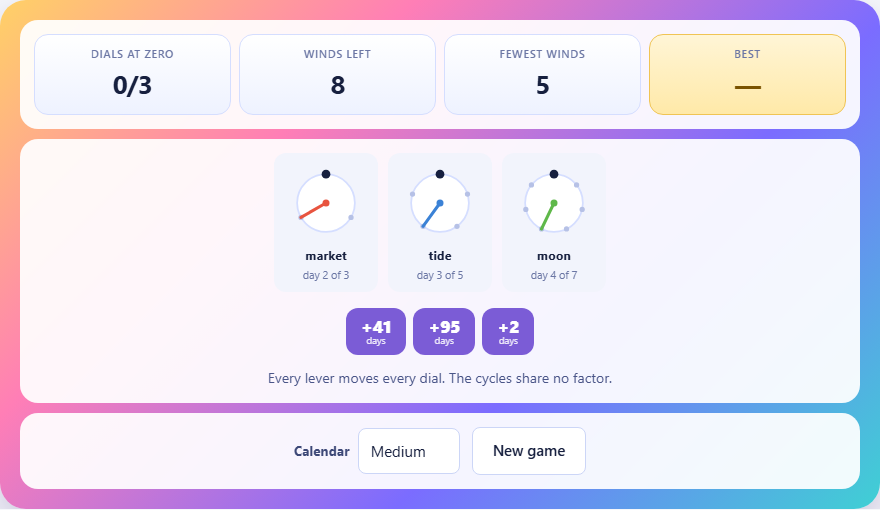
What the dials and levers do
Each dial represents a cycle of a certain length and shows which day of that cycle today is. A dial of five that reads two means the cycle has five days and you are on day two. Winding the almanac forward by one day would move that dial to three. Winding by four would move it to one, because five wraps back to zero.
The levers underneath each add a fixed number of days when you pull them. Pulling a lever that says three moves every dial forward by three days at once. You cannot turn one dial on its own. That is the whole constraint of the puzzle: all dials move together, and you have to land them all on zero at the same moment. A lever can be pulled more than once in the same game, so you are free to use the same value as many times as you need.
Why there is always an answer
The cycles are chosen so that they share no common factor. When that is true, a result from number theory guarantees that every possible combination of dial positions happens exactly once before the whole pattern repeats. The repeat length is the cycles multiplied together. For cycles of three, five, and seven, that is a hundred and five days. Somewhere in those hundred and five days there is exactly one day where every dial reads zero.
This means you never have to worry about whether a puzzle is solvable. It always is. The question is only how to reach that day using the levers available. The game works out the smallest number of lever pulls that can reach the right total, and that figure is what you are trying to match or beat. The same mathematical idea has been used for centuries to keep calendar systems in step, and it appears in modern cryptography as well.
Controls and how to play
The Calendar dropdown offers three sizes: Small, Medium, and Large. A small calendar has fewer dials and shorter cycles, which means fewer possible days and a simpler search. A large calendar has more dials, longer cycles, and a much bigger space to think through.
To play, tap any lever button to wind the almanac forward by the number shown on it. The dials all rotate at once. Overshooting is allowed, because the dials wrap and going past the end of the full cycle brings you back around. When every dial reads zero, you have won. The scoreboard carries three numbers: how many dials are home, how many winds you have left, and the fewest winds the puzzle can be done in. The winds left figure is the one to watch, because the spring is only wound a few turns past that minimum and running it dry ends the game.
Find the target day before you touch the levers
The most common mistake is to start pulling levers immediately. Resist that urge. The first job is to work out which day number brings every dial home. That calculation does not depend on the levers at all, only on the dial positions and the cycle lengths.
Take each dial one at a time. A dial of five on day two needs three more days to reach zero, or eight, or thirteen, and so on in steps of five. Write that list out. A dial of seven on day four needs three more days, or ten, or seventeen, in steps of seven. Now look for a number that appears on every list. That is the day you need. Only after you have that number do the levers matter, and the problem becomes: which combination of lever values adds up to that total?
Building the total from the levers
Once you know the target day, the puzzle turns into a different kind of problem. You have a set of lever values and you need to find a combination that adds up to exactly the right number. Each lever can be pulled more than once, and the total wraps around the full cycle length, so overshooting by the full span is the same as not overshooting at all.
Start with the largest lever. See how many times it fits into your target. Then look at what is left over and try to fill it with the smaller levers. If no exact match appears, remember that going past the target by a full cycle length is fine, so you can aim for the target plus the cycle length, or twice the cycle length, and work from there. The game searches every reachable total to find the true minimum, so its number is always exact.
Strategy for fewer winds
The fewest winds is not always obvious. Sometimes two pulls of a medium lever beat three pulls of a large one plus a small one, because the wrapping arithmetic lines up differently. The key insight is that you are not minimizing the total number of days added. You are minimizing the total number of lever pulls, and a single pull of a large lever covers a lot of ground.
On the larger calendars, where the cycle might run into the hundreds, brute force in your head becomes impractical. In those cases, focus on the largest lever first and try to get within one or two pulls of the target. Then use the smaller levers to close the gap. If you find yourself needing many small pulls to finish, step back and try a different number of large pulls, because one extra large pull might remove the need for several small ones. Think of the levers as coins of different values. You are trying to make change for a specific amount, and the goal is to use the fewest coins, not to use them all.
Why a dial at zero is not safe
A trap that catches new players is seeing one dial already at zero and thinking it is done. It is not. The next lever pull moves every dial, including the one that is already home. If you pull a lever of three, that dial jumps from zero to three, and you will need to bring it back again.
This means you cannot solve the dials one at a time. All of them must land on zero from the same set of lever pulls. That is what makes the puzzle harder than it looks at first glance, and it is also what makes the mathematical guarantee important: without it, you might reasonably wonder whether all the dials can actually reach zero together.
Common mistakes and how to avoid them
A few patterns come up often when people are learning the game.
- Pulling levers at random hoping to stumble onto the answer. The number of possible combinations grows fast, and random guessing almost never finds the shortest path.
- Forgetting that the dials wrap. Going past zero is not a failure. The dial comes back around, and sometimes the shortest route goes through the wraparound.
- Trying to zero each dial separately. Since every lever moves all dials at once, fixing one dial usually moves the others away from zero. The solution has to land all of them at the same time.
- Ignoring the fewest-winds figure. The game tells you the minimum number of pulls, so you always know whether there is a shorter path to find.
Everything stays on your device
The entire puzzle runs inside your browser. No data is uploaded, there is no account, and your best results are stored locally in this browser on this device only. Once the page has loaded, it works fully offline. There is no limit on how many puzzles you play, and no registration step of any kind.
The mathematics behind the puzzle, finding the unique day and searching for the shortest combination of levers, is all done by the page itself. The answer it shows you is exact, not an estimate, because every single reachable total is checked.