
Scoring goals with angles and patience
Air Hockey puts you at one end of a table with a mallet, a puck, and a computer opponent at the other end. The rules are simple: drag your mallet, hit the puck, and try to get it into the other goal. First to seven wins. This article covers every rule, explains the controls, describes how the physics work, and walks through the strategies that beat the computer at each difficulty level.
The table, the mallets, and the puck
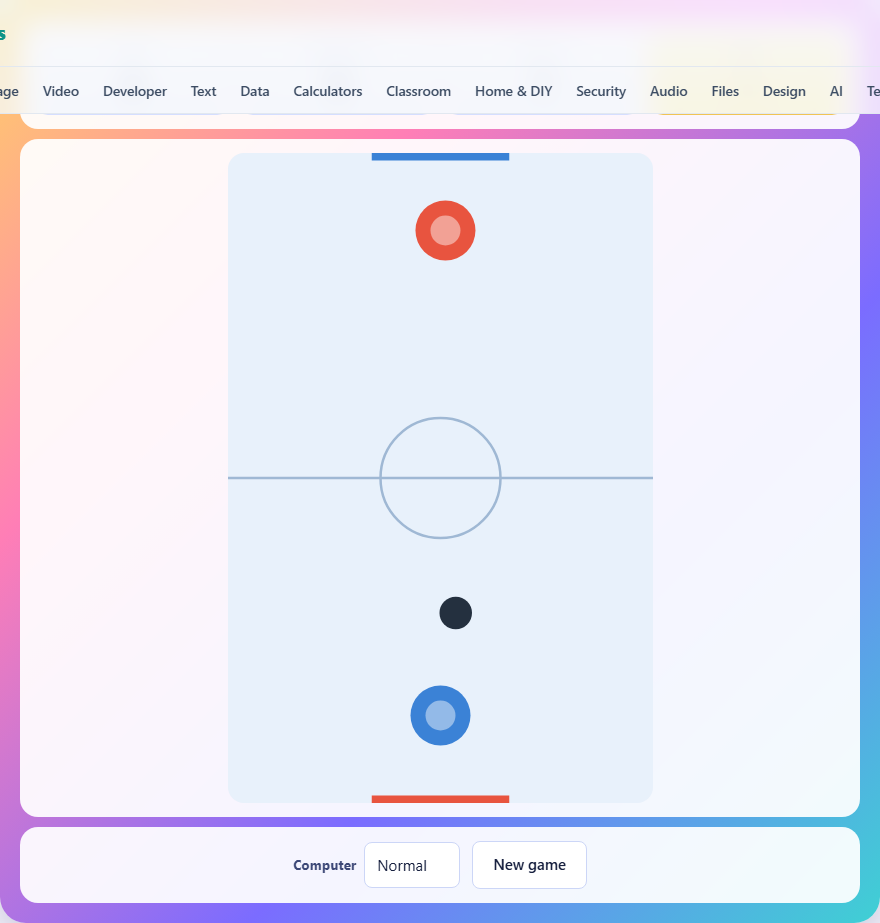
The playing area is a rectangular table with a goal at each end. Your mallet sits in the bottom half and the computer's mallet sits in the top half. A line across the middle marks the boundary neither mallet can cross. The puck starts in the centre after every goal and moves freely across the whole table, bouncing off the side walls.
Your mallet follows your mouse or finger. Drag it around your half and it moves. The mallet cannot cross the centre line, which prevents you from simply shoving the puck into the far goal at point blank range. The computer's mallet is controlled by the game and obeys the same rule, staying in its own half at all times.
How to control your mallet
On a desktop, hold the mouse button and drag. The mallet follows your cursor within your half of the table. On a phone or tablet, press and drag with your finger. The board scales to fit your screen, so the controls work the same way regardless of device size.
How fast you swing is not what sets the pace, though. A hit gives the puck back the speed it arrived with, plus about six per cent, with a floor under it so that even a slow drift is returned as a firm shot. Waving the mallet about adds nothing. What your movement really controls is where the mallet sits when contact happens, and that is what decides the direction.
Scoring and winning a game
A goal is scored when the puck passes entirely into either goal opening. After each goal, the puck resets to the centre and play resumes. The first player to reach seven goals wins the game. There is no timer on a game. It lasts as long as it takes for someone to score seven.
Each goal counts as one point regardless of how it was scored. A slow roller that barely crosses the line counts the same as a hard shot off the wall. There are no bonus points for style, speed, or consecutive goals. The score is simply a count, and the first to seven takes it.
Choosing a difficulty level
A dropdown labelled Computer offers three settings: Easy, Normal, and Hard. The difference between them is how well the computer moves its mallet. On Easy, the computer reacts slowly and leaves gaps in its coverage. On Normal, it plays a solid defensive game but can be beaten with angled shots. On Hard, it tracks the puck closely and covers its goal well, so you need consistent wall shots and quick reactions to score.
The computer has a deliberate speed limit at every difficulty. A mallet that could teleport to any position instantly would be unbeatable, and that would not be fun. The speed limit means the computer has to anticipate where the puck is going rather than simply arriving there, which gives you openings to exploit with well-placed shots.
The bank shot and why it is your best weapon
A straight hit sends the puck directly back toward the computer's mallet, which is probably sitting right in front of its goal. That is the easiest kind of shot to defend. A bank shot, where you strike the puck into the side wall so it bounces toward the goal at an angle, is much harder for the computer to stop.
The angle of the bounce follows the same rule as light reflecting off a mirror. If the puck hits the wall at a steep angle, it comes off at a steep angle on the other side. If it hits at a shallow angle, it travels along the wall. Aim for a mid-angle that sends the puck across the front of the goal rather than straight into the wall. With practice, you can place bank shots consistently enough to score on even the hard difficulty.
How to hit the puck at an angle
Where your mallet contacts the puck decides the direction the puck travels. A dead-centre hit sends the puck straight ahead. Hitting the puck off-centre, so that your mallet contacts its left or right side, sends it away at an angle. The further off-centre you hit, the sharper the angle.
This is how you set up bank shots. Park the mallet slightly to one side of the incoming puck and it deflects toward the opposite wall. The contact point is the only thing that decides the direction, which is why placing the mallet early beats swiping at the puck late. Getting the mallet into the right spot before the puck arrives is the core skill of the game, and it rewards practice more than anything else.
Defending your own goal
The best defensive position is close to your own goal, not in the middle of your half. Sitting near the goal line gives you the shortest distance to cover when the puck comes toward you. A mallet caught in the middle of the half has to travel further to reach either side of the goal, and that extra distance is often enough for the puck to slip through.
Resist the urge to chase the puck into the upper part of your half. Moving forward feels aggressive, but it pulls your mallet away from the goal and leaves a gap behind you. If the puck bounces off the wall and comes back at a sharp angle, your mallet is out of position and the goal is open. Stay near your line, wait for the puck to come to you, and strike when it arrives.
Using the puck's own speed against the computer
A fast puck picks up speed off your mallet. Each contact returns the puck a little quicker than it arrived, so a long rally builds pace on its own and a shot you return can come back faster than the one you sent. That speed can be enough to beat the computer to the spot, especially on Normal and Hard where it defends well against slow shots.
The trick is to sit in the right place rather than swinging wildly. A still mallet caught at the right angle is much more effective than a panicked swipe that sends the puck into the wall at a useless angle. Let it come to you, put the mallet in its path a moment early, and the bounce does the rest.
Common mistakes that let the computer score
The most common mistake is chasing the puck forward. Your mallet cannot cross the centre line anyway, and moving it to the top of your half leaves your goal wide open. The computer does not need a hard shot to score on an open goal. A gentle push is enough.
The second mistake is hitting the puck straight ahead every time. A direct hit goes back to the computer's mallet, which is already in position to return it. Without any angle, you are playing catch rather than trying to score. Mix in bank shots and off-centre hits to keep the computer guessing.
The third mistake is moving the mallet too fast. Quick, jerky movements make it hard to position your mallet precisely, and imprecise contact sends the puck in unpredictable directions. Smooth, deliberate movements give you better control over both the angle and the speed of your hits.
Beating the hard difficulty
On Hard, the computer tracks the puck closely and rarely leaves its goal exposed. Straight shots almost never get through. To score consistently you need to combine wall bounces with speed. Hit the puck into the side wall at a sharp angle so it crosses in front of the computer's goal before the mallet can slide into position. The computer is fast but it cannot be in two places at once, and a well-placed bank shot arrives from a direction it was not covering.
Patience matters just as much as aim. On Hard, the computer will return most of your shots, so each rally can last several exchanges. Wait for the puck to arrive at a good angle rather than forcing a shot from a bad position. A poor attempt that goes straight back gives the computer an easy chance to score, while a missed opportunity costs nothing if you are already defending your goal.
Privacy and how the game runs
The game runs entirely inside your browser. The physics, the scoring, and the computer opponent all work on your device with no server involved. Nothing is uploaded, there is no account, and your results are stored in your browser only. Once the page has loaded, the game works offline. Closing the tab ends the current match, and no record of your play is kept anywhere beyond your own device.