
Training your aim one target at a time
Target Practice is a reflex game that tests how fast and how accurately you can click. Targets appear one at a time inside a box, and your job is to hit thirty of them in thirty seconds. Every click that misses counts against you, and five misses end the game early. This article covers the rules, the controls, how scoring works, and the habits that lead to faster and more accurate play.
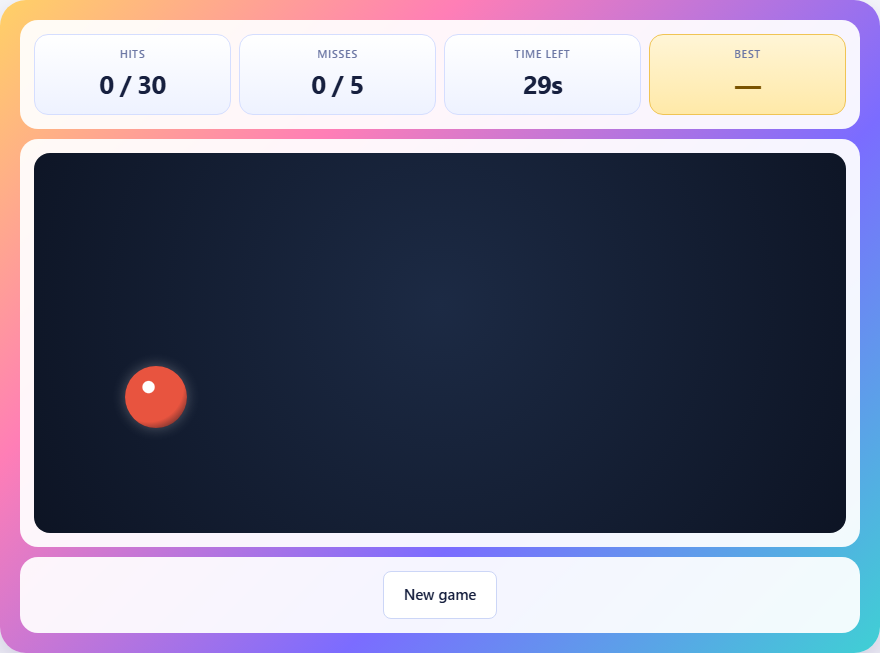
How a round works from start to finish
When the game starts, a target appears at a random position inside the playing area. Click or tap it, and it vanishes. A new target appears somewhere else immediately. This repeats until one of three things happens: you hit thirty targets and the round ends successfully, the thirty-second timer runs out, or you accumulate five misses and the game stops early.
Each round is independent. Your score, your accuracy, and your average time per target are reported at the end, and then you can start a fresh round. There is no carry-over between rounds, no lives system, and no progression through levels. Every round is the same challenge, and the only thing that changes is how well you rise to it.
What counts as a hit and what counts as a miss
A hit is any click or tap that lands on the target. A miss is any click or tap that lands inside the playing area but not on the target. Clicking outside the playing area entirely does not count as anything. The game only watches the box where the targets appear.
This distinction matters because a miss is not free. Five misses end the round, regardless of how many targets you have hit or how much time is left. A player who hits twenty-nine targets but clicks wildly between them can still lose. The miss limit exists to reward careful clicking rather than spraying the screen and hoping to land on the target by chance.
Shrinking targets and why they get harder
Targets gradually get smaller as your hit count rises during a round. The first few targets are easy to see and easy to hit. By the time you are chasing the last few, the target is noticeably smaller and demands more precise aim. This scaling keeps the game challenging even as your reactions improve over many rounds.
The shrinking is smooth rather than stepped. There is no sudden jump at a particular hit count. Each new target is just a little smaller than the last, which means you adapt gradually rather than slamming into a wall. That gradual curve is important because it lets you feel the difficulty rising rather than being surprised by it.
Controls on desktop and mobile
On a desktop, click the targets with your mouse. On a phone or tablet, tap them with your finger. The playing area scales to fit your screen, so the experience is similar regardless of device size, though the physical distance your hand travels is obviously different on a small phone screen versus a large monitor.
The only button outside the playing area is New game, which starts a fresh round at any time. There are no settings to adjust, no difficulty levels to choose, and no modes to select. The game is the same every time, and improvement comes from playing it rather than from changing the rules.
How scoring and statistics work
At the end of each round, you see a summary: the number of targets hit, the number of misses, your accuracy as a percentage, and the average time per target in milliseconds. The Best chip beside those stats is kept in your browser, but it only fills in when you finish a whole round of thirty. It reads thirty once you have managed that, and stays blank until then. The numbers worth watching from round to round are the accuracy and the average time in the end-of-round message.
Average time per target is the most useful number to watch. Under 500 milliseconds per target is quick by any measure. Under 400 milliseconds with high accuracy is genuinely fast. The accuracy percentage tells you whether your speed is real or just reckless. A fast average built on four misses is not as strong as a slightly slower average with no misses at all.
The flick and correct technique
The fastest way to reach a target is not a smooth glide across the screen. It is a quick flick to roughly the right spot, followed by a brief pause, followed by a small correction to land exactly on the target. This move-stop-correct pattern is faster than a single slow drag because your hand covers most of the distance at high speed and only slows down for the last few pixels.
Practice the flick consciously for a few rounds. Resist the urge to slide smoothly toward the target, because smooth movement means your hand is going slowly for the entire journey rather than just the end. Even a small improvement in your flick speed shaves dozens of milliseconds off every target, which adds up across thirty of them.
Accuracy matters more than speed
The five-miss limit means that a player who clicks carefully will almost always outscore a player who clicks fast but sloppy. Each miss brings you one step closer to an early end, and the targets you could have hit after that fifth miss are all lost. A controlled, steady pace that avoids misses leaves the full thirty targets available and the full thirty seconds usable.
This is especially true in the second half of a round when the targets are smaller. The temptation is to speed up because the timer is running, but speeding up with smaller targets leads to misses, and misses lead to an early end. Keeping the same calm pace all the way through is the most reliable way to finish a round with a strong score.
Using your arm, not just your wrist
For small movements, the wrist is fine. For large jumps across the screen, moving from the elbow or the shoulder is steadier and faster. The wrist has a limited range of motion, and pushing it to the edge of that range produces shaky, inaccurate movement. The elbow and shoulder can cover much more ground without losing control.
This advice is well known among people who play games that require accurate mouse work. It also applies to general computer use, but the benefit is most obvious in a game where you are measured in milliseconds. If you notice that targets on the far side of the screen take much longer to reach than nearby ones, switching to an arm movement for the long jump will even out your times.
Common mistakes that cost you misses
The most common mistake is clicking before your cursor has finished moving. The target is there, your hand is heading toward it, and you click a fraction of a second too early. The cursor was ten pixels short and the click lands on empty space. Waiting until your hand has stopped moving before clicking eliminates most accidental misses.
The second mistake is trying to predict where the next target will appear. Targets never repeat the same spot twice in a row, so there is no point camping on a previous position. Start each new target from wherever your cursor ended up, and react to its actual position rather than guessing.
The third mistake is tensing up as the timer runs low. Tension makes your hand less accurate, which leads to misses, which end the game even sooner. If you feel your grip tightening on the mouse, relax your hand deliberately. A loose grip is a fast grip.
Building a warm-up routine
Treat the first round of any session as a throw-away. Your hands are cold, your reactions are slow, and the score will reflect that. Play one or two rounds without caring about the result, and use them to get your hand moving and your eyes tracking. Once you feel loose, the scores from the third round onward will be noticeably better.
Consistency matters more than occasional brilliance. A player who averages 480 milliseconds per target across ten rounds is in better shape than one who hits 350 once and 600 every other time. Track your average over several rounds rather than chasing a single peak, and you will see steady improvement over days rather than random spikes.
Why the game works as daily practice
A single round takes less than a minute. That makes it easy to fit into a break or a waiting moment without committing to a long session. Playing three or four rounds a day, spread out rather than back to back, gives your hand-eye coordination regular practice without fatigue. Over a week, the improvement in your average time and accuracy is usually visible in the numbers.
The skills you train here transfer to general mouse work as well. Clicking toolbar buttons, selecting text, and navigating menus all involve the same move-stop-click pattern. Faster and more accurate clicking in a game translates into faster and more accurate clicking everywhere else, which is a side benefit that makes the daily minute worthwhile beyond the game itself.
Privacy and how the game runs
The game runs entirely inside your browser. Nothing is uploaded, there is no account, and your best score is stored on your device only. Once the page has loaded, it works offline. Closing the tab clears the current game, though your best score persists in the browser's local storage until you clear it yourself. No personal information is collected or transmitted at any point.