
Squeezing fifty-two cards into as few piles as you can
Accordion is a patience game with no hidden cards, no stock to draw from, and no foundations to fill. All fifty-two cards are laid out face up in one long row, and you collapse it by matching suit or rank one or three places to the left. The aim is to finish with as few piles as possible. This article explains every rule, walks through the controls, and covers the strategies that turn a messy row into a tight finish.
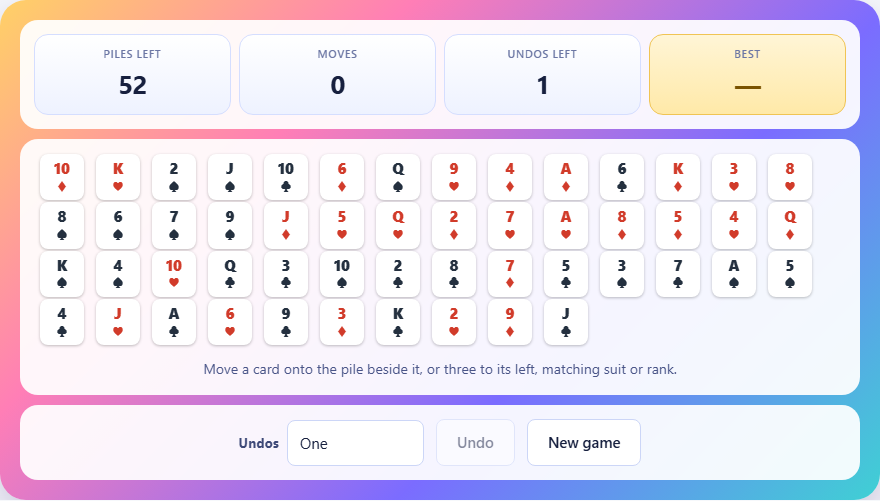
The layout and the only rule that matters
The game deals all fifty-two cards face up in a single row from left to right. Each card begins as its own pile. A pile can move onto the pile immediately to its left, or onto the pile three places to its left, if the top cards of both piles share a suit or share a rank. Nothing can move to the right. Nothing can skip two or four or five places. One place left or three places left are the only legal jumps.
When a pile moves, it lands on top of its target and the gap closes. Every pile to the right shifts one place left to fill the space. That shift is the hidden engine of the whole game, because it changes which piles are now one apart and which are three apart. A move that looks harmless can bring two important cards into range of each other, or push them out of range entirely.
What counts as a match
Two top cards match if they share a suit or share a rank. The three of hearts matches any heart, and it also matches any three. Both conditions count, and only one needs to hold. You never compare cards that are buried inside a pile. Once a card is covered, it is gone for the rest of the game. Only the top card of each pile matters.
This means the order in which you make moves changes which cards are visible and which are buried. Covering a versatile card early, one that shares its suit with several neighbours, can cut off opportunities that would have appeared later. Thinking about what you are burying is just as important as thinking about what you are matching.
How the controls work
Any pile that has a legal move is outlined. Tap or click one and its legal destinations light up. Tap the destination to make the move. The row closes up and the outlines update to show the new set of available moves.
Below the board, the Undos dropdown lets you choose how forgiving the game is. The pure setting gives no undo at all, which is how the game is traditionally played. The normal setting allows one undo, and the easy setting allows three. The Undo button takes back the most recent move and returns the board to its previous state. Once you have used all your undos, the button does nothing until a new game starts. A New game button deals a fresh row at any time.
How scoring works
The score is simply the number of piles remaining when no more moves are available. Lower is better. One pile is the best possible result. Getting below ten piles is a strong game. Finishing with twenty or more is typical for a new player who has not yet learned to plan ahead.
Because the score is a count of what is left rather than a running total, every move matters equally. There is no bonus for speed, no multiplier for streaks, and no reward for making a particular type of merge. The only thing that counts is how far you compress the row. That scoring system makes Accordion unusual among patience games. Most card games give you a clear win condition and call everything else a loss. Here, the question is not whether you won but how well you played the hand you were dealt.
Why most deals cannot be solved completely
Reaching a single pile is possible on some deals, but not on most. The deal is random, and many random arrangements simply do not have a sequence of moves that reduces them all the way down to one. This is not a fault in the game. It is the nature of a puzzle where every card is visible and the challenge is to do the best you can with what you were given.
Judging yourself by the pile count rather than by whether you reached one pile keeps the game rewarding. A deal where you finish with four piles is a better result than a deal where you finish with twelve, even if neither is a perfect solve. Treating every deal as an optimisation problem rather than a pass-or-fail test is the right mindset.
Prefer the three-place jump
When you have a choice between moving one place left or three places left, the three-place jump is usually better. It closes a wider gap, which means more piles shift, which means more new adjacencies appear. A one-place move closes a small gap and changes less. In a game where the shifting is what creates your future moves, a bigger shift gives you more to work with.
There are exceptions. If the one-place move buries a card you will never need again and the three-place move buries something useful, the smaller jump might be right. But as a default, reaching for three is the stronger habit.
Look ahead before taking the obvious move
The biggest trap in Accordion is the greedy move. You see a match, you take it immediately, and you do not notice that making it destroyed two better matches that the row shift would have created. The row closing up after every move is both your best friend and your worst enemy. It creates opportunities, but it also removes them.
Before you commit, scan the row to the right of the move you are about to make. Ask what will be one apart and three apart after the gap closes. If the answer includes a match that is more valuable than the one you are about to take, wait and look for a different first move that preserves both opportunities. This kind of look-ahead is the entire skill of the game.
Working from right to left
A useful habit is to scan the row from right to left when looking for moves. Moves on the right side of the row cause more shifting than moves near the left, because there are more piles to the right of them. More shifting means more change in the board state, which generally means more new moves appearing.
Starting your scan from the right also prevents a common oversight. New players tend to focus on the left end of the row because that is where the reading eye naturally starts. But the right end is where the action is, because that is where the most recent shifts have created fresh adjacencies. Checking the right end first catches opportunities that a left-to-right scan might not reach before the player runs out of patience.
Common mistakes that inflate the pile count
The most common mistake is playing on autopilot. Accordion looks passive because nothing is timed and nothing is hidden, so it is easy to click every match you see without thinking. That approach finishes with many piles because it ignores the cascade effects of the row shift.
The second mistake is always choosing the one-place move when both one and three are available. The smaller move feels safer, but it leaves the row more spread out and produces fewer new adjacencies. Over the course of a full game, consistently choosing one over three adds several extra piles to the finish.
The third mistake is ignoring what gets buried. When you place the five of clubs onto the king of clubs, the king vanishes. If the king was the only club on the board that was next to another club, you have lost a future match permanently. Checking what a move buries before you make it avoids this.
Privacy and how the game runs
The game runs entirely inside your browser. The deal is generated on your device, and no information about your play is sent anywhere. There is no account, no login, and no server keeping track of your results. The page works offline once it has loaded, and closing the tab clears everything.
That offline capability also means the randomness of each deal comes from your own device rather than from a server. Every shuffle is fresh, every game is independent, and no two sessions need to produce the same deal. Your games and your results are yours alone.