
Counting syllables by rule instead of by dictionary
This page puts a number on every word you give it, and it is honest that the number is an educated guess. Here is how that guessing works, what the haiku, pangram and isogram checks are really testing, how to read the warning list, and which words will always need your own ear as the final judge.
A count without a lookup
Ask two people how many syllables sit in a word and they will usually agree, because both of them say the word aloud and count the beats. Software cannot do that. A full pronunciation dictionary is one answer, but it is heavy, it dates quickly, and it still misses names. This tool takes the other route: it applies spelling rules and accepts that rules sometimes lose.
The core rule is short. Runs of vowels count as one beat each. A silent e at the end of a word is dropped. A word ending in a consonant plus le, like little or table, gets a beat paid back. Words of three letters or fewer are simply scored as one beat, because at that length the general rule is wrong more often than the flat answer is.
On ordinary prose this lands on the dictionary answer roughly nine times out of ten. The tool does not bury the remaining tenth. It names the words it is unsure about, which is worth far more than a confident wrong number.
Who actually needs this
Poets working in counted forms are the obvious visitors. A haiku lives or dies on five, seven, five, and checking your own lines by hand becomes unreliable at exactly the moment you are tired enough to write a good one. Having a second opinion on screen keeps the form honest while you chase the image.
Teachers use counts to build clapping exercises and phonics drills, where a batch of two-beat words is the raw material for a lesson. Songwriters fit lyrics to a melody one beat at a time and want to know quickly whether a swapped word still fits the bar.
Editors of plain writing watch the average count per word, since long words are the main thing that pushes a reading grade up. None of these people wants a linguistics lecture. They want a quick number and a note about where the number is shaky, which is precisely the deal on offer.
Driving the page
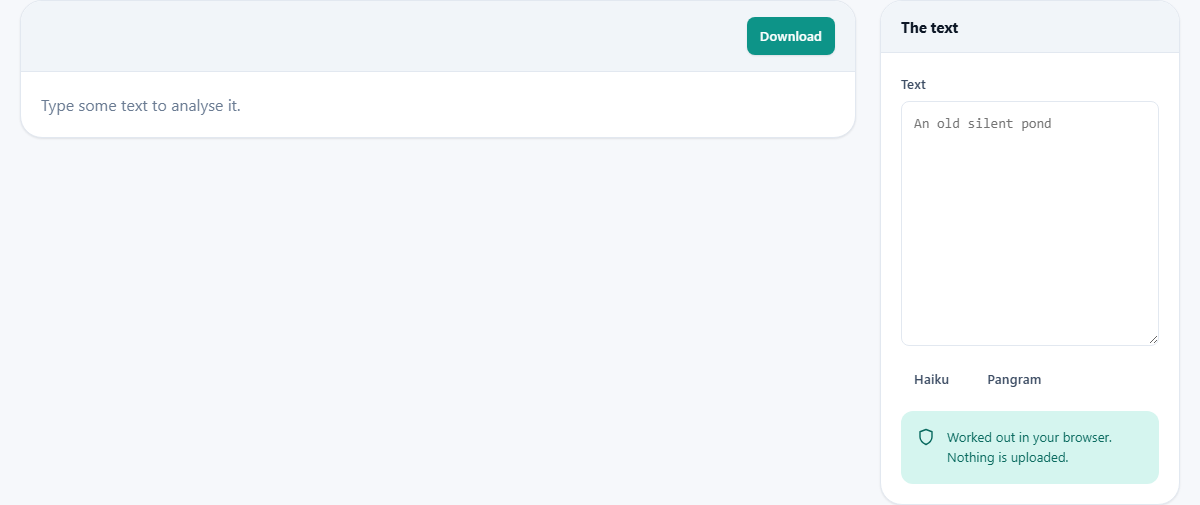
Everything begins in the box labelled Text on the right. Type or paste, and the results redraw as you go. There is no run button to press and no length ceiling worth worrying about for poems and lyrics.
Line breaks are not decoration here. Each line receives its own total whenever there are at least two lines, and the haiku check reads the first three lines specifically. Paste a poem as one long line and you lose both features at once, so keep the breaks.
Two small buttons load samples: Haiku drops in a short three-line example, and Pangram loads a sentence that uses every letter. They exist so you can see the sheet working before you commit your own draft. The Download button at the top saves the whole results sheet as a file, useful when the counts need to travel with the draft into your notes.
Reading the sheet
The summary at the top gives the totals: words and beats overall, plus the verdicts from the extra checks. Below it, the sheet breaks the text down fine enough that you can see the number assigned to any individual word and to any line.
The warning panel deserves your trust most of all. When the text contains a word the rules are known to stumble on, that word is listed by name rather than silently miscounted. Read the message as an instruction: say that word out loud, count it yourself, and adjust the line total in your head if needed.
Three lines, checked
Suppose you have drafted this: Slow rain on the roof / the kettle hums in the dark / steam writes on the glass. Paste it as three separate lines, exactly as you would print it.
The first line scores five, since every word in it is a single beat. The second lands on seven, and it shows the rules earning their keep: kettle ends in a consonant plus le, so the dropped e is paid back and the word counts as two beats. The third line scores five again, and the haiku check reports a clean five, seven, five.
Now revise. Change dark to darkness and the middle line jumps to eight, the check fails, and the per-line totals point at the exact line to trim. That is the whole working loop: draft, glance at the lines, adjust one word, glance again. It takes seconds, which is the point.
The letter games on the side
A pangram is a sentence using every letter of the alphabet at least once. The check cares about letters only, never meaning, so any text containing all twenty-six passes. Writers use pangrams to preview fonts and to build typing drills, and inventing a short one is a decent parlour puzzle in itself.
A perfect pangram goes further and uses each letter exactly once, twenty-six letters total. Managing that with real words is brutally hard, which is why nearly every famous example is merely short rather than perfect. The sheet tells you which kind you have.
An isogram is a word that never repeats a letter. The sheet fishes these out of your text automatically. They matter to puzzle setters, to people choosing product names who want every letter distinct, and to typists who practise on them. Uncopyrightable is a beloved long specimen: fifteen letters, no repeats.
A second run: choosing between four lyric lines
The per line counts are not only for poetry in a fixed form. Say a chorus needs eight beats and you have four candidate lines. Type all four, one to a line, and the row headed Syllables per line reads them off in order with slashes between: eight, then nine, then eight, then seven. Two candidates fit the bar, one is heavy and one is thin, and you knew that in a second rather than by humming each one twice.
Two small behaviours help here. Blank lines are ignored, so leaving a gap between verses does not produce a stray zero in the row. And because you have given it three lines or more, a haiku row appears and says no. Ignore it. That check only ever looks at the first three lines with words in them, and it has no opinion about lyrics.
The average and the six heaviest words
Two parts of the sheet are easy to skip past and worth a second look. The row called Average per word divides the beats by the words and shows the result to two decimal places. On plain writing it usually sits a little above one and a half. When it climbs past two, the prose has gone heavy, and that single figure is often a better warning than reading the paragraph again with tired eyes.
Underneath, a short strip names the six words carrying the most beats, each with its number beside it. That strip is the practical follow up to a high average: it hands you the exact words to consider swapping. Replace one four beat word with a two beat one and watch both the average and the strip change.
Building a pangram from the missing letters
The pangram row does more than pass or fail. When your text does not yet contain all twenty six letters, it names the ones that are absent, and that turns a yes or no test into a game you can actually play.
Write any sentence and look at the row. It might report that j, q, v, x and z are missing, which are the usual stragglers. Now work them in. One word can often carry two of them, and each edit shortens the list in front of you. When the last letter goes, the row flips to yes. If you have also managed to use every letter exactly once, in twenty six letters altogether, it says so and names the feat as a perfect pangram. That is extremely hard with real words, which is why nearly every famous example is merely short.
Where the rules lose
Two vowels sitting together are the classic failure. In coat they make one beat; in poet they make two. Spelling alone cannot tell those cases apart, so words like create, science and quiet risk being undercounted. The warning list exists mostly to catch this family.
Names and borrowed words do worse than everyday vocabulary, because their spelling never promised to follow English habits in the first place. A menu, a cast list or a page of place names will produce more doubtful counts than a paragraph of plain prose.
The rules are built around English spelling, full stop. Paste French, Malay or anything else and numbers will still appear, but they describe nothing real. Treat the tool as English-only, because it is.
Better choices for other jobs
If what you really want is a reading-grade score, use a readability checker; those formulas combine beats with sentence length and more, and they interpret the result for you. If you are scanning verse for stress, meaning which syllables are loud rather than how many there are, no counter can help, because stress lives in the performance and not in the spelling.
For other languages, find a counter built on that language's spelling habits. The honest scope of this page is English text, fast answers, and doubts stated by name.
Where the poem goes
Nowhere. The counting is done by the page you already loaded, running on the machine in front of you, and closing the tab is the end of the matter. No copy of the text is transmitted, logged or kept.
That matters more here than on most tools, because unpublished drafts are private by nature. You can paste the poem you have shown to nobody, check its shape, and walk away with the only copy still yours.