
Measuring how hard your writing is to read
This guide explains what the Readability Checker measures, how to read each part of its report, and how to turn the numbers into an actual edit. The scores are blunt instruments, but used well they point straight at the passages holding a reader back.
Who reaches for it
Anyone who writes for other people can use it. A support team wants a help article a worried customer can follow. A marketer wants web copy that does not lose a reader in the first line. A teacher wants a handout pitched at the right age. A student wants an essay that reads as clearly as it argues.
The common thread is a gap between the writer and the reader. The writer knows the subject and stops noticing hard sentences. A quick score is a cold second opinion that does notice.
Paste your writing
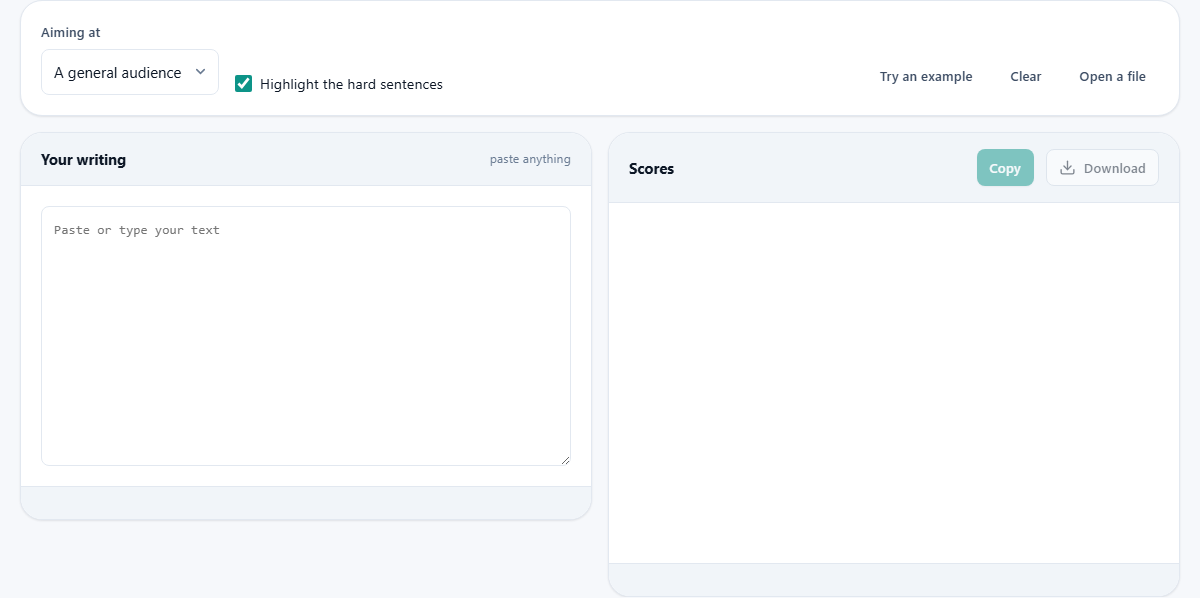
Drop your text into the left box. You can type, paste, or use Open a file to load a plain text file from your machine. A single paragraph gives a rough figure. A few hundred words gives a steady one.
There is a floor. Fewer than about ten words and the tool refuses to score, because a formula run on a handful of words returns noise rather than a reading. If you just want to see it work, the Try an example button loads a short passage that mixes an easy sentence with a deliberately heavy one.
The number to read first
The large figure at the top is the Flesch reading ease. It runs from zero to one hundred, and higher means easier. A short label sits under it to save you memorising the scale.
Sixty and above is plain English that most people read without effort. The seventies and eighties feel conversational. Drop into the fifties and it turns into work. Below thirty is heavy going for almost everyone, whatever the subject. If you read only one number, read this one.
The row of quick figures
Under the headline sits a small panel of counts. It shows an average grade level drawn from the school-grade formulas, the number of words, and the number of sentences.
Three more figures give the texture. Words per sentence is the single biggest driver of difficulty. The share of long words shows how much of the load is vocabulary. An estimated reading time, worked from a steady reading pace, tells you how long the piece asks of a reader. Together they explain why the headline landed where it did.
The table of scores
Below the counts is a table that names each score, gives its value, and says in a few words what it leans on. Flesch reading ease is the ease figure from the top. The Flesch-Kincaid grade turns the same counts into years of schooling.
The rest come at difficulty from other angles. Gunning Fog punishes long words hardest. SMOG was built for health information. The Automated Readability Index counts characters instead of syllables, and Coleman-Liau is also character based. Seeing several at once is the point: when they agree you can trust the reading, and when one strays you know to look closer.
Aiming at an audience
The Aiming at menu tells the tool who you are writing for. A general audience sets a target around grade eight. Web copy aims a little lower, an academic reader much higher, and children lower still. There is also a setting for no particular target.
Pick one and a coloured line appears under the counts. If your writing already sits at or below the target it says so. If it reads above the target, it tells you by how many grades, and reminds you that shortening the longest sentences will close most of the gap.
The hardest sentences
This is the part you can act on. A score tells you a problem exists; it does not tell you where. With the Highlight the hard sentences box left ticked, the tool ranks your sentences by difficulty and shows the worst offenders.
Each one is listed with its own grade and its word count, worst first. Almost always the list is topped by a long sentence, not a rare word. That is good news, because a long sentence is the easiest thing to fix: find its natural break and put a full stop there.
The list holds only a handful at a time, so you are never faced with a wall of them. Clear the sentence at the top, run the text again, and the next one to work on comes into view. A few rounds of that will lift a whole piece.
A short walkthrough
Paste two sentences. The first: We shipped the fix on Monday. The second: The comprehensive reorganisation of the underlying authentication system demanded extensive coordination across several engineering teams.
The headline ease drops low and the average grade climbs, because the second sentence is long and stacked with heavy words. The scores table agrees across the board. The hardest sentences panel lists that second sentence first, tagged with a high grade. Split it into two, swap a couple of the longest words, and rerun. The number lifts at once, and it lifted because the writing genuinely got easier.
What the scores cannot do
Every formula here works from sentence length and syllable count alone. None of them can read. That has two consequences worth holding on to.
A page of tidy nonsense can score beautifully, and a clear sentence about photosynthesis will always score badly, because the word is long. So use the number to find suspects, not to hand out marks. If a passage reads well to your ear but scores poorly, trust your ear and move on.
Common mistakes
The first is scoring a scrap. A single line swings wildly, so give the tool a real sample before you believe it. The second is chasing the number for its own sake, chopping every sentence until the writing reads like a telegram.
The third is expecting the scores to line up exactly. They were built from different samples for different ends, so a spread of a grade or two between them is normal, not a fault. And remember the syllable count is estimated, which adds a small wobble on short passages.
What the grades mean
The grade figures map onto years of schooling. A grade of nine means a fourteen year old should be able to follow the text. Push high enough and the label changes: a very high figure reads as university level, and higher still as postgraduate.
For the general public, grade eight is the usual aim. Most national newspapers sit between grades seven and ten. Plain-language guidance in several countries asks for grade eight or lower. Land your writing there and you are in good company.
Sentence length is the biggest lever
If you change one habit after seeing a score, make it sentence length. Every formula here punishes a long sentence harder than a long word, because length is what makes a reader lose the thread.
A good ceiling for anything meant to be read quickly is around twenty words. You do not have to count them. Find the sentence the tool flagged, look for the point where the thought turns, and put a full stop there. Splitting one long sentence usually moves the score more than changing a dozen words ever will.
How long a sample to give it
Length changes how far to trust the reading. Ten words is the floor, but a single sentence still swings from one extreme to the other as you tweak it. A paragraph steadies things. A few hundred words gives a figure that barely moves when you add a line.
So for a quick gut check, a paragraph is plenty. For a number you plan to quote or act on, feed it the whole piece. The more text it counts, the less any one odd sentence can tip the average.
Reading the report as a whole
Take the parts together rather than one at a time. The headline ease sets the mood. The grade figures translate it into schooling. The counts explain the cause, and the flagged sentences point at the cure.
A healthy pattern is a headline in the sixties, a grade near your target, and a short list of hard sentences you can clear in a few edits. When those line up, stop. Chasing a perfect score past that point tends to flatten the writing rather than help it.
When another tool fits
This tool measures difficulty; it does not rewrite, spell-check or judge whether an argument holds together. For grammar and spelling you want a proofreading tool. For the raw size of a piece, a word counter answers faster.
Reach for this one when the question is whether your reader can keep up. Take the flagged sentences, do the edit yourself, and let the score confirm the change worked.
Counted on your own device
Your draft is measured right here in the page, by a handful of formulas built into it, on the device in front of you. The words are never transmitted to a server.
That keeps an unpublished article, a private essay or a confidential memo where it belongs. When you are happy with the result, the Copy button places the scores on your clipboard so you can paste them into a note or a review.