
Letters, Tallies and Lucky Shuffles
The help block above covers the basics, so this article goes further. It explains how the checker reaches its verdict, what the arrangement total really means, and why the word finder behaves the way it does. There is a full session with a real phrase, a list of slips that produce wrong answers, and a plain account of the jobs better handled elsewhere.
Who opens this page, and why
Three kinds of people land here. The first has a puzzle in front of them: a crossword clue that smells like a rearrangement, a riddle from an escape room, a quiz question with scrambled letters. The second is checking a claim. Someone insists two names share the same letters, and they want proof rather than squinting at both for ten minutes.
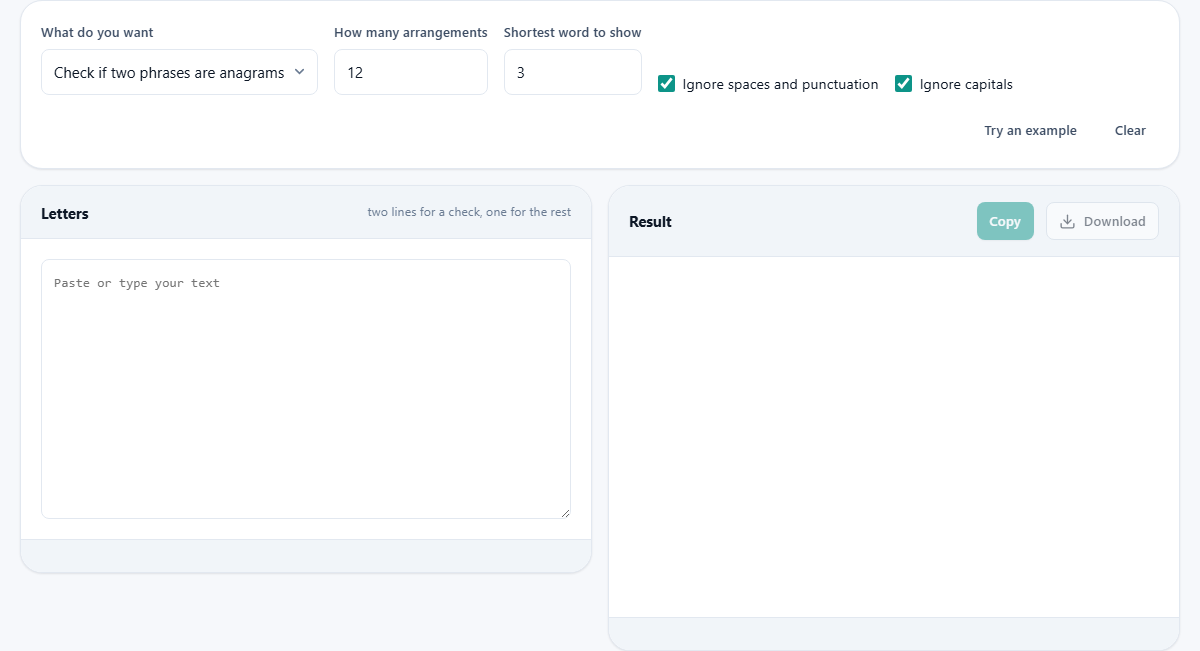
The third is playing with a name. A boat, a small business, a character in a novel, a team at work. Shuffled letters have a long history in naming, and a random deal can hand you an idea you would never reach on purpose. All three visitors use the same input box. The dropdown labelled What do you want decides which job runs, so the first move is always to make sure that setting matches your intent. The result panel changes shape with it.
How the check reaches its verdict
Type one phrase on the first line and the other on the second. The tool strips whatever you have asked it to ignore, sorts the remaining letters of each line, and compares the two sorted runs. If they match exactly, the pair is genuine: every letter used once, nothing spare, nothing missing.
This is the same trick you might do with pencil and paper, minus the slips. Order never matters to the verdict. Only the stock of letters does. That is worth holding onto, because it means the check cannot tell a clever rearrangement from a dull one. It rules on the letters and leaves taste to you.
The tally that explains a failure
A bare no would be unhelpful, so when the two lines disagree, the result lists the letters left over on each side. One side might show a spare e while the other shows a spare a. At a glance you know whether the claim was close or nowhere near.
The tally doubles as a proofreading aid. Very often the two phrases really do match, and the leftovers are pointing at a typo: a doubled letter, a missing one, a stray plural s. Correct the typo and the verdict flips to yes. Checking by eye, one extra letter in a long phrase can hide for a long time. In the tally it has nowhere to hide.
Shuffling, and the huge number behind it
Pick the rearrange option and the tool deals out random orderings of your letters. The box labelled How many arrangements sets the size of each deal, from 1 to 60, starting at 12. The stats row also reports how many orderings exist in total, and that figure is the surprise. Eight distinct letters can be ordered in over forty thousand ways. Twelve letters push the total into the hundreds of millions.
So a deal of a dozen samples a tiny corner of a huge space. Most deals are noise. Now and then a few letters fall together into a real word, and that fragment is the prize: keep it, and think about what the remaining letters could spell around it. Each press of the button produces a completely fresh set, so dealing again costs nothing.
What the word finder can and cannot find
The third mode digs through your letters for common English words. The box labelled Shortest word to show hides anything below the length you choose, from 2 up to 12. It starts at 3, because two-letter finds are rarely worth reading.
The list it searches is deliberately compact. A complete dictionary is a heavy file, and this site sends nothing to a server, so the finder ships with everyday vocabulary only. Expect it to spot plain words and to miss rare ones, and treat the output as raw material. A practical rhythm: find one strong word, set those letters aside mentally, then rerun your thinking on what remains until the whole stock is spent.
The two tick boxes, and one quiet rule
Ignore spaces and punctuation is on by default and should usually stay on. Classic rearrangements work across the whole phrase, so spaces, hyphens and apostrophes are free to move or vanish. Untick it only when you need a strict character-for-character comparison, which is a data-checking job more than a word game.
Ignore capitals is also on by default, so Elvis and lives agree. Untick it and case must match exactly. Underneath both sits one quiet rule: an accented letter counts as its own letter, not as the plain one. A name typed with an accent will never match the same name typed without it. When a pair fails and you cannot see why, look for an accent before anything else.
A session from start to finish
Suppose you have heard that the classroom and school master are built from the same letters, and you want to verify it. Leave the mode on the checking option. Type the classroom on line one and school master on line two, with both boxes ticked. The verdict comes back positive: twelve letters on each side, in perfect agreement.
Curious, you switch the mode to the word hunt, delete the second line, and raise the shortest word to 4. Out come finds such as charm, roams and school, all built from that same stock. Then you try the rearrange mode with the count set to 20. Most of the twenty deals are gibberish, one contains a promising fragment, and none beats the original pairing. That is a typical five minutes here: one proof, a handful of finds, and a reminder that great rearrangements are rare enough to be worth collecting.
A second run: hunting for a business name
The naming job works differently from the puzzle job, so here it is with its own numbers. Two friends are opening a small bakery and want a name hidden inside the words morning harvest. Start in the word hunt mode with Shortest word to show raised to 5, because a bakery sign wants something with a bit of weight to it. The list that comes back is short and useful, and anything under five letters never clutters the screen.
Then switch to the rearrange mode and set How many arrangements to 30. Deal once, skim, deal again. You are not reading for finished names; you are watching for two or three letters that fall together well, a soft opening sound, a pleasing ending. Note those fragments on paper as they appear. After four or five deals you will have a small pile of raw syllables, and the name usually comes from combining a fragment with a word the finder already gave you rather than from any single deal.
The three small buttons
Around the boxes sit three buttons that are easy to overlook. Try an example loads a ready made sample into the input, which is the quickest way to see the layout each mode expects, especially the two line arrangement the checker needs. Clear empties the input and the result together, ready for the next attempt.
Over in the result panel, Copy stays greyed out until there is something worth copying, then places the whole result on your clipboard in one press. That is how a deal of thirty arrangements becomes a list in your notes app, where you can strike out the hopeless ones and keep the two that survive.
Slips that lead to wrong answers
Most bad results trace back to one of a few habits, all cheap to fix.
- Both phrases typed on one line. The check needs one phrase per line; run together, they read as a single phrase and there is nothing to compare.
- Testing a two-word classic with the spaces box unticked. The space itself then counts as a character, and the comparison fails for a reason that has nothing to do with letters.
- Expecting the finder to know proper names. The built-in list holds common vocabulary, so a place or person will not be found even when its letters are all present.
- Reading an empty result as a fault. Short inputs with few vowels often contain no common words at the length you set. Lower the shortest-word number before deciding something is broken.
When to reach for something else
Be clear about the edges. This page will not solve a crossword pattern with fixed blanks, because that is a matter of matching a shape against a dictionary rather than reordering a stock of letters. It does not score tiles for board games, and it will not compose a witty result for you; the shuffle deals blind, and wit remains your department.
If your puzzle turns on an obscure word, pair this page with a full dictionary: let the dictionary confirm the word exists, and let this page do the letter arithmetic that proves it fits.
Private by construction
Everything described above happens inside your own browser tab. The letters are processed by the page's script on your device, and no copy travels anywhere, because no server takes part in the work at any step. Close the tab and the text is gone.
That matters more than it might seem. People test names here, and names are personal: a child, a company that does not exist yet, a pen name. The mechanics make discretion automatic rather than promised, which is the better kind of promise.