
Three birthday traditions and what they actually say
How the western zodiac, the Chinese zodiac and the birthstone tradition each work, why January birthdays cause confusion in the Chinese system, and what the tool shows for any date of birth.
Three systems from three places
This tool brings together three different traditions that assign meaning to a birthday. The western zodiac splits the year into twelve signs by date. The Chinese zodiac assigns an animal and an element to each year. Birthstones and birth flowers attach a gem and a plant to each calendar month. They come from different cultures, different centuries and different parts of the world. The only thing they share is the birthday as their starting point.
None of them predict anything. They are cultural traditions with long histories, and the tool presents them accurately without claiming they say something about who you are. Think of it as a reference card for the traditions rather than a personality test.
The western zodiac
Twelve signs run through the year, each covering roughly a month. Aries begins around 21 March and Pisces ends around 20 March the following year. The boundaries fall between the 19th and the 23rd of each month, depending on the sign.
Each sign belongs to one of four elements: fire, earth, air or water. Each has a ruling planet from the old set that predates the discovery of Uranus and Neptune. The tool shows both alongside the sign.
The cusp - the idea that someone born on the boundary between two signs shares traits of both - is a modern invention. Traditional astrology assigns one sign based on the exact position of the sun, and the date alone is not always enough to settle it when the birthday falls right on the border. The tool uses the standard date ranges and does not attempt to split borderline dates.
The Chinese zodiac
Twelve animals run on a twelve-year cycle: Rat, Ox, Tiger, Rabbit, Dragon, Snake, Horse, Goat, Monkey, Rooster, Dog and Pig. Each year belongs to one animal.
Layered on top of that is a five-element cycle: Wood, Fire, Earth, Metal and Water. Each element governs two consecutive years, so the full combination of animal and element repeats every sixty years. A Fire Horse and a Water Horse are different years, separated by a decade.
The catch is the start date. The Chinese year does not begin on 1 January. It begins at Chinese New Year, the second new moon after the winter solstice, which falls anywhere from 21 January to 20 February. Anyone born in January or early February may belong to the previous year's animal. The tool uses the actual Chinese New Year dates for years from 1996 to 2030, so it gets the boundary right rather than guessing.
Why January birthdays cause confusion
Suppose you were born on 28 January 2006. The western calendar says 2006, which is the Year of the Dog. But Chinese New Year in 2006 fell on 29 January. Your birthday is one day before the new year, so you belong to the Year of the Rooster, which is the animal for the ending year, 2005.
This is the single most common mistake. Websites that simply divide the year number by twelve and pick an animal get it wrong for everyone born in January and the first three weeks of February. The error is small on paper but it means the wrong animal entirely.
The tool avoids this by storing the actual Chinese New Year date for each year in its range. If your birthday falls before that date, it assigns the previous year's animal and element.
Birthstones and birth flowers
The birthstone list shown is the modern one, agreed in 1912 by the American National Association of Jewelers and still used by most shops today. January is garnet. February is amethyst. March is aquamarine, and so on through the year.
Older lists disagree. The traditional list swaps several stones, and ancient regional lists differ even more. June, for example, has been pearl, alexandrite and moonstone at different times and places. The tool uses the 1912 list because it is the most widely recognised, but it is worth knowing that other answers exist.
Birth flowers follow a similar pattern. Each month has one or two flowers linked to it by tradition. January has carnation and snowdrop. December has narcissus and holly. These assignments are less standardised than birthstones, but the common list is well established in greeting card and florist culture.
Using the tool
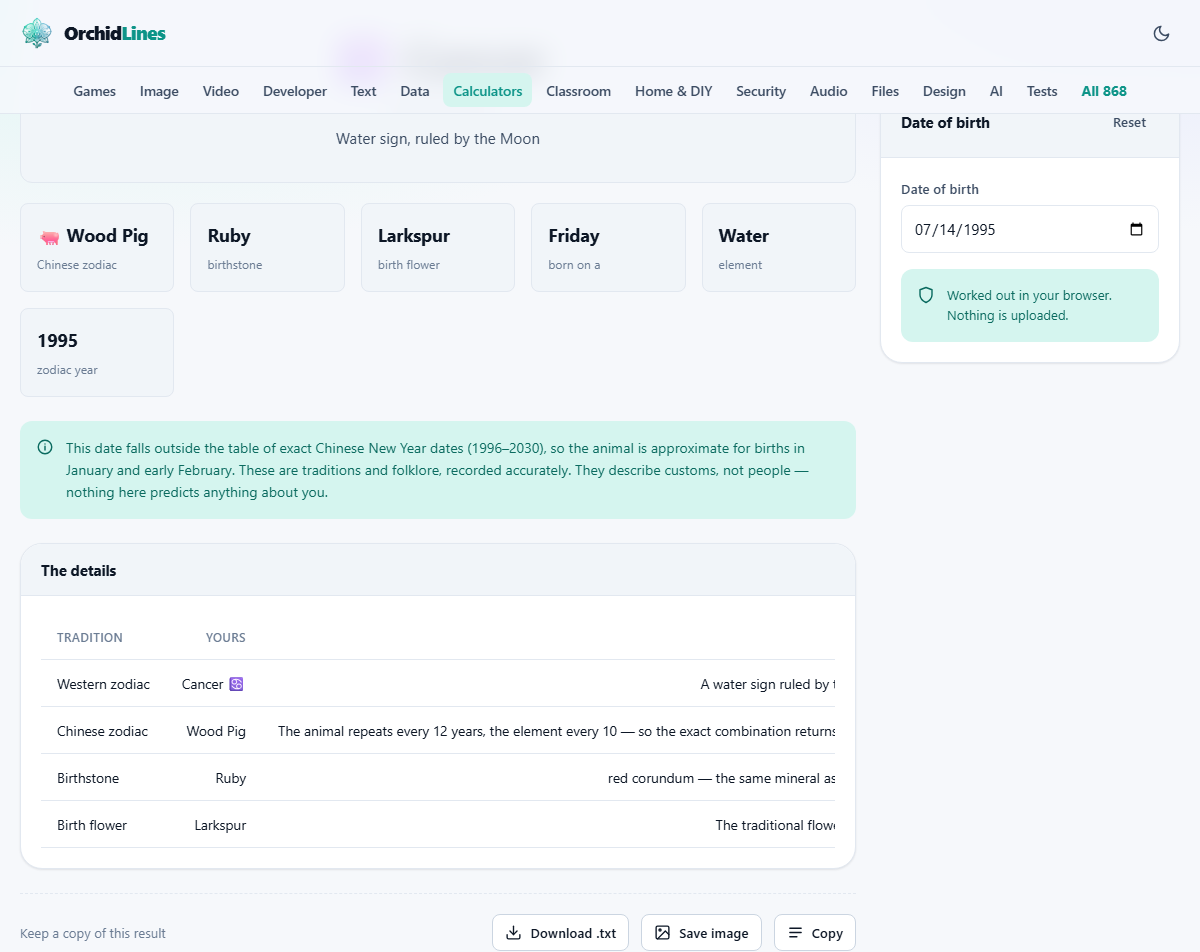
There is one input: Date of birth. Pick the date from the calendar control and everything appears at once. The western sign with its element and ruling planet. The Chinese animal with its element. The birthstone and the birth flower for the month.
There is no submit button to press. The result updates as soon as the date is set. Change the date and the result changes with it. This makes it easy to look up several birthdays in a row without clearing anything.
The Reset button on the panel header returns the date field to its blank starting state.
The sixty-year Chinese cycle explained
Most people know the twelve animals but stop there. The full Chinese system is sixty years long, not twelve, because each animal pairs with one of five elements in sequence.
The five elements - Wood, Fire, Earth, Metal and Water - each rule for two years in a row. Wood covers the first two years, Fire the next two, and so on. After ten years the element cycle starts over, but the animal cycle still has two more animals to go. The two cycles only line up again after sixty years, which the Chinese call a jiazi.
That means there are sixty distinct combinations. A Wood Rat and a Water Rat are completely different years, separated by fifty years. The element adds a layer of distinction that the animal alone does not carry. The tool shows both the animal and the element for whatever year you look up.
This is also why someone born in the Year of the Dragon in 2000 and someone born in the Year of the Dragon in 2012 carry different element labels. The first is a Metal Dragon and the second is a Water Dragon.
Practical uses for the information
Birthday cards and gifts. Knowing someone's birthstone settles the question of what gem to put on a pendant or a ring. Knowing their birth flower narrows the bouquet. Neither choice requires believing in the tradition; it is simply a way to make the gift feel specific to that person.
Party themes and conversation starters. Telling a table of guests their Chinese zodiac animals is a reliable icebreaker. The sixty-year cycle means that two people born twelve years apart share an animal but not an element, which gives the conversation a second beat.
Creative projects. Writers, game designers and illustrators who assign zodiac traits to characters need the lookup to be accurate even if the traits are fiction. Getting the dates wrong breaks the internal consistency that readers notice.
What this does not do
It does not draw a natal chart. A natal chart uses the exact time and location of birth to plot where every planet sat in the sky at that moment. That is a far more complex calculation and a different kind of tool entirely.
It does not make predictions. Horoscopes are interpretive writing based on the zodiac, and this is not a horoscope. It is a lookup table for three traditions, presented as fact about the traditions themselves rather than as fact about the person.
It does not cover every zodiac system in the world. The Hindu zodiac, the Celtic tree calendar and various indigenous calendar systems all assign meanings to birth dates in different ways. Adding them would mean adding their full rule sets, which is a much larger project than a birthday lookup.
Common mistakes
- Assuming your Chinese animal is set by the calendar year. If you were born in January or early February, check the actual Chinese New Year date for your birth year.
- Thinking the cusp means you are two signs at once. Traditional astrology assigns one sign. The tool picks one based on the standard date ranges.
- Quoting a birthstone from a list that does not match your region. The modern 1912 list is the default in most English-speaking countries, but other lists circulate and they disagree on several months.
- Looking up someone else's birthday with the wrong year. The western sign depends only on the month and day, but the Chinese animal depends on the year, and the element depends on it too.
- Treating any of this as a personality guide. The tool records traditions. It does not endorse them as descriptions of character or destiny.
Nothing about you leaves your browser
The date you enter stays on your device. The lookup happens entirely in your browser using data that is already loaded with the page. No birthday is sent anywhere, no account is created, and no record is kept. Close the tab and there is no trace of the date you typed in.