
Understanding your loan repayments before you sign
Borrowing money costs money, and the total cost hides in the schedule. This article walks through how a repayment loan works, what the numbers on the calculator actually mean, and why a small change in your monthly payment can knock years off the term.
How a repayment loan actually works
When you borrow to buy a house, a car, or anything else on a fixed repayment plan, you agree to pay the same amount every month for the life of the loan. That fixed sum covers two things at once: the interest the lender charges that month, and a slice of the debt itself. At the start, interest takes the bigger share. By the end, almost all of each payment goes toward clearing the balance.
This arrangement is called amortisation. The word sounds technical, but the idea is simple. You owe a large amount on day one, so the interest bill is large. As the balance shrinks, the interest bill shrinks with it, and the portion of your payment that reduces the debt grows. Over a long enough term the total interest can rival or even exceed the sum you borrowed in the first place.
What the calculator asks for
The panel on the right collects the details of your loan in a handful of fields. Amount borrowed is the principal, the figure on the contract before any charges. Interest rate a year is the annual rate the lender quotes; the tool converts it to a monthly rate behind the scenes. Years and Extra months together set the full term, so a loan of five and a half years would be five in one field and six in the other.
Below those sits the Extra paid each month field, which is where the calculator becomes genuinely useful rather than just confirming a number you already know. Further down, One-off fees lets you add arrangement or processing charges to the true cost. And a Currency selector at the top formats the figures in the right symbol for your country.
Reading the results
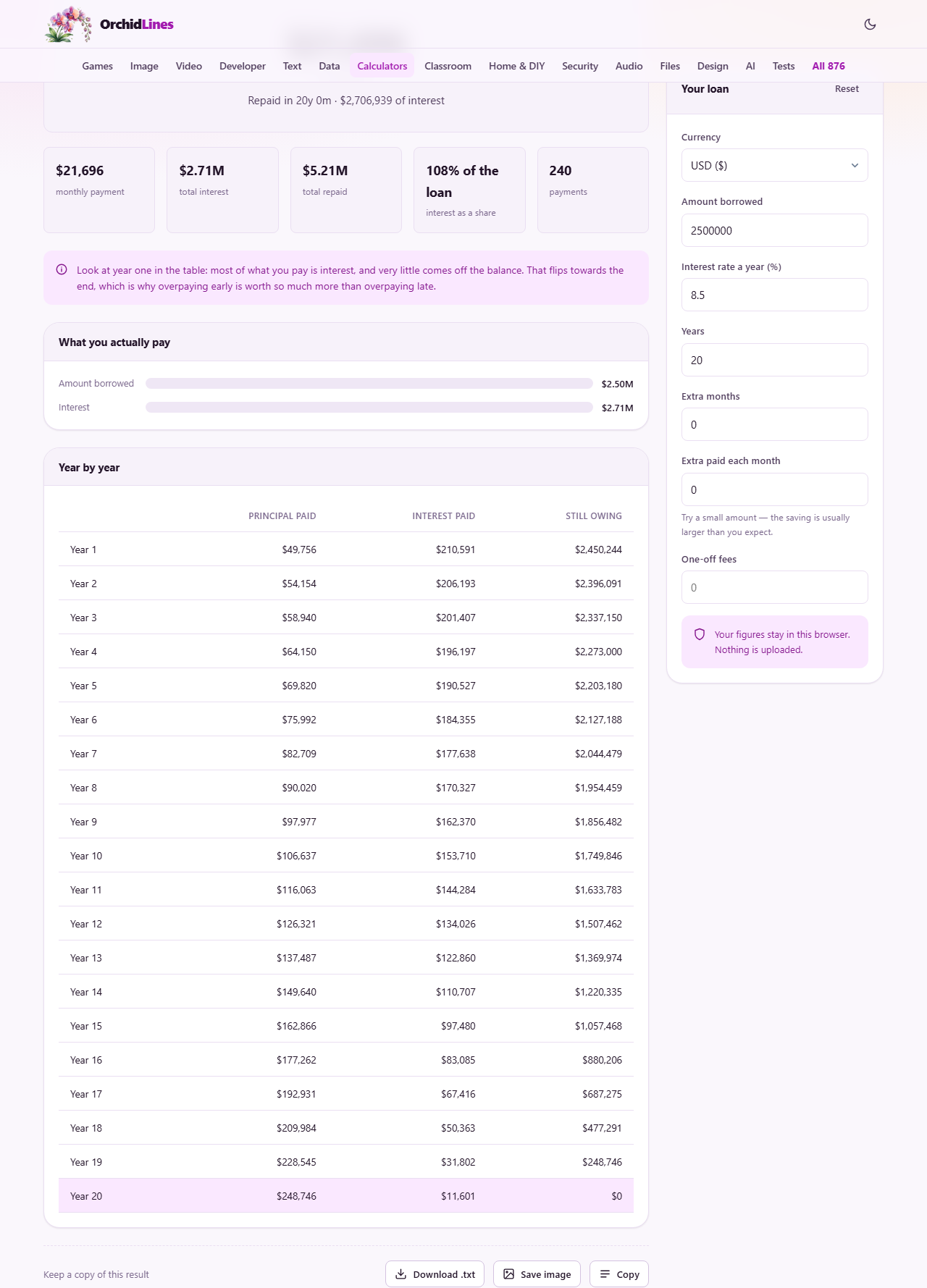
Once you fill in the fields, three figures appear right away. The first is your monthly payment, which is the fixed sum due every month for the life of the loan. The second is the total interest across the whole term, and the third shows that interest as a proportion of what you borrowed. That proportion is the number most people have never seen, and it tends to surprise them.
A twenty-year loan at a modest rate can easily cost you half the borrowed amount again in interest alone. Seeing that single percentage puts the real price of time in front of you. It is the reason that shortening the term by even a year or two, or paying a little extra each month, has such a large effect on the final bill. If you borrow two hundred thousand at five per cent over twenty-five years, the total interest is roughly a hundred and fifty thousand. That is a second house you never get to live in, paid for entirely in time.
The year-by-year schedule
Below the headline figures, the tool lays out a full amortisation table. Each row represents one year and shows how much of that year's payments went to interest, how much reduced the balance, and what you still owe at the end. Compare the first row with the last. In the first year of a typical mortgage, roughly eighty per cent of everything you pay is interest. In the final year, the split is almost entirely the other way around.
That contrast is not a flaw in the system; it is the system. It also explains a complaint that many borrowers voice in the early years: they feel like they are not getting anywhere. They are not imagining it. The balance barely moves at first because most of their money is covering the cost of what they still owe. Looking at the schedule year by year removes that frustration, because you can see exactly when the curve tips and the balance starts falling faster.
Why overpaying early matters so much
Type a modest number into the Extra paid each month field and watch what happens. The term drops, and the total interest drops with it. Now try the same extra amount but imagine you started overpaying five years in. The saving would be noticeably smaller, and the reason is straightforward.
Every extra pound or dollar you pay at the start removes principal that would otherwise have been charged interest for the entire remaining term. Pay an extra hundred in month three, and you avoid interest on that hundred for the next nineteen years and nine months. Pay the same extra hundred in year eighteen, and you only avoid two years of interest on it. The leverage is wildly different. This is why financial advisers talk about overpaying early rather than late, and it is why rounding your payment up to the next convenient figure, say from 847 to 900, often trims more off the term than people expect. The amortisation table makes this visible: look at the interest column in year one and then in year fifteen, and you will see exactly where your early overpayment would have gone if you had not redirected it.
Comparing rate against term
Most people shop for the lowest rate and give less thought to the length of the loan. But a lower rate stretched over a longer term can cost more in total than a slightly higher rate over a shorter one. The calculator makes this comparison easy. Run the same amount at two different rates and two different terms, note down the total interest for each, and compare.
A common example: a car loan at four per cent over five years versus three and a half per cent over seven. The monthly payment on the seven-year deal is lower, which is why the dealer offers it, but the total interest is higher because the balance sits there earning interest for two extra years. Seeing both scenarios side by side, with real numbers from your own situation, takes the guesswork out of the decision.
Things the calculator does not cover
The One-off fees field handles arrangement charges, processing fees, and anything else you pay once at the start. It does not model ongoing costs like mortgage insurance, buildings cover, or payment protection, because those vary by provider and change over the term. Add them separately when you compare deals.
The tool also assumes a fixed interest rate. If your rate is variable or moves after an introductory period, the figures here describe only the fixed portion. You would need to run a second calculation at the expected higher rate to see what the payment becomes once the deal ends. And it does not account for tax relief, offset savings, or any scheme that changes the effective rate. Those are worth knowing about, but they belong in a conversation with the lender, not in a general-purpose calculator.
Practical habits that save money
Before you sign anything, there are a few things worth doing with this tool. First, run the loan at the offered rate and term to see the headline numbers. Then add a small overpayment and note the difference. Even twenty or thirty pounds a month makes a visible dent on a long mortgage. Next, try shortening the term by a year and see whether the higher monthly payment is something you could manage. The total interest saved by a shorter term is usually larger than the saving from chasing a slightly lower rate.
Finally, check the early repayment terms in the contract. Some lenders penalise overpaying above a threshold, which could wipe out the benefit the calculator shows. If overpaying is allowed without penalty, this tool gives you a clear picture of exactly how much it saves.
Privacy and how the tool runs
Everything runs on your own device. The numbers you type stay in your browser and are never sent to a server. There is no account, no login, and no record kept anywhere outside the page. That means you can test sensitive loan figures, compare offers, and explore worst-case scenarios without anyone else seeing what you entered. When you close or refresh the page, the numbers are gone. For a decision as large as a mortgage, having a private space to run the arithmetic without pressure from a salesperson is worth more than it sounds.