
Turning a humidity reading into something useful
What dew point, heat index and wind chill actually measure, why relative humidity misleads people, how to fill in every field, and a full worked example with two seasons.
The problem with relative humidity
Relative humidity sounds like it should tell you how damp the air is. It does not. It tells you how full the air is compared to how much water it could hold at the current temperature, and that capacity changes with temperature. Warm air holds far more water than cold air.
So 80 per cent humidity on a winter morning at 5 degrees Celsius means the air is carrying about 4 grams of water per cubic metre. The same 80 per cent on a summer afternoon at 35 degrees means about 32 grams. The winter air is nearly full but still quite dry in absolute terms. The summer air is carrying eight times more water, and that is what you feel on your skin.
Dew point cuts through this. It is the temperature at which the air would have to cool before it starts dropping its water as dew. A dew point of 20 degrees means the same thing whether the air temperature is 25 or 40. That is why forecasters prefer it, and that is the number this tool gives you first.
Who needs these numbers
Pilots checking whether fog will form at an airfield. Builders deciding if a concrete pour will cure properly. Homeowners trying to work out why their windows are wet on the inside. Photographers protecting lenses from condensation. Farmers watching frost risk. Anyone running outside who needs to know whether sweat will actually cool them down.
- HVAC engineers setting indoor conditions that prevent mould.
- Greenhouse growers balancing humidity against plant disease.
- Athletes deciding whether a workout is safe in high heat.
- Brewers and bakers whose processes depend on precise moisture levels.
- Anyone planning outdoor paint, varnish or glue work where dew ruins the finish.
Every input on the panel
Air temperature is the starting point. Type it and pick the unit from the dropdown to the right: Celsius, Fahrenheit or Kelvin.
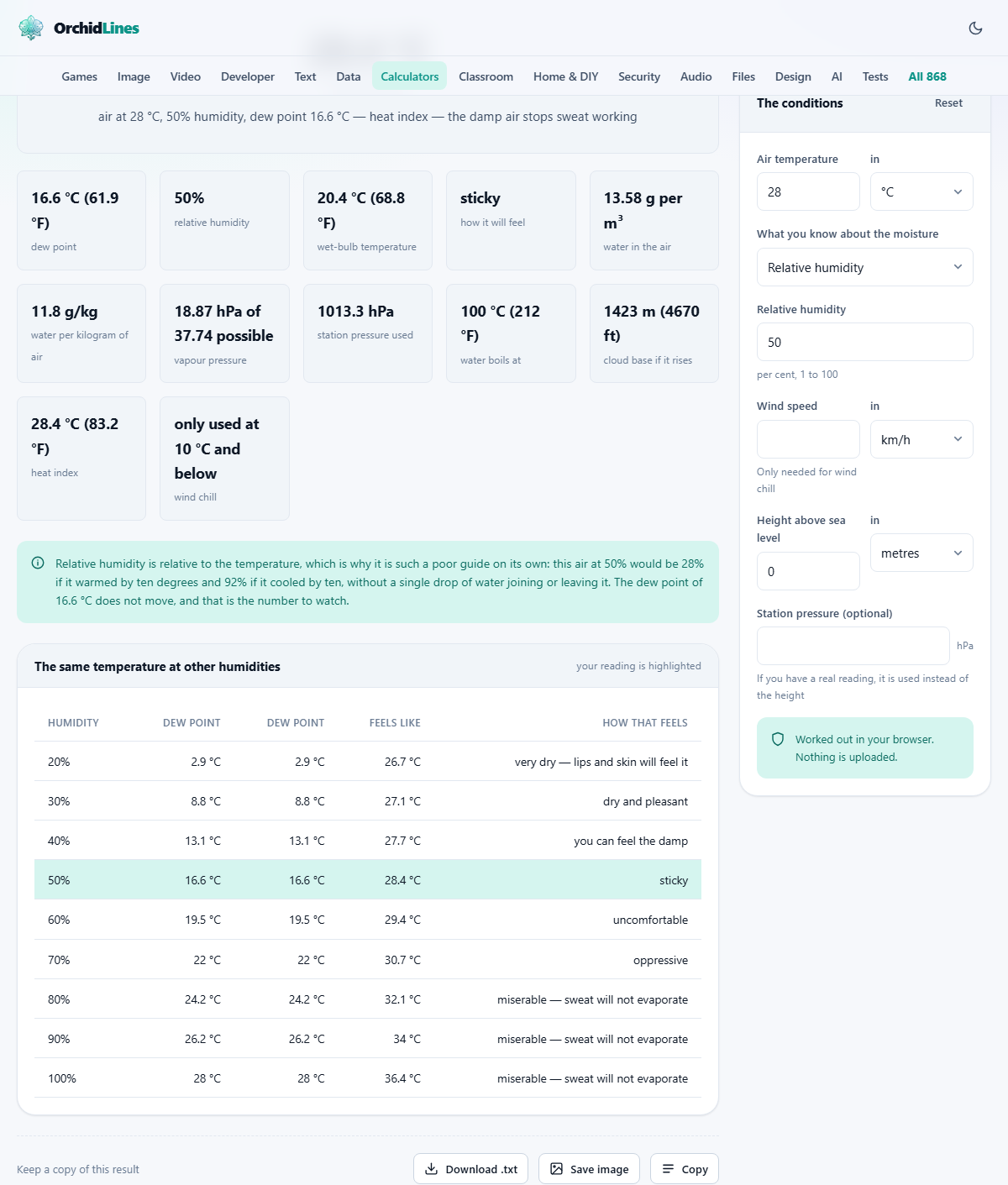
What you know about the moisture lets you choose your starting fact. Pick Relative humidity and type the percentage. Pick Dew point and type that temperature instead. Pick Wet-bulb temperature if you have one. The tool works out the other two from whichever you provide. You do not need all three.
Wind speed only matters for wind chill, and wind chill only applies at 10 degrees Celsius and below with a real breeze. Outside those conditions the tool leaves it out rather than showing a meaningless number. Pick the unit from km/h, mph, m/s or knots.
Height above sea level sets the air pressure that the wet-bulb and boiling-point calculations need. Type your altitude in metres or feet. If you happen to have a real pressure reading from a weather station, type it into Station pressure in hPa and that figure is used instead of the altitude estimate.
What comes back
The result panel shows several things at once. Dew point in both Celsius and Fahrenheit. Relative humidity as a percentage. Wet-bulb temperature. A feels-like figure that uses the heat index in warm conditions and wind chill in cold conditions. The amount of water the air is carrying in grams per cubic metre. And the temperature at which water boils at your altitude.
Each figure has a purpose. The dew point tells you the condensation threshold. The wet-bulb temperature tells you whether sweating can still cool a person. The feels-like figure tells you what your body will experience. The boiling point is there because it changes with altitude and matters to anyone cooking or brewing at height.
A summer worked example
It is a July afternoon. You type 34 into Air temperature, pick Celsius, leave Relative humidity selected, and type 65. Wind speed is blank. Height above sea level is 0.
The dew point comes back at about 26.6 degrees. That is well above 20, which is the threshold most people find oppressive. The heat index - the feels-like figure for warm weather - shows roughly 44. That is the temperature your body acts as though it is experiencing, because the high humidity stops sweat from evaporating.
The wet-bulb temperature is around 29. Above 35 degrees wet-bulb, the human body cannot cool itself at all even in the shade. At 29 it is working hard but still managing, provided you are not exercising.
This is the kind of day where a weather report saying 65 per cent humidity sounds moderate. The dew point of 26.6 and the heat index of 44 tell the real story.
A winter worked example
It is a January morning. Air temperature is minus 2 Celsius. Relative humidity is 85 per cent. Wind speed is 25 km/h. Height above sea level is 150 metres.
The dew point is about minus 4.2. That is below freezing, so any moisture that condenses will form frost rather than dew. The wind chill comes back at about minus 9 - that is what exposed skin feels. Frostbite risk starts at minus 10 wind chill for prolonged time outside.
Notice that 85 per cent humidity sounds very damp, but the air at minus 2 holds barely any water. The dew point confirms this. Indoors, heated air from that same supply can drop to 20 or 25 per cent relative humidity, which is why winter air feels so dry in heated rooms.
Why windows get wet on the inside
Condensation on a window has nothing to do with how humid the room feels. It happens because the glass is colder than the dew point of the air in the room. A room at 21 degrees with a dew point of 14 will fog any surface below 14 degrees. Single-glazed windows in winter are often below that.
Turning the heating up can make it worse if the extra heat puts more moisture into the air - a gas heater and a room full of drying laundry will raise the dew point faster than they raise the glass temperature. The real fix is either to warm the glass (double glazing) or to lower the dew point (ventilation or a dehumidifier).
Boiling point and altitude
Water boils when the vapour pressure inside it matches the air pressure pushing down on it. At sea level that happens at 100 degrees Celsius. Climb to 2,000 metres and the air pressure drops enough that water boils at about 93 degrees. At 3,000 metres it is around 90.
The water is boiling perfectly well. It is simply not as hot, which matters for cooking. An egg takes longer to hard-boil. Pasta stays al dente for longer. Pressure cookers exist precisely because they raise the pressure back up and let the water get hotter. The tool shows the boiling point at your altitude, or at the station pressure you typed in, so you know what temperature your kettle is actually reaching.
This also matters for brewing coffee and tea. Guides that say to use water at 96 degrees assume you are near sea level. At 1,500 metres your kettle tops out below that without any effort on your part.
When another tool fits better
If you want to convert temperature units without any humidity calculation, a plain temperature converter is faster. If you need wind speed conversions between knots, metres per second and kilometres per hour, a unit converter handles that on its own. For tracking daily weather trends over time, you need a log or a spreadsheet, not a single-reading calculator.
This page turns one set of readings into all the derived figures at once. It is useful when you have a thermometer and a hygrometer and want to know what the numbers actually mean for your body, your building or your plans.
Common mistakes
- Reading 40 per cent humidity in summer and thinking the air is dry. At 35 degrees that still means a dew point around 20 and a heat index above 40.
- Quoting wind chill on a warm day. It has no meaning above about 10 degrees Celsius, which is why the tool leaves it blank.
- Assuming heat index applies in cold weather. It only means something above roughly 27 degrees. Below that, the formula produces numbers that look dramatic and mean nothing.
- Ignoring the wet-bulb figure when exercising. It is the single best number for deciding whether outdoor effort is safe. Above 32 degrees wet-bulb, even fit people are at serious risk.
- Comparing humidity percentages between seasons. Eighty per cent in January and eighty per cent in July describe completely different amounts of water in the air.
All the arithmetic happens on your machine
This does not look up a weather forecast. It does not fetch your location. You type the readings you already have and the sums are done inside your browser. No data leaves your device. You can disconnect from the internet and it still works, because there was never a server involved in the calculation.