
How much water your body actually needs in a day
Why the eight glasses rule was never real advice, what actually drives your fluid needs, how to use every input on the page, and a step-by-step example with real numbers.
Where the eight glasses myth came from
In 1945 a US nutrition board suggested that adults need about 2.5 litres of fluid a day. In the same paragraph it said that most of that comes from food. The second sentence got lost and the first became a rule. Eight glasses of 250 millilitres is two litres, close enough to that old number to feel official.
The problem is that it treats everyone the same. A 50 kilogram woman working at a desk needs far less than a 95 kilogram man doing construction in the heat. Body size is the biggest driver, exercise is the second, and climate is the third. This tool uses all three instead of a flat number.
Who benefits from a proper target
Anyone who suspects they drink too little or too much. Both directions cause trouble. Too little leads to headaches, poor focus and sluggish digestion. Too much in a short time can dilute the salts in your blood, a condition called hyponatremia that hits endurance athletes more than anyone.
- People starting a diet who want to separate hunger from thirst.
- Runners and gym-goers who lose fluid through sweat and need to replace it.
- Pregnant or breastfeeding women whose bodies demand more fluid than usual.
- Office workers in air-conditioned rooms who forget to drink because they never feel hot.
- Anyone moving to a warmer climate or a higher altitude and noticing drier skin and darker urine.
Walking through every control
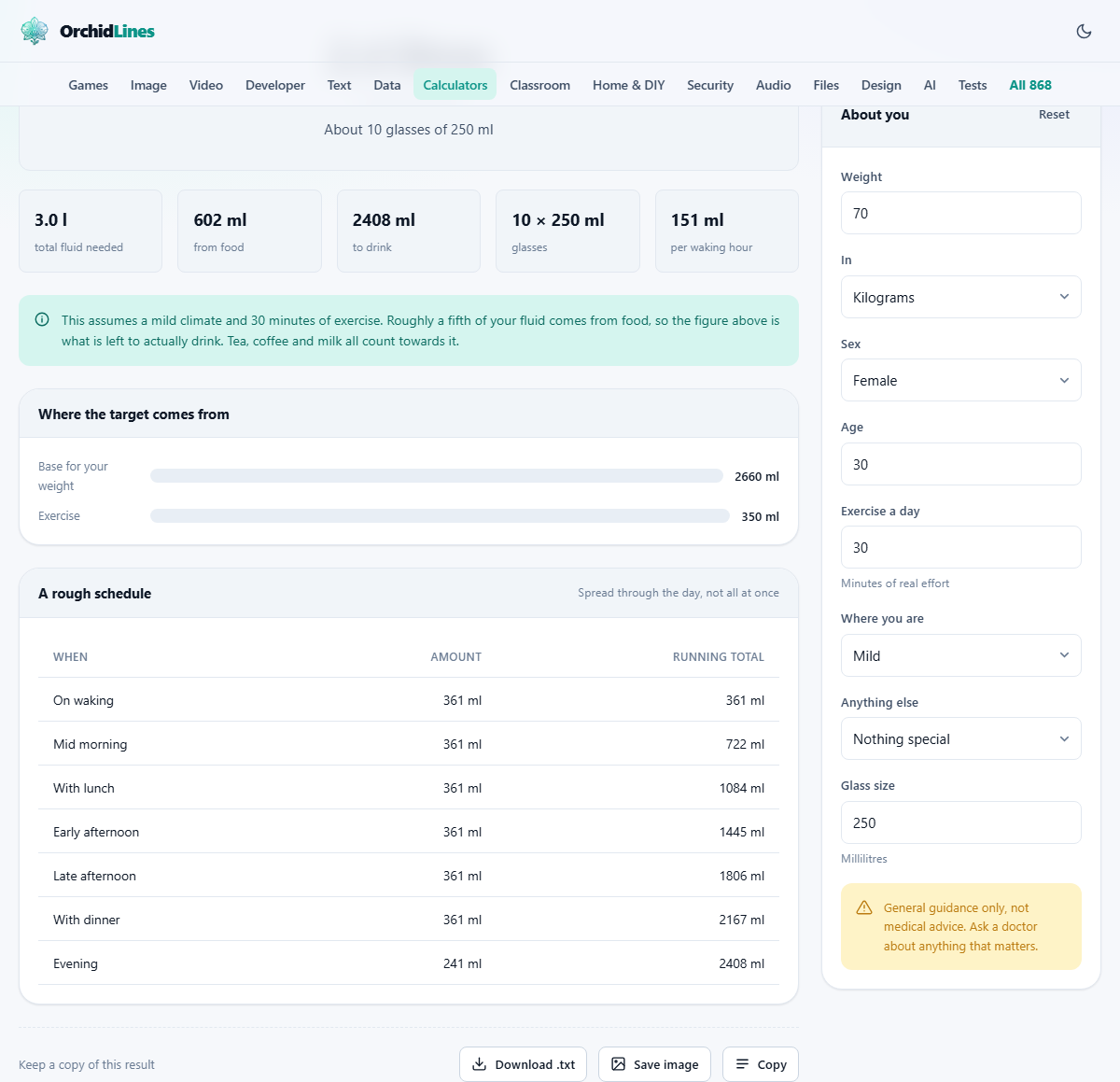
Weight is the foundation. The baseline calculation uses roughly 30 to 35 millilitres per kilogram. Type your weight and pick Kilograms or Pounds from the In dropdown.
Sex matters because muscle holds more water than fat. Males carry a higher water fraction on average, so the calculation adjusts slightly upward.
Age shifts the target for young children and older adults, whose bodies handle water a little differently.
Exercise a day is the minutes you spend actually sweating. A slow walk does not count. A run, a gym session, or hard physical work does. The tool adds roughly 350 millilitres for every half hour of real effort.
Where you are sets the climate. Mild is the baseline. Warm and Hot and humid both increase the total because you lose more through sweat and breathing. Cold raises it too, which catches people off guard - dry winter air pulls moisture out of your lungs with every breath. High altitude does the same, because the thinner air is also drier.
Anything else covers pregnancy and breastfeeding. If neither applies, leave it on Nothing special.
Glass size is the last field. Set it to the actual millilitres your usual glass or bottle holds, and the tool converts the daily target into a count of those containers. The default is 250 millilitres, which is a standard drinking glass.
A worked example
A 70 kilogram woman, age 30, runs for 30 minutes a day in mild weather. She is not pregnant. Her glass is 300 millilitres.
She types 70 into Weight, picks Kilograms, selects Female, sets Age to 30, puts 30 in Exercise a day, leaves Where you are on Mild and Anything else on Nothing special, and enters 300 for Glass size.
The tool returns a daily target of roughly 2.6 litres. It shows how much of that typically comes from food - about 20 per cent - leaving around 2.1 litres to actually drink. At 300 millilitres a glass, that is about seven glasses spread through the day.
She then changes Where you are to Hot and humid. The figure jumps to about 3.3 litres. The extra litre reflects the sweat she loses in the heat on top of the exercise. Moving the exercise slider to 60 minutes adds more still.
What counts towards the total
Water is the obvious one, but it is not the only thing. Tea, coffee, milk, juice and soup all count. The old claim that coffee dehydrates you is wrong. The mild diuretic effect is far smaller than the water in the cup, so every cup of coffee adds to your fluid total rather than taking away from it.
Food provides roughly a fifth of daily intake for most people. Fruit, vegetables, yoghurt and soup contribute the most. Someone eating a lot of watermelon, cucumber and broth gets more from food than someone eating mostly bread and crackers.
The figure on screen is total fluid need. The part you actually have to pour into a glass is smaller once you subtract the food contribution, and the tool shows that split.
Why climate changes the answer so much
In mild weather, most of your water loss is invisible. You breathe it out and it evaporates from your skin before you notice. In hot and humid conditions that evaporation slows down because the air is already full of moisture, so your body sweats harder to compensate. You can easily lose an extra litre a day without doing anything more strenuous than walking around.
Cold weather is the trap most people miss. The air outside is dry. The heated air inside is even drier. You lose water with every breath, and because you do not feel thirsty in the cold the way you do in the heat, you simply forget to drink. People moving to a cold climate for the first time often notice dry skin, cracked lips and darker urine before they connect it to drinking less.
High altitude works the same way as cold. The air is thinner and holds less moisture. You breathe faster to get enough oxygen, and each breath carries water out with it. Anyone hiking above 2,000 metres should drink noticeably more than they would at sea level, even if the temperature feels comfortable.
Pregnancy and breastfeeding
The Anything else dropdown adds fluid for pregnancy and breastfeeding. A pregnant woman needs extra water to support the increased blood volume and the fluid around the baby. The increase is modest, roughly 300 millilitres a day above the normal target.
Breastfeeding demands more. Breast milk is almost 90 per cent water, and producing 750 millilitres of it each day means that much extra fluid has to come from somewhere. The tool adds that on top of everything else. If you are breastfeeding in hot weather while exercising, the total can surprise you.
The colour test your body already runs
No formula knows your exact needs on a given day. Your own urine colour is a better guide than any calculation. Pale straw means you are well hydrated. Dark yellow means drink more. Completely clear all day long means you might be overdoing it.
The number from this tool is a starting point, not a prescription. Use it to set a rough target, then let the colour check confirm whether you are hitting it. On a hot day you will need more than the formula says. On a cool day with lots of soup for lunch, you might need less.
Spreading it through the day
Drinking a litre in one sitting is less useful than spreading it out. Your kidneys can only process so much at once, and the rest simply passes through. Small, steady sips across the morning and afternoon keep your hydration level stable.
A practical schedule might look like a glass when you wake up, one mid-morning, one with lunch, one in the afternoon, and one with dinner. That covers five glasses without thinking about it. Add one before and one after exercise if you are training that day.
Common mistakes
- Ignoring exercise entirely. Thirty minutes of running can lose half a litre of sweat. The flat eight glasses number does not account for that.
- Forgetting that cold weather dries you out. Winter air is dry, heated rooms are drier, and heavy clothing makes you sweat without noticing it.
- Drinking too much water during a long race. Endurance athletes are the most common victims of overhydration because they force fluids without matching their actual losses.
- Counting only plain water and skipping everything else. Tea, coffee and milk are mostly water. They all count.
- Using the same target year-round. Your needs shift with the seasons, your activity level and even your diet.
Your numbers stay on your own device
The whole calculation runs in your browser. Your weight, age and exercise habits are never sent to a server. There is no account to create and no data stored anywhere except on your own machine. Close the tab and every trace is gone.