
Understanding and estimating your aerobic fitness
What VO2 max actually measures, which of the four field tests to pick, how to fill in every input, and what the rating at the end really tells you about where you stand.
What the number means
VO2 max is the most oxygen your body can use in one minute of flat-out effort, measured per kilogram of body weight. The unit is millilitres of oxygen per kilogram per minute. A higher number means your heart, lungs and muscles are better at turning air into work.
A lab test puts a mask on your face and measures the gas you breathe out while you run harder and harder on a treadmill. That is the gold standard, but it costs money and needs equipment most people never see. Field tests skip the mask and estimate the same figure from something you can measure on your own - a distance, a time or a heart rate.
Who needs this figure
Anyone who runs, cycles, rows or swims and wants a single number to track over months of training. A coach planning intervals. A doctor screening a patient before a stress test. A person coming back from an injury who wants to know how far their fitness has dropped.
- Runners setting a training zone based on percentage of max effort.
- Coaches comparing athletes of different sizes on the same scale.
- Older adults tracking the slow yearly decline that training can reverse.
- People starting a fitness plan who want a before-and-after comparison.
The four tests and how they differ
The first dropdown, Which test, gives you four choices. Each one asks for different inputs and suits a different situation.
Cooper is the simplest to understand. Run as far as you can in twelve minutes on a flat surface, then type the distance in metres into Distance covered. It is a maximal test, meaning you really do go as hard as you can. That is its strength and its problem: it only works if you push to the limit, and doing that cold is not safe for everyone.
Rockport is a walk. Cover one mile as fast as you can without breaking into a jog, then note the time and your heart rate the moment you stop. You fill in Time taken in minutes, Heart rate at the finish, and Weight in kilograms. Because the formula uses weight directly, that field only matters for this test.
Resting heart rate needs no effort at all. Sit quietly for five minutes, count your pulse, and type it into Resting heart rate. The trade-off is accuracy. It only uses the ratio of your maximum heart rate to your resting rate, so the estimate is the roughest of the four.
Bruce treadmill protocol is a graded test used in clinics. The treadmill gets steeper and faster every three minutes until you stop. You enter how many minutes you lasted into Time taken. It is the closest to a real lab test, but you need a treadmill that follows the Bruce stages.
Every input on the panel
Which test controls which other fields are used. You can leave the rest filled in from a previous run; only the ones that matter for the chosen test are read.
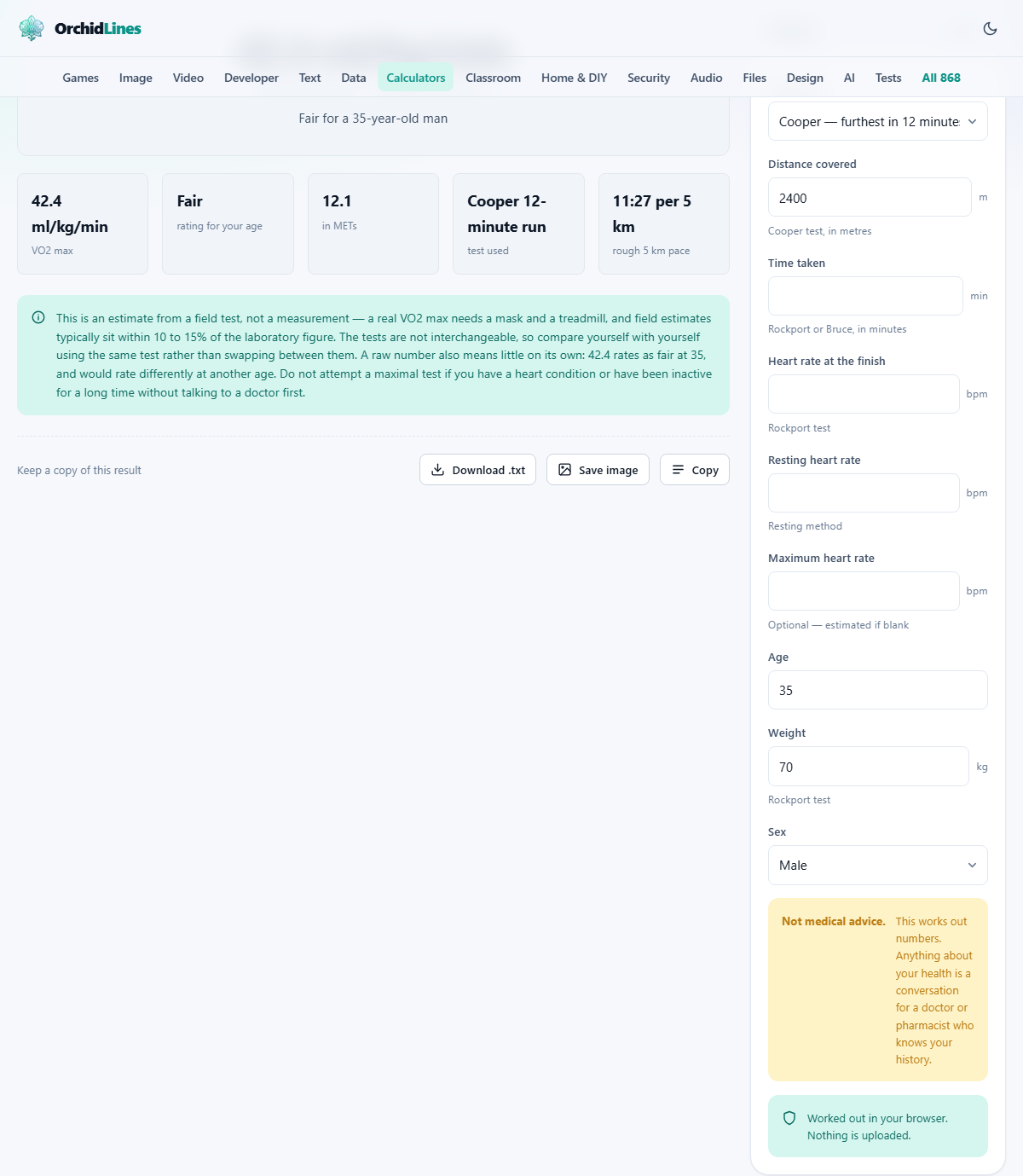
Distance covered is for Cooper only, in metres. A running track is 400 metres per lap, so six laps is 2,400.
Time taken is for Rockport and Bruce, in minutes. A decimal works: type 14.5 for fourteen and a half minutes.
Heart rate at the finish is for Rockport. Take it within ten seconds of stopping - it drops fast.
Resting heart rate is for the resting method. Measure it after sitting still, not after walking across the room.
Maximum heart rate is optional for every test. If you leave it blank, the tool estimates it from your age using the standard formula. If you know yours from a real test, type it in for a better result.
Age and Sex set the rating bands. A score of 42 means something very different at 25 than it does at 60, and the norms differ between males and females.
Weight is for Rockport only, in kilograms. Other tests do not need it because VO2 max is already per kilogram.
A worked example with the Cooper test
A 35-year-old male runs six laps of a 400-metre track in twelve minutes. That is 2,400 metres. He types 2400 into Distance covered, sets Age to 35 and Sex to Male.
The result comes back at roughly 33.3 ml per kilogram per minute. The rating shows this as Fair for a 35-year-old man. That means he is in the middle of the pack, not behind it, but not near the front either.
He trains for three months, mostly interval runs three times a week, and repeats the test. This time he covers 2,700 metres. The new estimate is about 39.9, and the rating moves up to Good. The improvement is real and measurable because he used the same test both times.
If he had switched to Rockport for the second test, the two numbers would not be directly comparable. Each formula has its own error margin, so mixing tests hides the real change behind the noise.
Reading the rating
The raw number alone is not useful. A VO2 max of 45 is below average for a fit 20-year-old but excellent for a 65-year-old. The tool places your score into a band - Poor, Below Average, Average, Above Average, Good, Excellent or Superior - based on published norms for your age and sex.
Think of the rating as a percentile bracket. Excellent does not mean you are an elite athlete. It means you are fitter than most people your age. That is a useful thing to know, and it is all a field estimate can honestly claim.
The decline with age is roughly one per cent a year after 30 in untrained people. Consistent training can slow it, stop it, or even reverse it for a while. That is the real point of tracking: not the number on screen today, but whether it is moving in the direction you want.
Common mistakes
- Comparing results across different tests. Each formula has its own bias. Pick one test and stick with it.
- Running the Cooper test without warming up. Cold muscles and a sudden sprint give a lower score and risk injury.
- Counting your resting heart rate right after sitting down. You need five full minutes of stillness for it to settle.
- Ignoring the not medical advice warning. A maximal test is genuinely hard work. If you have a heart condition or have been inactive for a long time, talk to a doctor first.
- Treating the number as exact. Field estimates run ten to fifteen per cent off the lab value. They are good for tracking change, not for quoting as fact.
- Leaving Maximum heart rate blank when you know it. The age-based formula is a rough average. If you have a measured figure, it makes every test more accurate.
What a good score looks like
For a 30-year-old man, a VO2 max above 48 is rated excellent and above 54 is superior. For a 30-year-old woman, above 41 is excellent and above 45 is superior. These bands shift downward with age, which is why the tool asks for your birthday rather than just showing a single table.
Most untrained adults land somewhere between 30 and 40. With three to six months of steady cardio, a gain of 15 to 20 per cent is realistic. Someone starting at 32 could reach 37 or 38 without anything extreme. Beyond that the curve flattens and each point costs more work.
When a different tool is better
If you want to figure out training heart rate zones rather than a single score, a heart rate zone calculator breaks the range into five bands. If your goal is to track body composition alongside fitness, a BMI or body fat tool serves that side. For calorie burn during the run itself, an exercise calorie calculator is the right page.
The VO2 max estimate is one snapshot of one part of fitness. It says nothing about strength, flexibility or balance. It is the best single measure of how well your body uses oxygen, and that is exactly what it should be used for.
Everything stays on your device
The calculations happen entirely inside your browser. Your weight, heart rate and test results are never sent anywhere. There is no account, no server, and no record kept after you close the tab. You can test this by turning off your connection and running the tool - it works exactly the same way.