
Making sense of the numbers on a tyre wall
What the three-part tyre size code means, how swapping to a different size changes the car's ride height and speedometer reading, how to use every input on the comparison page, and how to find substitute sizes that keep things accurate.
Reading the code on the wall
A tyre marked 205/55R16 carries three pieces of size information. The 205 is the width in millimetres, measured across the tread. The 55 is the aspect ratio - the height of the sidewall as a percentage of that width. The 16 is the rim diameter in inches. The R in the middle just means radial, which almost every road tyre has been for decades.
The aspect ratio is the part that trips people up. It is not a measurement in millimetres. It is a percentage of the width. A 205/55 tyre has a sidewall height of 55 per cent of 205, which works out to 112.75 mm. Change the width to 225 and keep the 55, and the wall becomes 55 per cent of 225 - that is 123.75 mm. The tyre got wider and taller at the same time, even though the middle number stayed the same.
The overall diameter of the tyre is two sidewalls plus the rim. For the 205/55R16 that is 112.75 plus 112.75 plus 406.4 mm for the 16-inch rim, giving roughly 632 mm. Every other figure on the page - circumference, turns per mile, speedometer error - follows from this single number.
Some older tyres and off-road sizes use a different format. Something like 31x10.50R15 gives the overall diameter and the width in inches, with the rim size at the end. The page accepts both styles.
Filling in the two sizes
The field labelled The size on the car now takes the size already fitted. Type it exactly as it appears on the wall - 205/55R16, for example. Load and speed markings like 91V can be left on. They carry no size information and the page ignores them.
The size you are thinking of is the one you are considering. Type that in the same format. The comparison updates as you type, so you can try several sizes quickly without pressing a button.
Speed shown on the dial is a number used to show how far the speedometer would be out with the new tyre. The default is 70. You can change it to any speed you normally drive at, and the Speed in dropdown lets you choose between km/h and mph.
What the comparison tells you
The page works out the overall diameter of each tyre and reports everything that follows from it. Width and sidewall height come first, in millimetres. Then the overall diameter and the circumference, because those two numbers drive everything else.
Ground clearance change is half the diameter difference. A tyre that is 20 mm taller lifts the body by 10 mm, because the extra height is split between the top and the bottom of the wheel. People often expect twice as much lift as they actually get.
Revolutions per mile and per kilometre show how many times each tyre turns over a fixed distance. A bigger tyre turns fewer times because it covers more ground in each rotation. That number feeds directly into the speedometer and the odometer.
The speedometer error line shows what your actual speed would be when the dial reads the number you entered. A taller tyre means you are going faster than the dial says. In most countries, a speedometer may read high but never low, so fitting a bigger tyre pushes the reading in the direction that gets people fined.
The odometer problem nobody mentions
A speedometer that reads two per cent low is annoying. An odometer that under-counts by two per cent is money. The car quietly logs 980 miles for every 1,000 you actually drive. Services come late because the interval counter thinks you have driven less than you have. A lease priced by the mile looks cheaper than it really is. And the figure on a sale advert is not the actual distance the car has covered.
Anti-lock brakes and stability control also use wheel-speed data. They were calibrated for the original tyre size, and a big enough change can make them trigger at the wrong moment or report false faults. Three per cent in rolling diameter is where most manufacturers draw the line.
If you change tyre size permanently, write down the correction factor and keep it with the service book. A one per cent error over 100,000 miles is a thousand miles missing from the record.
A worked comparison: 205/55R16 against 225/45R17
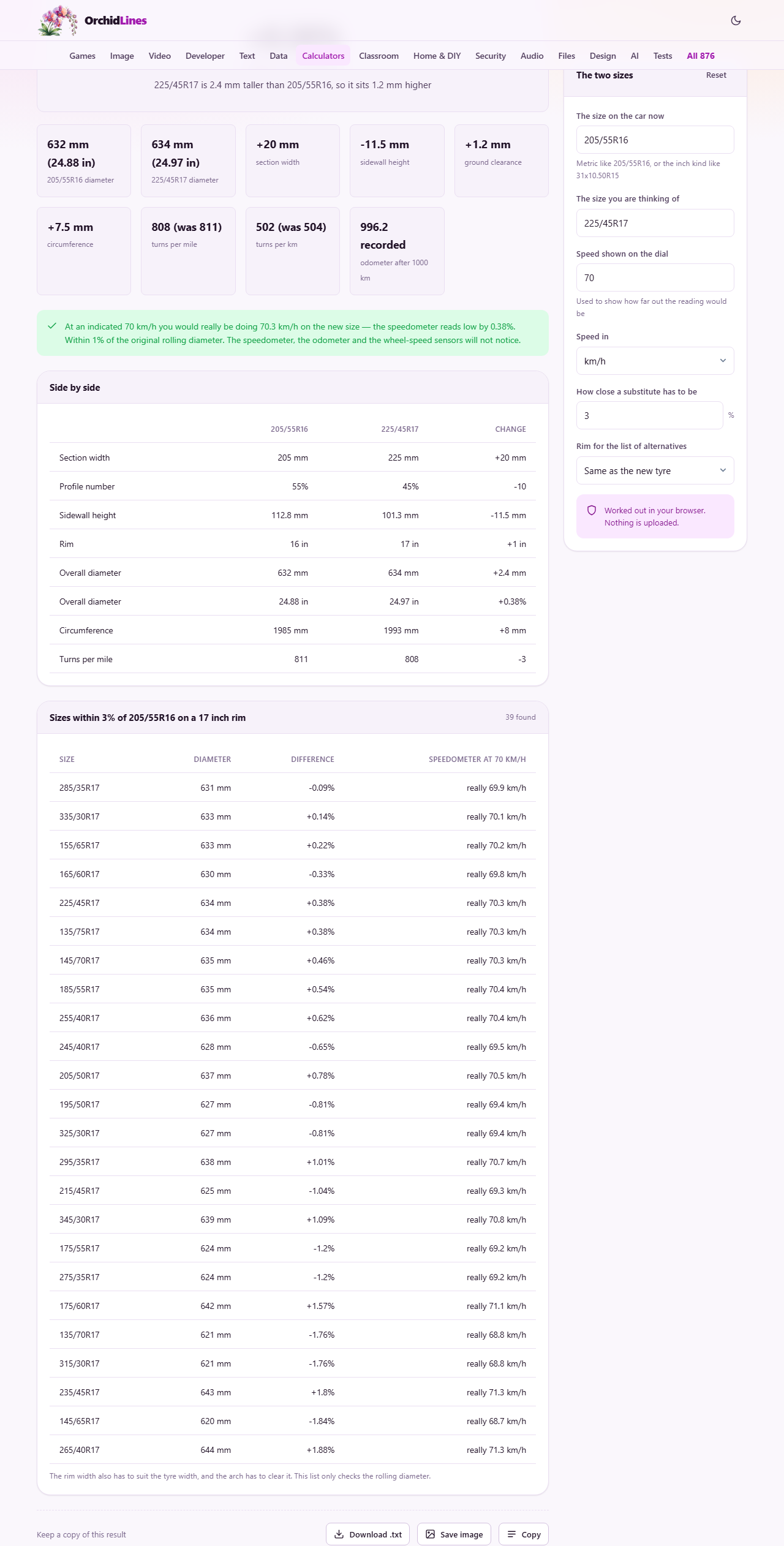
The page opens with 205/55R16 as the current size and 225/45R17 as the proposed one. These two are a classic pairing. The wider, lower-profile tyre on the larger rim comes out almost the same height as the original.
The 205 has a sidewall of 112.75 mm. Two sidewalls plus a 16-inch rim give an overall diameter of about 632 mm. The 225 has a sidewall of 101.25 mm. Two sidewalls plus a 17-inch rim give about 634 mm. The difference is roughly two millimetres - well under one per cent.
At 70 km/h on the dial, the real speed with the new tyre would be about 70.2 km/h. That is small enough that no instrument on the car would notice. It is also why this particular swap is so common - the car handles differently on the wider rubber, but the readings stay honest.
Change the proposed size to 235/45R17 and the gap opens up. Now the diameter is several millimetres larger, and the speedometer error at 70 shows a more noticeable drift. The page updates instantly, so trying a third or fourth size takes seconds.
Finding substitutes on a particular rim
Below the comparison sits a list of substitute sizes. These are every standard width-and-profile combination that falls within your tolerance of the original diameter, fitted to the rim you choose.
The tolerance field, labelled How close a substitute has to be, defaults to three per cent. That is the figure the tyre trade normally works to. Tighten it and the list gets shorter. Loosen it and more options appear, though anything beyond three per cent starts to affect the electronic systems on the car.
The rim dropdown, Rim for the list of alternatives, defaults to the same rim as the proposed size. Change it to see what fits on a different wheel. The list sorts closest first, so the tyre at the top is the one that changes the diameter the least.
Common mistakes when shopping for tyres
- Treating the aspect ratio as a fixed measurement. A 55-profile tyre on a 205-wide rim is a different height from a 55-profile on a 225-wide rim. The percentage stays the same but the actual millimetres change because the base number changed.
- Ignoring the speedometer direction. A bigger tyre makes the dial read lower than your real speed. A smaller tyre does the opposite. Only one of those directions leads to speeding tickets.
- Focusing on width instead of diameter. The electronic systems on the car care about how far the wheel travels per turn, not how wide it is. Diameter is the number that must stay close to the original.
- Fitting a size that clears the arch while parked but rubs on full lock or over bumps. This page cannot check arch clearance - that depends on the car's suspension geometry.
What this page does not check
The comparison deals only with rolling diameter. A size can be the right height and still be wrong for your car. The rim has to be wide enough for the tyre bead. The wheel arch has to clear it on full steering lock and over bumps. The load rating has to be at least what the manufacturer specifies.
None of those checks appear here because they depend on the car, not just the numbers. Consult the vehicle handbook or a tyre fitter before ordering anything. The page tells you whether the diameter is close enough. The rest is a conversation with someone who knows the car.
Nothing you type leaves your device
Every calculation runs inside your browser using the standard formulas for tyre geometry. No sizes, no speeds, and no vehicle details are sent to a server. There is no login, no tracking of which sizes you compare, and no record kept after you close the tab. You can load the page, disconnect from the internet, and compare as many sizes as you like. The arithmetic needs nothing that is not already in the page.