
Solving any triangle from the pieces you already have
Which combinations of sides and angles are enough to fix a triangle, how to enter them, what the results include, the ambiguous case that gives two valid answers, and a step-by-step worked example.
What the calculator does
Give it three measurements of a triangle and it fills in everything else. That includes any missing sides, any missing angles, the area, the perimeter, and the height on side a. The three values you supply must include at least one side, because three angles alone describe a shape but not a size.
Behind the scenes it uses the law of cosines and the law of sines, the same formulas taught in school trigonometry. The difference is that the tool picks the right formula for whatever combination you gave it, handles the arithmetic, and warns you when the numbers describe two different triangles instead of one.
Who needs it
Students checking homework answers. Carpenters measuring a roof truss. Surveyors triangulating a distance they cannot measure directly. Designers laying out a triangular panel. Anyone building a shelf into a corner.
The common thread is that you know some measurements but not all of them, and you need the missing ones without doing the trigonometry by hand. Even if you know the formulas, typing a cosine rule into a pocket calculator and keeping track of which side is opposite which angle is a frequent source of errors. One wrong keystroke and the answer is off by enough to ruin a cut piece of wood or fail a homework problem.
The six input fields
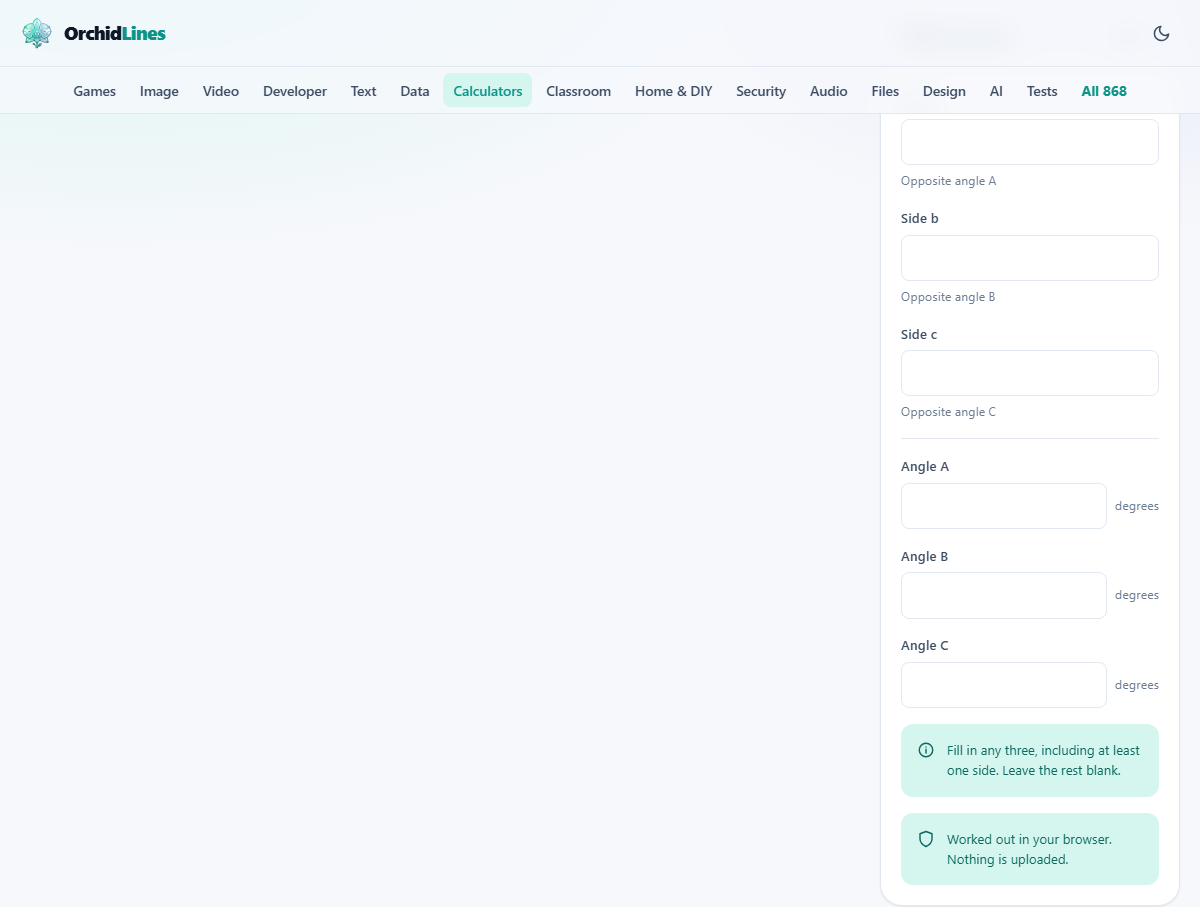
Three fields are for sides: Side a, Side b, and Side c. Three fields are for angles: Angle A, Angle B, and Angle C. Each angle is named for the side it sits opposite. Angle A is opposite Side a, Angle B is opposite Side b, and Angle C is opposite Side c.
Getting this pairing right is the single most important thing. If you enter 5 for Side a and 30 for Angle B, the tool reads that as the side opposite A being 5 and the angle opposite B being 30 degrees. Swapping the letter turns it into a different triangle entirely.
Sides are in whatever unit you choose. Enter metres, inches, centimetres, or anything else. The results come back in the same unit, and the area is in that unit squared. Angles are always in degrees. There is no switch for radians.
Fill in exactly three fields, including at least one side. Leave the rest blank. The tool reads what you gave it, decides which case applies, and solves from there.
The valid combinations
Three sides (SSS). All three side lengths are known. The law of cosines gives each angle, and area follows from Heron's formula.
Two sides and the included angle (SAS). You know two sides and the angle between them. The law of cosines gives the third side, and then the remaining angles follow.
Two sides and a non-included angle (SSA). You know two sides and an angle that is not between them. This is the ambiguous case, discussed in the next section.
Two angles and a side (AAS or ASA). You know two angles and any one side. The third angle is 180 minus the other two. Then the law of sines gives the missing sides. It does not matter whether the known side is between the two known angles or next to just one of them. Both arrangements produce a single unique triangle.
Three angles alone (AAA) does not work. Infinitely many triangles share the same three angles but have different sizes. A 30-60-90 triangle could be the size of a postage stamp or the size of a football pitch. The tool tells you to add at least one side length.
The ambiguous case and why it matters
When you supply two sides and an angle that is not between them, something unusual can happen. Depending on the lengths, there may be no valid triangle, exactly one, or two. This is called the SSA ambiguous case.
Imagine you know side a, side b, and angle A. The law of sines gives you the sine of angle B. If that sine is greater than 1, no triangle exists and the tool says so. If the sine equals 1, angle B is a right angle and there is exactly one triangle. If the sine is less than 1 the arcsine offers two candidate angles, one acute and one obtuse, but the obtuse one only closes into a real triangle when side b is longer than side a. That extra condition is the one the tool tests before it warns you that a second answer exists.
When two solutions exist, the tool shows the acute one and warns you that the obtuse one also fits. Many other calculators pick one silently and never mention the second. If you are working from a diagram, check which answer matches your drawing. If it is a homework problem, you may need to give both.
What the results include
Once it solves the triangle, the result shows every side, every angle, the perimeter, the area, and the height on side a. The triangle is also named by type: equilateral, isosceles, scalene, right-angled, acute, or obtuse.
The area is computed from Heron's formula once all three sides are known. Heron's formula does not need an angle or a height as input, which makes it the most reliable route regardless of which three values you started with.
The height on side a is the perpendicular distance from the vertex opposite a down to side a. It is useful in construction and in problems where you need the altitude. In a right triangle where the right angle is at C and side c is the hypotenuse, the height on side a is simply the length of side b.
A full worked example
You are building a triangular shelf. You know two sides are 40 cm and 30 cm, and the angle between them is 90 degrees. Enter 40 in Side a, 30 in Side b, and 90 in Angle C. Leave the other three fields blank.
The result fills in Side c as 50 cm. That is the hypotenuse. Angle A comes out as about 53.13 degrees and Angle B as about 36.87 degrees. The triangle is named as right-angled and scalene.
The perimeter is 120 cm. The area is 600 square centimetres. The height on side a is 30 cm, which in a right triangle is simply the other short side. The 40-30-50 combination is a scaled version of the classic 3-4-5 right triangle.
Now change the problem. Suppose you only know Side a is 7, Side b is 5, and Angle A is 40 degrees. That is the ambiguous case. The tool solves the acute version and warns you that an obtuse angle B also produces a valid triangle. Both answers are correct. Your drawing tells you which one you meant.
The triangle inequality
Not every set of three side lengths can form a triangle. The two shorter sides must add up to more than the longest side. If they do not, the three segments cannot close into a shape.
Enter 3, 4, and 10 as three sides and the tool refuses them. Three plus four is seven, which is less than ten. Those segments would leave a gap. Enter 3, 4, and 7 and it still refuses, because the sum exactly equals the third side, giving a flat line rather than a triangle. Enter 3, 4, and 6 and it works, producing a valid scalene triangle.
Common mistakes when solving triangles
- Mixing up which angle is opposite which side. Angle A must be opposite Side a. Swapping a letter produces a completely different triangle.
- Entering more than three values. The tool expects exactly three. Extra inputs can conflict with each other and produce an error.
- Entering angles that add up to more than 180. The three angles of any flat triangle must total exactly 180 degrees. If your two known angles already sum to 180 or more, no third angle exists.
- Forgetting units. The tool does not convert between centimetres and inches. If one side is in centimetres and another is in inches, the answer is meaningless.
- Ignoring the ambiguity warning. When the tool says a second triangle also fits, that second answer might be the one your problem is asking for.
Everything runs on your own machine
All the trigonometry happens inside your browser. No side lengths, no angles, and no results are sent to any server. There is no account, no sign-up, and no data stored between sessions. Close the tab and every value you entered is gone. You can use it offline, too, since no network request is needed for the math.