
Comparing lifters fairly across bodyweights
A 60-kilogram lifter and a 120-kilogram lifter can both total 500 kilograms, but the lighter one did something far harder. This article explains why dividing the lift by bodyweight is the wrong fix, what the three scoring formulas actually do, and how to read the numbers this calculator gives you.
The problem with lift-per-kilo
The simplest way to compare two lifters of different sizes is to divide total lifted by bodyweight. It sounds fair, but it is not. The reason sits in basic geometry.
Strength comes from muscle cross-section. Cross-section is an area, and area scales with the square of a linear dimension. Bodyweight is a volume, and volume scales with the cube. As a lifter gets bigger, their weight increases faster than their strength can keep up. A ratio of total to bodyweight will always favour the lighter person.
This is not a subtle bias. At elite level the raw ratio makes a 59-kilogram lifter look stronger than a 120-kilogram lifter who is, by any competition standard, the more impressive athlete. The scoring formulas exist to correct for this.
Three formulas and when each one matters
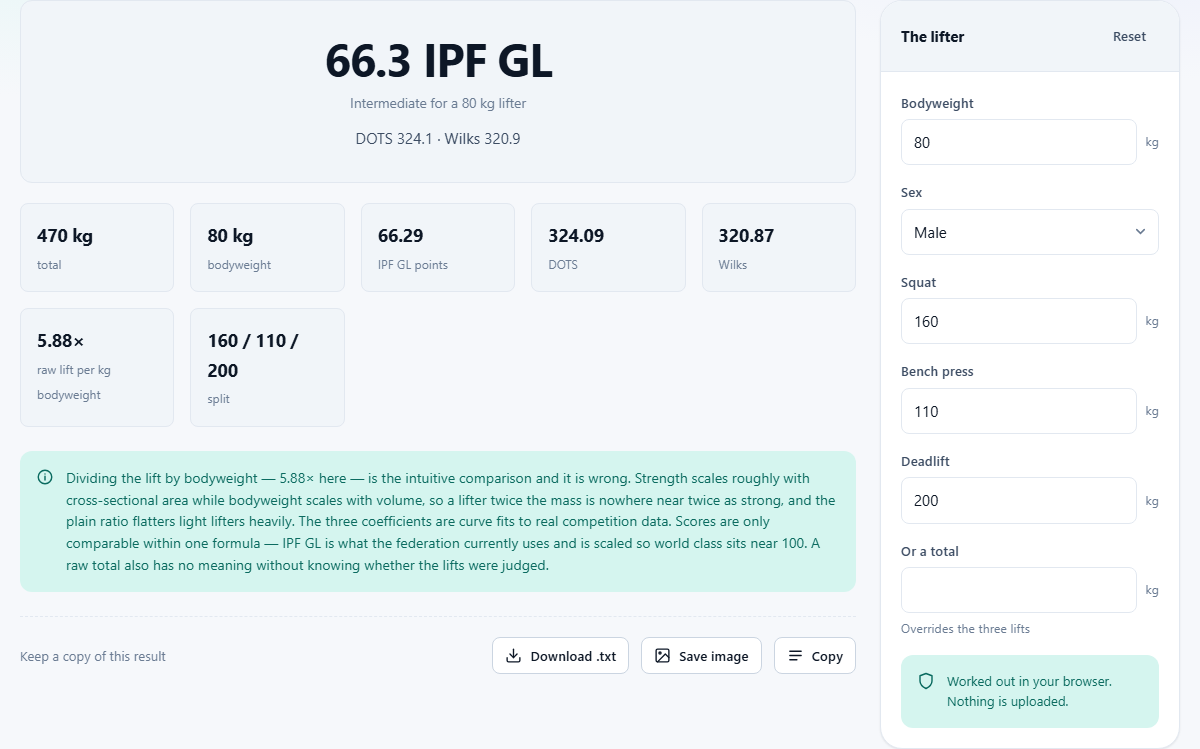
The calculator produces three scores from the same inputs: Wilks, DOTS and IPF GL. Each takes a powerlifting total and a bodyweight, applies a set of polynomial coefficients fitted to competition data, and returns a single number meant to be comparable across all bodyweights.
Wilks was the standard for roughly two decades. It was developed in the 1990s and its coefficients were fitted to the competition results available at the time. As the sport grew and lifters at the extremes of bodyweight became more common, the curve drifted. Light lifters and very heavy lifters were scored less fairly than those in the middle.
DOTS was introduced as a replacement. It uses a different curve fitted to a broader and more recent data set. It is widely used in federations outside the IPF and has a reputation for being kinder to lighter lifters than Wilks was.
IPF GL is the formula the International Powerlifting Federation currently uses in its own competitions. Its scale is pegged so that world-class performance sits near 100 points, which makes the number easy to read at a glance. A score of 40 is a novice, 55 is intermediate, 70 is advanced, 85 is national level, and 100 is world class.
Entering your lifts
The side panel is labelled The lifter. Start with your Bodyweight in kilograms and choose your Sex. Both matter because the coefficient curves are fitted separately for men and women. The male and female curves are not the same shape because the relationship between size and strength differs between the sexes, and applying one curve to the other would distort the comparison rather than correct for it.
Below that are three fields: Squat, Bench press and Deadlift, all in kilograms. Fill in whatever you have. If you only know your total, skip those three and type the number into the Or a total field instead. That field overrides the individual lifts when it has a value in it.
The result updates as you type. You do not need to press a button. Change a number and the three scores recalculate instantly.
Reading the result
The output shows the total, then three scores side by side. Each score is a single number with one or two decimal places. The scales are different for each formula, so comparing a Wilks score to an IPF GL score is meaningless. Always compare within the same formula.
If you entered the three individual lifts, the total is their sum. If you entered a total directly, that number is used as given. The three scores are then calculated from that total, your bodyweight, and your sex.
A practical use is tracking your own progress. Your total might go up by ten kilograms, but if your bodyweight also rose, the score tells you whether the gain was real strength or just extra mass. A rising score means you are getting genuinely stronger relative to your size.
Another common use is comparing yourself to training partners of different sizes. Two lifters who train together can have very different totals and still be at the same level of development. The score makes that visible. A 70-kilogram lifter totalling 420 and a 90-kilogram lifter totalling 510 might produce almost the same IPF GL score, which tells both of them they have reached the same stage despite very different numbers on the bar.
Why the coefficients keep changing
None of these formulas are derived from physics. They are curve fits to real competition data, and that data changes over time. Equipment improves. Coaching evolves. The population of competitive lifters shifts. A formula fitted to the data of 1995 may not describe the sport of 2025 accurately.
This is exactly why Wilks was replaced. It was not wrong when it was published. It drifted as the sport changed around it, and the drift showed most clearly at extreme bodyweights where the data was thinnest.
DOTS and IPF GL will face the same pressure eventually. If the sport changes enough, their curves will drift too, and a new set of coefficients will be fitted. That is the nature of a regression-based score. It describes the era it was built from.
Single lifts and why they do not fit
The coefficients were built for the three-lift powerlifting total: squat, bench press and deadlift combined. You can type a single lift into the total field and get a number out, but the number does not mean what it would for a full total.
The reason is that the curve was shaped by lifters who were training all three movements. The relationship between bodyweight and a bench press alone is different from the relationship between bodyweight and a full total. The polynomial does not know you only gave it one lift.
If you want to compare bench press across bodyweights, there are bench-specific formulas and rankings. Using a total-based coefficient on a single lift gives you a number, but not a fair comparison.
Which formula flatters whom
Lifters tend to quote whichever score makes them look best. This is human nature, not dishonesty, but it means you should always ask which formula is behind a number before you compare it to your own.
As a rough guide, Wilks tends to produce higher numbers for middleweight lifters and can underrate very light and very heavy ones. DOTS tends to be more generous to lighter lifters. IPF GL, because it is scaled to peak near 100, produces the smallest absolute numbers and feels the most conservative.
None of this means one formula is better than another. They are different lenses on the same data. Pick the one your federation uses, or pick IPF GL for the simplest scale, and stay with it when tracking yourself over time.
Practical benchmarks
On the IPF GL scale, which is the easiest to read because of its 100-point ceiling, rough benchmarks look like this. A score around 40 is where a lifter with a year or two of consistent training might land. Around 55 is a solid intermediate, someone who is clearly trained and competitive at a local level.
At 70 you are looking at an advanced lifter, probably placing well at regional meets. At 85 the lifter is competitive at national level in most countries. And at 100 and above, you are in world-class territory, the kind of performance that makes highlight reels.
These numbers apply across all bodyweights, which is the entire point. A 58-kilogram lifter with an IPF GL of 70 and a 105-kilogram lifter with the same score have achieved equally impressive things relative to their size.
Everything stays on your machine
The calculator runs entirely in your browser. No bodyweights, no lift numbers, and no scores are sent to any server. There is no account, no login, and no data stored anywhere except your own screen.
You can check this by disconnecting from the internet and changing the numbers. The scores still update, because the polynomial coefficients are baked into the page and the multiplication happens right where you are sitting. For a lifter tracking personal bests over months or years, this also means the numbers are private. Your training data does not end up in someone else's database, and you do not need to create a profile just to run a quick comparison after a meet.