
Turning your step count into an actual distance
Every pedometer and fitness tracker counts steps, but the distance it reports depends on the stride length it assumed for you. This article explains why that assumption matters more than people think, how to set up the converter with your own measurements, and what changes when you walk faster or break into a run.
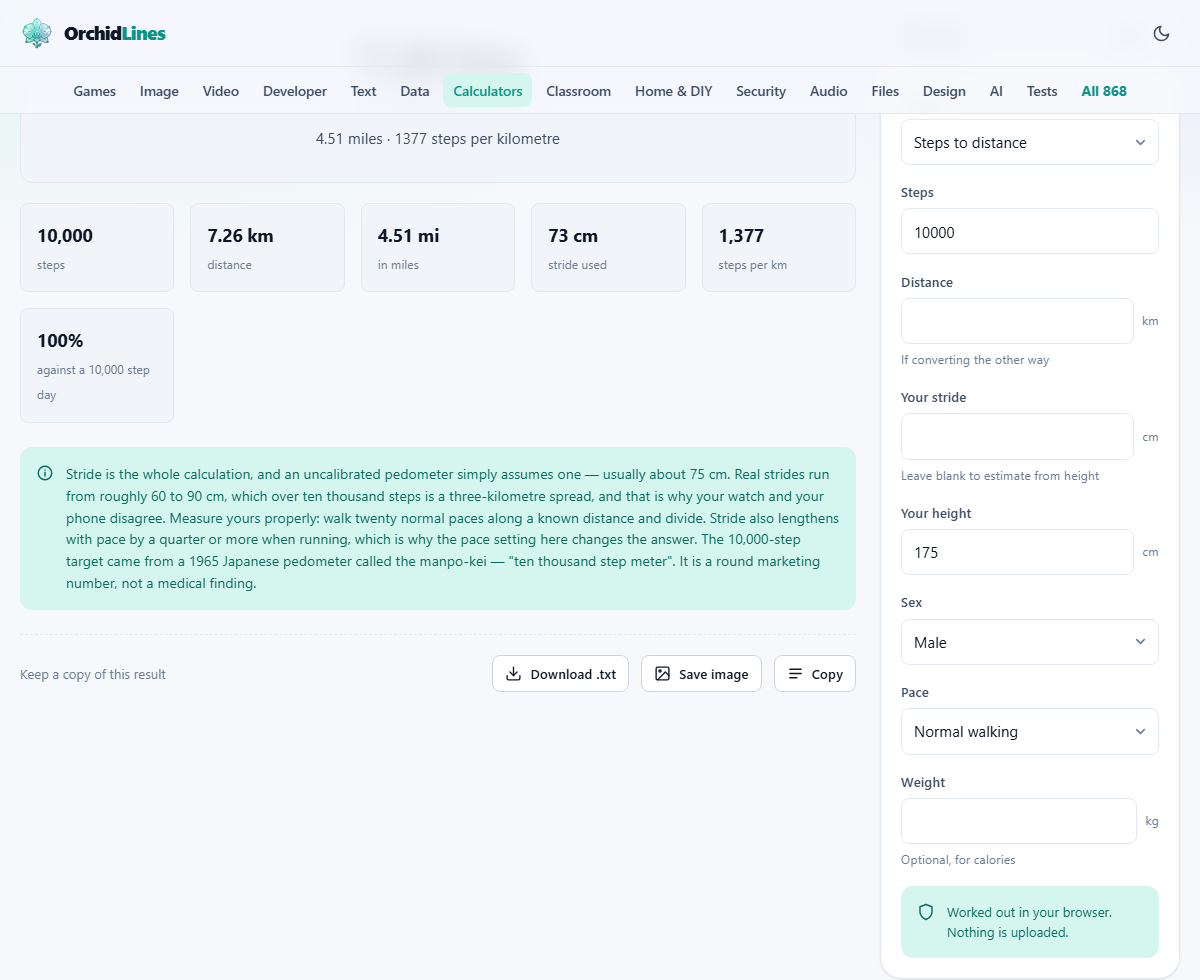
Why the default stride is the problem
A pedometer does not measure distance. It counts impacts and multiplies by a stored stride length. The number on the screen is arithmetic, not measurement, and the arithmetic is only as good as the stride figure it starts with.
Most devices ship with something near 76 centimetres for men and 67 for women. Those are population averages, and they work well enough for a person of average height walking at a normal pace on flat ground. Move away from any of those conditions and the error grows quickly.
Over ten thousand steps a stride that is just five centimetres too short costs you half a kilometre of credit. Over a week of daily walks, the gap is wide enough to throw off a training plan or a calorie target that depends on distance.
What this converter does differently
The tool works in two directions. Give it a step count and it returns a distance in kilometres. Give it a distance and it returns the number of steps that distance would take. Both directions use the same stride figure, so the answers are consistent.
The stride can come from you directly, typed into the Your stride field in centimetres. If you leave that field blank the tool estimates it from your height, using roughly 0.415 of your height for men and 0.413 for women. Those ratios come from gait research and hold up well at a normal walking pace.
The key difference from a simple converter is the Pace selector. Walking, strolling, brisk walking, jogging and running each stretch or shorten the stride by a known proportion. A jogging stride is around twenty percent longer than a walking one, and a running stride can be thirty percent longer or more. That single adjustment changes the final distance by a surprising amount.
Setting up the fields
Start with the Convert dropdown. Choose Steps to distance if you have a step count from your watch or phone and want to know how far you went. Choose Distance to steps if you are planning a route of a known length and want to know how many steps it will take.
Enter your step count in the Steps field or your target distance in the Distance field. The distance is in kilometres.
If you know your stride, type it into Your stride in centimetres. If you do not, leave it blank and fill in Your height and Sex instead. The tool will work out an estimate and use that.
Choose the pace that matches what you were doing. Normal walking is the default. Strolling is a slow, relaxed pace. Brisk walking is the purposeful speed a fitness program would prescribe. Jogging and running are self-explanatory and each brings a longer stride.
The Weight field is optional. If you fill it in, the tool adds a rough calorie estimate to the result. Leave it empty and the result simply skips that line.
How to measure your real stride
The best thing you can do for every step count you will ever read is spend ten minutes measuring your stride once. The method is simple.
Find a straight stretch of ground where you know the distance, or can measure it with a tape. A hallway, a running track, or a pavement between two lamp posts all work. Walk twenty normal steps at your normal speed, starting from a standstill. Mark where step twenty lands and measure the total distance from your start point. Divide by twenty.
The result is your average step length in whatever unit you measured with. Convert to centimetres and type it into the tool. From that point on, every conversion you run uses a figure that actually belongs to you.
Two things matter when you do this. Walk at your usual pace, not a careful, self-conscious pace that changes the moment you think about it. And count steps, not strides. Some references use stride to mean two steps, a full left-right cycle. This tool means one step, which is what pedometers count.
Pace and why it changes the answer
When you walk faster your stride gets longer. When you start to jog, it gets longer again. When you run, it stretches further still. This is not a small effect.
At a brisk walking pace a stride might be ten percent longer than a stroll. At a jog it might be twenty to twenty-five percent longer than a normal walk. At a full run it could be thirty to forty percent longer. The same ten thousand steps covers very different ground depending on whether those steps were a morning stroll or a training run.
Most fitness apps ignore this entirely. They store one stride figure and apply it to everything. That is why your phone might say you covered four kilometres on a gentle walk and the same four kilometres on a run that clearly went further. The steps were similar but the stride was not.
The Pace selector here applies a multiplier to the base stride before doing the multiplication. It is an approximation, since your actual running stride depends on your fitness, your leg length, the terrain and the speed within the range, but it is far closer than using the same number for everything.
The calorie figure and its limits
If you enter your weight the result adds a calorie estimate. The numbers are deliberately rough. Walking burns around half a kilocalorie per kilogram of body weight per kilometre. Running burns closer to one kilocalorie per kilogram per kilometre.
These figures are useful for perspective. They tell you the right order of magnitude and they let you compare a short run to a long walk. They are not precise enough to build a diet around. Actual calorie burn depends on gradient, surface, wind, temperature, fitness level, and how much of your weight is muscle versus fat. None of those are in the calculation.
If you need detailed calorie data, a heart rate monitor paired with a calibrated app is the right tool. The number here is a sanity check, not a food budget.
Why your watch and your phone disagree
A common frustration is that two devices carried on the same walk report different distances. The step counts are usually close, within a few percent, because the accelerometers are similar. The distances can be far apart because each device multiplied by a different stride.
Your phone might have a factory default of 75 centimetres. Your watch might have estimated 72 from your height, or 78 from a GPS-calibrated walk you did when you first set it up. Over ten thousand steps those three centimetres of difference become three hundred metres of disagreement.
Neither device is measuring distance directly. Both are doing the same multiplication this tool does. The one with the better stride figure wins, and you now know how to get that figure.
The ten thousand step target
Ten thousand steps a day is the most widely quoted fitness target in the world, and it started as a product name. In 1965 a Japanese company released a pedometer called the manpo-kei, which translates to ten thousand step meter. The name stuck, the number became a goal, and decades later it is still the default target on most fitness trackers.
Research since then paints a more nuanced picture. Health benefits from walking accumulate steeply through the first few thousand steps and begin to level off somewhere between seven and eight thousand for older adults and a bit higher for younger ones. Ten thousand is not a bad number, but it is not a medical threshold either.
What matters more than the round number is knowing how far your steps actually take you. A person with a short stride walking ten thousand steps covers less ground and burns fewer calories than a tall person doing the same count. The step count is the effort, but the distance and the calorie burn are the outcomes.
Privacy and where the maths happens
The entire calculation runs on your own device, inside your browser. No step counts, heights, weights or distances are sent anywhere. There is no account, no login, and no server doing the work.
You can verify this yourself. Load the page, disconnect from the internet, change the numbers, and watch the result update. It still works because the arithmetic never needed a connection in the first place.