
Waking between cycles instead of in the middle of one
Most people set an alarm for the latest possible moment and drag themselves out of whatever stage of sleep they happen to be in. The result is grogginess that has nothing to do with how many hours they got. This article explains sleep cycles, shows how the calculator picks bedtimes and wake times that land at the right point, and covers the settings that make the result fit your own body.
How sleep moves in waves
Sleep is not a flat block of unconsciousness. It moves through a repeating pattern of stages, starting with light sleep, dropping into deep slow-wave sleep, and then rising into the rapid eye movement stage where most dreaming happens. One complete pass through these stages takes roughly ninety minutes for the average adult, and a full night usually contains four or five of them.
Deep sleep dominates the early cycles. The brain is doing its heaviest repair work, and being pulled out of this stage is what produces that thick, leaden feeling people call sleep inertia. Later cycles shift the balance toward lighter and REM sleep, which is why the last hour before a morning alarm tends to be the easiest to wake from. The transition between one cycle and the next is a shallow trough, and waking there feels dramatically better than waking ten minutes earlier in the deep middle.
Choosing a mode
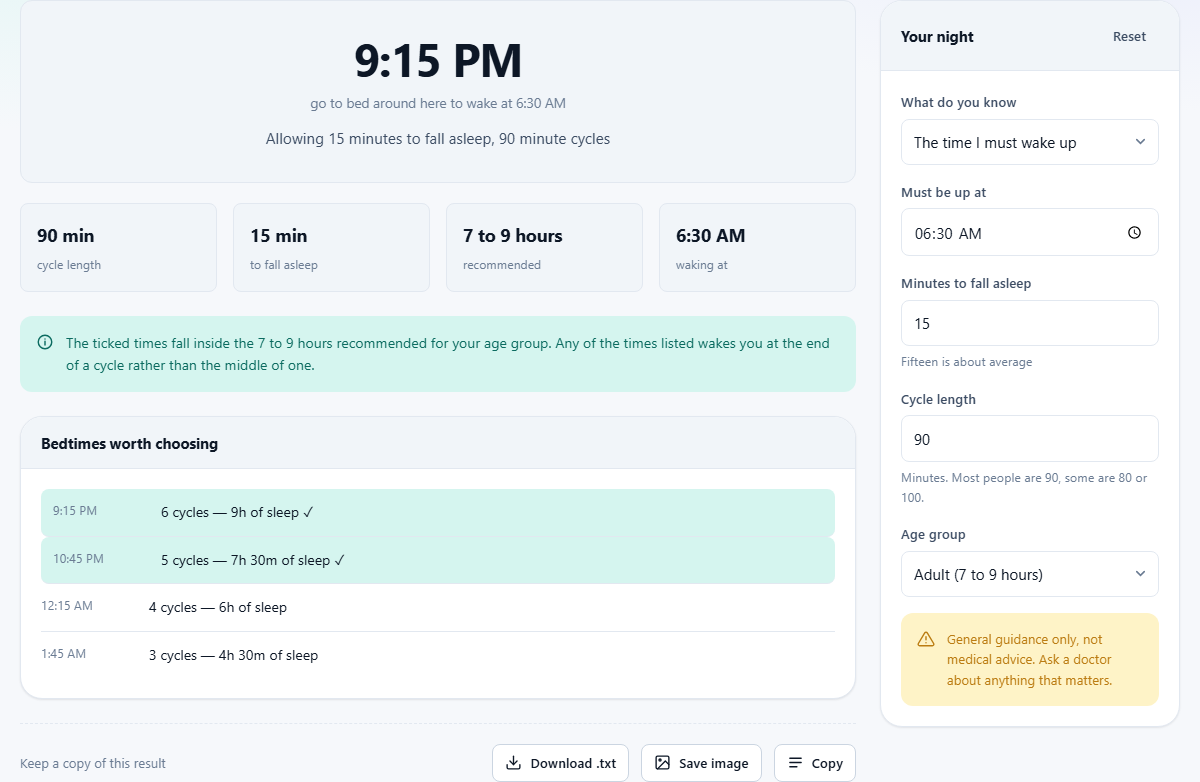
The dropdown labelled What do you know has three options. The first, The time I must wake up, is the most common: you know the alarm has to go off at a certain hour and you want to know when to get into bed. The second, The time I am going to bed, works the other way: you are heading to bed at a known time and want to set the alarm at a point that finishes a whole number of cycles. The third, I am going to bed right now, uses the current time on your device as the bedtime and suggests alarm times from there.
Each mode produces a short list of times. Every entry is a whole number of cycles apart from the reference time, after allowing for the minutes it takes you to fall asleep. The list covers everything from a short night of three cycles up to a long one of six or seven.
Adjusting the time it takes to fall asleep
The field labelled Minutes to fall asleep defaults to fifteen, which is a widely cited average for healthy adults. If you know from experience that you lie awake for half an hour, change it. Every answer in the list shifts by the same amount, because the cycles do not start until you are actually asleep.
Getting this number roughly right matters more than getting the cycle length exact. An error of five minutes in the fall-asleep estimate pushes every suggested time by five minutes, which can be enough to land you in the wrong part of a cycle. Pay attention to how long you usually lie awake and update the field to match.
Cycle length is personal
The Cycle length field defaults to ninety minutes, which is the textbook average. Real cycles run anywhere from about eighty to a hundred minutes, and they vary between people, between nights, and even across the same night. The early cycles tend to be slightly longer and heavier; the later ones get shorter and lighter.
If you have been using ninety minutes and still wake up groggy, try eighty or a hundred and see which feels better over a week. Small changes here shift the suggested times by enough to make a real difference. There is no test you can take at home to measure your exact cycle length, so this is a matter of trial and observation rather than precision.
Age and recommended hours
The Age group dropdown has four choices: Adult with a recommendation of seven to nine hours, Teenager at eight to ten, Child at nine to twelve, and Over 65 at seven to eight. The calculator uses this to highlight which times in the list give a total sleep duration inside the recommended window.
Highlighted entries are not orders. They are a visual nudge based on guidelines from sleep research, not a prescription for your body. Some adults do well on six hours; others need more than nine. The highlight helps you spot the entries that land in the usual range without scrolling through arithmetic in your head.
Why fewer hours can sometimes feel better
This surprises people, but it follows directly from how cycles work. Four complete ninety-minute cycles give you six hours of sleep. Four and a half cycles give you six hours and forty-five minutes, but the alarm goes off in the deep middle of the fifth cycle. Many people report feeling more rested after the clean six-hour night than after the longer one where they were dragged out of deep sleep.
This is not a recommendation to sleep less. Five full cycles will always beat four, and consistently short nights carry real health costs. The point is narrower than that: when you cannot get a full night, it is better to set the alarm at a cycle boundary than to squeeze in an extra half-hour that leaves you waking in the worst possible stage. A tidy six hours beats a messy six and a half.
Naps and the twenty-or-ninety rule
The same cycle logic applies to daytime naps, but in miniature. A twenty-minute nap keeps you in the lightest stage of sleep and leaves you feeling sharper without any grogginess. A ninety-minute nap completes a full cycle and gives you a block of deep and REM sleep, which can genuinely restore alertness for the rest of the day.
Anything between those two lengths is the worst of both worlds. You drop into deep sleep but the alarm pulls you back out before the cycle finishes, producing the same heavy feeling as a badly timed morning alarm. If you can afford the time, go for ninety. If you only have a short window, stop at twenty and set a firm alarm.
Building a steady routine
Cycle timing is useful, but it is not the most powerful thing you can do for your sleep. A consistent schedule beats any single-night trick. Going to bed and waking up at the same times every day, including weekends, lets your body anticipate the transitions rather than being surprised by them. The cycles themselves become more regular, which makes the calculator's suggestions more accurate.
The worst pattern is the weekend catch-up, where someone sleeps five or six hours on work nights and tries to recover with ten hours on Saturday. The body's clock shifts back and forth, jet-lag style, and Monday morning feels worse than Friday did. Picking a bedtime that gives you five full cycles every night and sticking to it is more effective than any amount of weekend sleep.
What this page does not replace
This is a rule of thumb drawn from average biology, not a medical device. Real cycle lengths vary, the estimates are approximate, and no calculator can diagnose a sleep disorder. If you consistently cannot fall asleep, wake many times during the night, or feel exhausted despite apparently sleeping enough, those are questions for a doctor, not for a web page.
The warning at the bottom of the settings panel says the same thing: general guidance only, not medical advice. Use the results as a starting framework and adjust based on how you actually feel. Treat the suggested times as good guesses that you refine with experience, not as exact prescriptions that must be followed to the minute.
Screen light and the hour before bed
No cycle calculator can help if you are lying awake for an hour after you get into bed. Bright screens close to bedtime suppress the hormone that tells your brain it is time to sleep, pushing your actual sleep onset later than you planned. That extra delay throws the cycle timing off because the page assumes you fall asleep after the number of minutes you entered, not an hour later.
If you find the suggested bedtimes are not working, the culprit may not be the cycle length setting. It may be that you are falling asleep much later than you think, and adjusting the fall-asleep field to reflect reality is more useful than changing the cycle length.
Runs entirely on your device
The calculation happens in your browser. No times, no age group and no other detail you enter is transmitted anywhere. There is no account, no server-side processing and no data stored outside your own machine. You can disconnect from the internet after loading the page and it will keep working exactly as before.