
Building a savings plan you can actually follow
This article covers the three questions the savings goal calculator answers, how the controls work together, why the monthly deposit matters far more than the interest rate for short goals, and how to turn the output into a plan that survives contact with real life.
Three questions from one set of numbers
You can ask this calculator three different things. How long will it take to reach a target at my current rate. How much do I need to put away each month to reach it by a certain date. And what will I end up with if I keep going for a set number of years. The What do you want to know dropdown picks which one, and the fields that do not apply to your chosen question are quietly ignored.
All three share the same inputs. A goal, whatever you already have, a monthly deposit, a time frame, and an interest rate. The calculator rearranges the same formula to solve for whichever piece is missing.
The fields and what they expect
Amount you need is the number you are aiming for. A house deposit, a car, an emergency fund, a wedding. Saved already is what you have right now. If that number is zero, every penny has to come from future deposits.
Putting away each month is the regular contribution. This is used when you ask how long it will take or what you will end up with. When you ask how much a month you need, the calculator fills this in for you.
Years you have sets the time horizon. It is used by the monthly and total questions and ignored by the how-long question, which works out the time for you.
Interest a year is the annual rate, compounded monthly. A savings account might pay a few per cent. A current account paying nothing should be zero. This is not a prediction of stock market returns. It is arithmetic on the number you supply.
Increase the deposit yearly by is a percentage that bumps the monthly amount up once a year. A figure matching your expected pay rise keeps the plan from falling behind as prices climb. Currency picks the symbol used in the output.
The deposit does nearly all the work
On a goal of three to five years, the interest rate barely changes the finish line. Suppose you save ten thousand a month for three years with no interest at all. That is three hundred and sixty thousand. At six per cent annual interest, compounded monthly, you finish with roughly three hundred and ninety-four thousand. The interest added about thirty-four thousand, which is less than four months of deposits.
Doubling the interest rate to twelve per cent adds another thirty-five thousand or so. But adding just two thousand to the monthly deposit adds seventy-two thousand. The deposit moves the needle twice as far as a doubled return.
This is not true for long horizons. Over twenty or thirty years, compound interest starts to dominate and a percentage point matters a great deal. But most people saving for a specific goal are thinking in terms of a few years, not a few decades. For that time frame, the plan is the deposit. The interest is a bonus.
How the yearly increase pulls the finish line closer
The Increase the deposit yearly by field is easy to overlook, but it makes a real difference. A five per cent increase each year, roughly matching a typical pay rise, means your deposit in year three is about ten per cent larger than it was in year one. Over five years it is about twenty-two per cent larger.
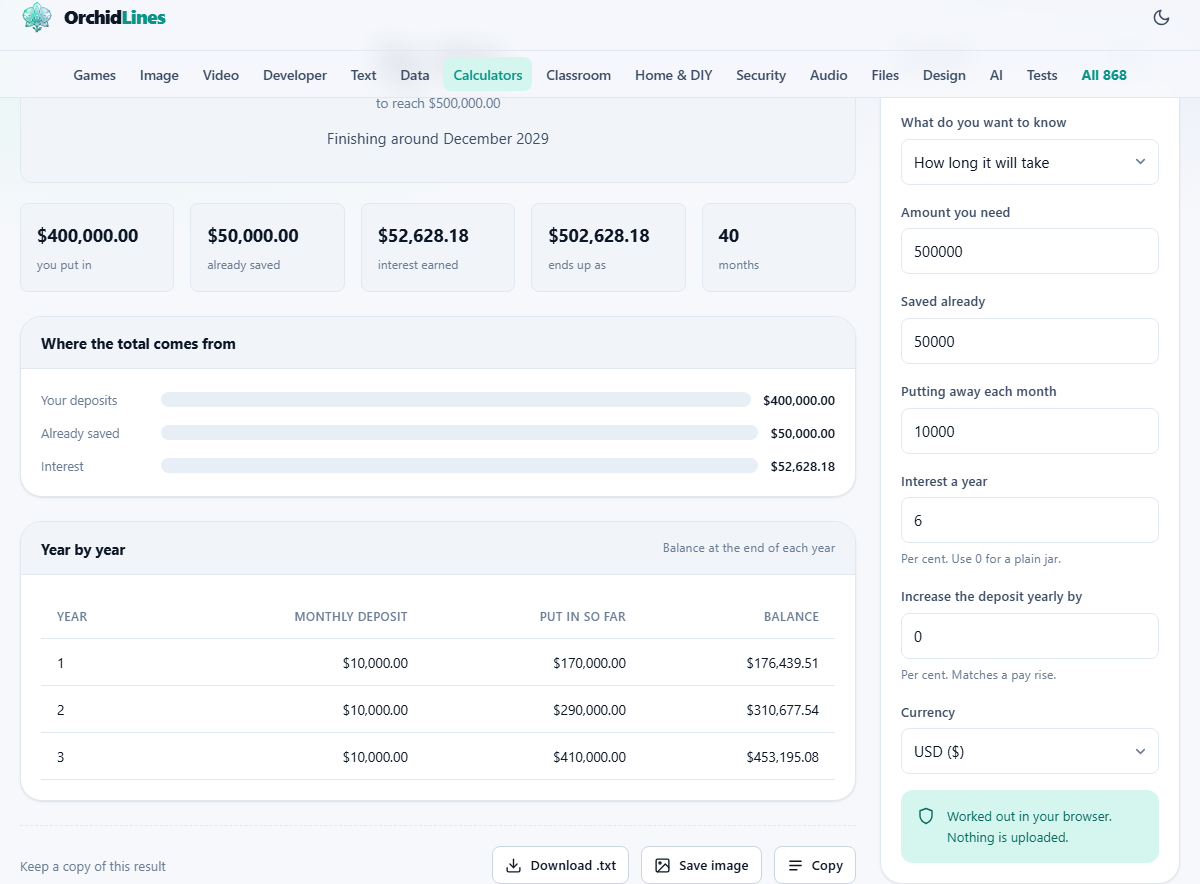
The year-by-year table in the results shows exactly where the extra money appears. Each row carries four things: the year, the monthly deposit that applied during it, everything put in so far including what you started with, and the balance at the end. Watch the second column climb and the gap between the third and fourth widen, and you can see the growing deposit doing its work.
If you are not sure whether your income will rise, leave the field at zero. The plan is then built on your current capacity, and any raise you do get is a genuine windfall that shortens the timeline.
Using the how-long question
Pick How long it will take from the dropdown, fill in the goal, what you have, the monthly deposit, and the interest rate. The result appears in years and months.
This is the question to start with when you have a target but no deadline. It tells you whether the answer is two years or twelve, which is the difference between a plan and a daydream. If the answer is longer than you expected, the table shows exactly where each year's money goes, so you can see which lever to pull.
The most common reaction is surprise at how long modest goals take without a serious monthly commitment. A one hundred thousand goal starting from zero at five thousand a month, with no interest, takes twenty months. That is fine. At two thousand a month it takes fifty months, which is more than four years. The deposit is the speed control.
Using the how-much-a-month question
Pick How much a month I need, enter the goal, what you have, the number of years, and the interest rate. The calculator fills in the monthly deposit.
This is the right question when you have a deadline. A wedding in two years, a tuition bill in four, a deposit on a flat in five. The number it gives you is the minimum. If you can beat it, you arrive early.
When the answer is more than you can afford, try extending the years by one or two. Each extra year drops the monthly amount noticeably, especially at higher interest rates. But be honest about whether the deadline really is flexible. A school term starts when it starts.
Using the what-will-I-have question
Pick What I will have by then, enter what you have now, the monthly deposit, the years, and the interest rate. The result is the final balance.
This is for the situation where you are already saving and want to know what it adds up to. There is no goal to aim for, just a curiosity about the number at the end. It is also useful for testing what-if scenarios. What if I saved a hundred more a month. What if I got a better rate. What if I kept going for one more year.
The bars under the headline split the total three ways: your own deposits, what you had already saved, and the interest. That is the quickest way to see how much came from you and how much came from the rate. The table below tracks deposits and balances rather than interest, so read the split off the bars.
Practical advice for plans that survive
Round the monthly figure up. If the calculator says eight thousand three hundred and forty, save nine thousand. A plan built on exact numbers fails the first month something unplanned happens, and something unplanned always happens.
Keep your emergency fund separate from the goal. Money that doubles as your safety net is money you will spend when the boiler breaks. Reaching the target twice takes far longer than reaching it once.
Account for inflation on long goals. If you are saving for something three years away and prices rise three per cent a year, the target should be about nine per cent higher than today's price. Add a couple of per cent to the goal for each year of the plan.
- Start the standing order on payday, not three days later when the money has found other uses.
- Review the plan every six months. A pay rise or a drop in expenses is a chance to increase the deposit and shorten the timeline.
- Do not chase a higher interest rate at the cost of locking money away. Access matters when plans change.
Privacy and the limits of the tool
Every calculation runs on your own device. The page does not upload your numbers, does not require an account, and does not store anything on a server. Your figures stay in your browser so they are still there when you come back, and closing the tab removes them.
This is not financial advice. The output is arithmetic on the inputs you provide. Real returns vary from month to month, and tax, fees and inflation are not included in the result. Use the numbers to build a framework, then check the details with a real savings product and, if the amount is large, with someone qualified to advise you.