
Roasting times, carryover heat and when to pull the meat out
Most roasting charts give you a time and a temperature, and both are rougher than they pretend. This article explains why the calculator tells you to take the meat out early on purpose, how carryover heat finishes the cooking for you, and what the numbers behind the times actually mean.
The two things most charts leave out
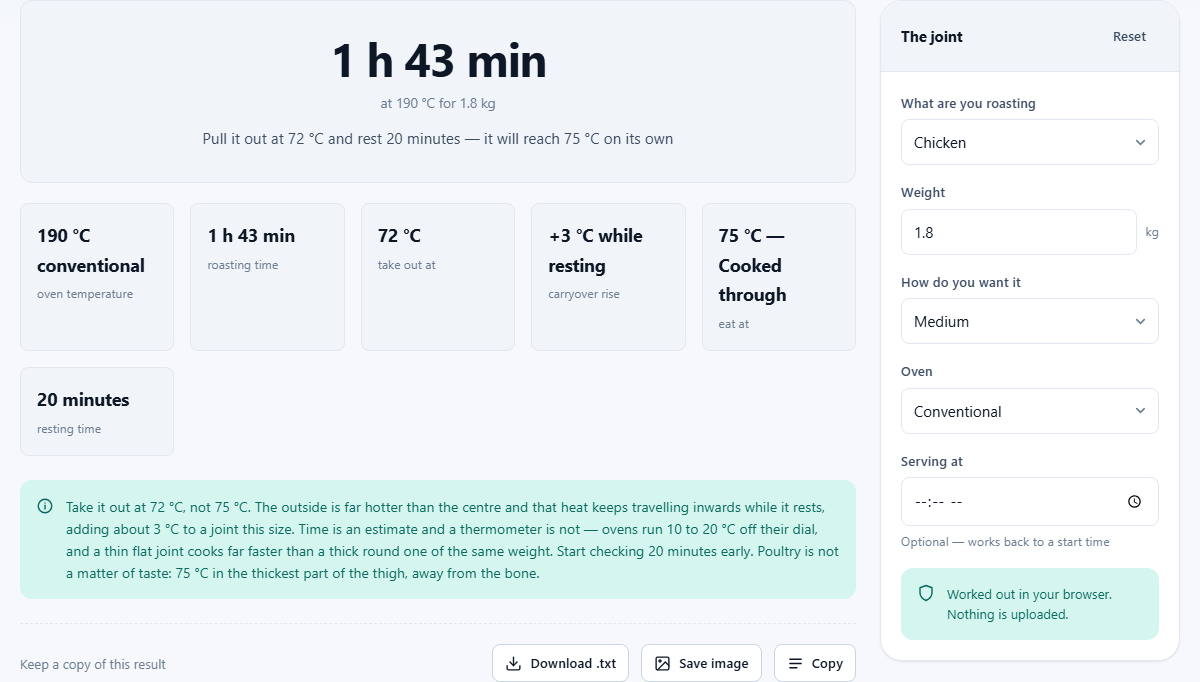
A roasting chart typically says to cook a chicken at 190 degrees for about an hour and a half, and then it stops. What it does not say is that the meat keeps cooking after you take it out of the oven. The outside is much hotter than the centre, and that heat keeps travelling inward while the joint rests on the counter.
A large joint of beef can climb five to seven degrees while resting. A small chicken rises two to three. That means if you pull a rib roast out at the exact temperature you want to eat at, it overshoots by the time you carve it. The calculator shows both figures: the temperature to take it out at, and the temperature it will reach on its own. The gap between them is the carryover.
The second thing charts miss is that time is not a straight line. Doubling the weight does not double the cooking time, because heat has to travel to the middle of the joint, and the distance to the middle grows with the cube root of the mass, not the mass itself. A simple minutes-per-kilo rule overcooks small joints and undercooks large ones. The calculator applies a correction for this.
Picking the meat and setting the weight
The dropdown labelled What are you roasting covers the most common cuts: chicken, turkey, duck, beef rib or sirloin, beef brisket or silverside, lamb leg or shoulder, and pork loin or shoulder. Each has its own base time, per-kilo rate, oven temperature and carryover figure built in.
Weight is the weight after trimming, as the joint goes into the oven. Use kilograms. If the packaging gives pounds, divide by 2.2. The accuracy of the result depends on this number being close to reality, so weigh the joint if you can rather than trusting the label. A joint that has been sitting in a marinade or brine will weigh more than its original packaging says, and a heavily trimmed one will weigh less.
Doneness and why poultry is different
For red meat, the How do you want it selector offers rare through well done. Each setting corresponds to a target internal temperature measured in the thickest part of the meat. Rare is around 52 degrees, medium is 63, and well done is 74. The time adjusts accordingly, a few minutes shorter for rare and a few longer for well done.
Pick chicken, turkey or duck and the doneness dropdown stops counting for anything. It stays on the panel and you can still move it, but the answer ignores it entirely and targets 75 degrees in the thickest part of the thigh, away from the bone. That is not a matter of taste. Below it, harmful bacteria survive. The safety note under the figures says so every time a bird is selected.
Colour and clear juices are not reliable tests for poultry. A properly cooked chicken can still show pink near the bone, and a dangerously undercooked one can run clear. A thermometer is the only trustworthy check.
Conventional versus fan ovens
The Oven selector offers two choices: conventional and fan, which is also called convection. A fan oven circulates the hot air around the food, which transfers heat faster. The same dial setting in a fan oven cooks harder than in a conventional one.
The standard rule of thumb is to reduce the temperature by twenty degrees when using a fan oven. The calculator applies this automatically. If you select fan, the displayed oven temperature drops by twenty degrees from the conventional figure.
No oven runs exactly at the temperature its dial says. Most are ten to twenty degrees off, and a cheap oven thermometer is the best investment any cook can make. The calculator gives you a starting point. The thermometer in the meat tells you when you are actually there.
Working backwards from a serving time
The Serving at field takes a time of day. Fill it in and the calculator works backwards: it adds the roasting time and the resting time, then subtracts both from the serving time to tell you when to put the joint in the oven.
This is more useful than it sounds, because roasting, resting and everything else has to land at the same moment as the side dishes. Knowing the start time in advance lets you plan the rest of the meal around it.
If you leave the field empty, the calculator just shows the roasting time and resting time without a clock. Either way, treat the time as a guide and start checking the internal temperature about twenty minutes before the predicted finish.
Resting the meat properly
Resting does two things. It lets the temperature even out from a hot outside to a cooler centre, which is the carryover effect. And it lets the muscle fibres relax and reabsorb juice that would otherwise run out onto the board the moment you cut.
The calculator sets the resting time based on the weight. A small joint gets about fifteen minutes, a medium one twenty, and a large one thirty. Rest the meat on a warm plate, loosely covered with foil. Wrapping it tightly steams the crust and turns it soft, undoing the browning you spent an hour creating.
A joint that goes straight from the oven to the carving board will bleed juice across the plate and end up drier than one that rested. The few minutes of waiting pay for themselves in the final result. Use the resting time to finish the gravy, crisp the potatoes, or set the table. The joint is doing its own work. Leave it alone.
Stuffed birds and other adjustments
If you are roasting a stuffed bird, add the weight of the stuffing to the bird's weight before you enter it. The stuffing sits in the cavity and is the slowest part of the whole thing to heat up. Check that the stuffing itself reaches 75 degrees, not just the thigh.
Bone-in joints cook slightly differently from boneless ones because bone conducts heat faster than meat. The calculator does not ask whether the joint has a bone, but you can expect a bone-in piece to finish a few minutes sooner than the prediction. Start checking early.
A very thick, round joint takes longer per kilo than a thin, flat one of the same weight, because the heat has further to travel. The shape correction in the calculator handles the average case. An unusually shaped joint may need you to adjust by feel and by thermometer.
Using a meat thermometer
The single most useful piece of kitchen equipment for roasting is a probe thermometer. Push it into the thickest part of the meat, away from any bone, and read the number. That tells you where the joint actually is, regardless of what the clock says.
The calculator gives you two target temperatures. The first is the pull temperature: the reading at which you take the joint out of the oven. The second is the final temperature after resting, which is the one that determines how the meat tastes.
If the probe reads below the pull temperature when the predicted time is up, leave the joint in and check again in ten minutes. If it reads above, take it out immediately. Time is always an estimate. Temperature is a measurement.
All the maths runs on your own device
The calculator runs entirely in your browser. No data is sent anywhere, and there is no account or login. Your settings are saved locally so they are still there next time you open the page, and clearing your browsing data removes them.
The times and temperatures here are estimates based on general cooking science. They are not a substitute for checking the meat with a thermometer, and they should not be relied on for food safety without that check. Every oven is different, every joint is shaped differently, and the only number that truly counts is the one on the probe you push into the thickest part of the meat. Use the calculator to plan. Use the thermometer to decide.