
Scaling a recipe so the numbers still work at the worktop
This article explains how the recipe scaler changes quantities while keeping them in fractions you can actually measure, why it leaves cooking times alone on purpose, and how to handle the tricky cases like eggs and baking where straight multiplication is not the whole story.
The problem with decimal quantities in a kitchen
Multiply one and a half cups by 1.6 and the honest answer is 2.4. That number is correct and completely useless. There is no 2.4-cup marking on a measuring jug. Standing at a worktop with flour on your hands, you need a number that matches a line on a real measure.
Most recipe calculators give you the decimal and leave it at that. This one snaps the result back to the fractions that actually exist on measuring spoons and jugs. Halves, thirds, quarters and eighths are all fair game. The nearest one is chosen, and the result comes back as something you can measure without doing mental arithmetic while a pan heats up.
Pasting a recipe and setting the servings
Type or paste the recipe into the Your recipe panel. Whole recipes work, not just ingredient lists. Method steps, notes and headings all pass through unchanged. Only lines with numbers get scaled.
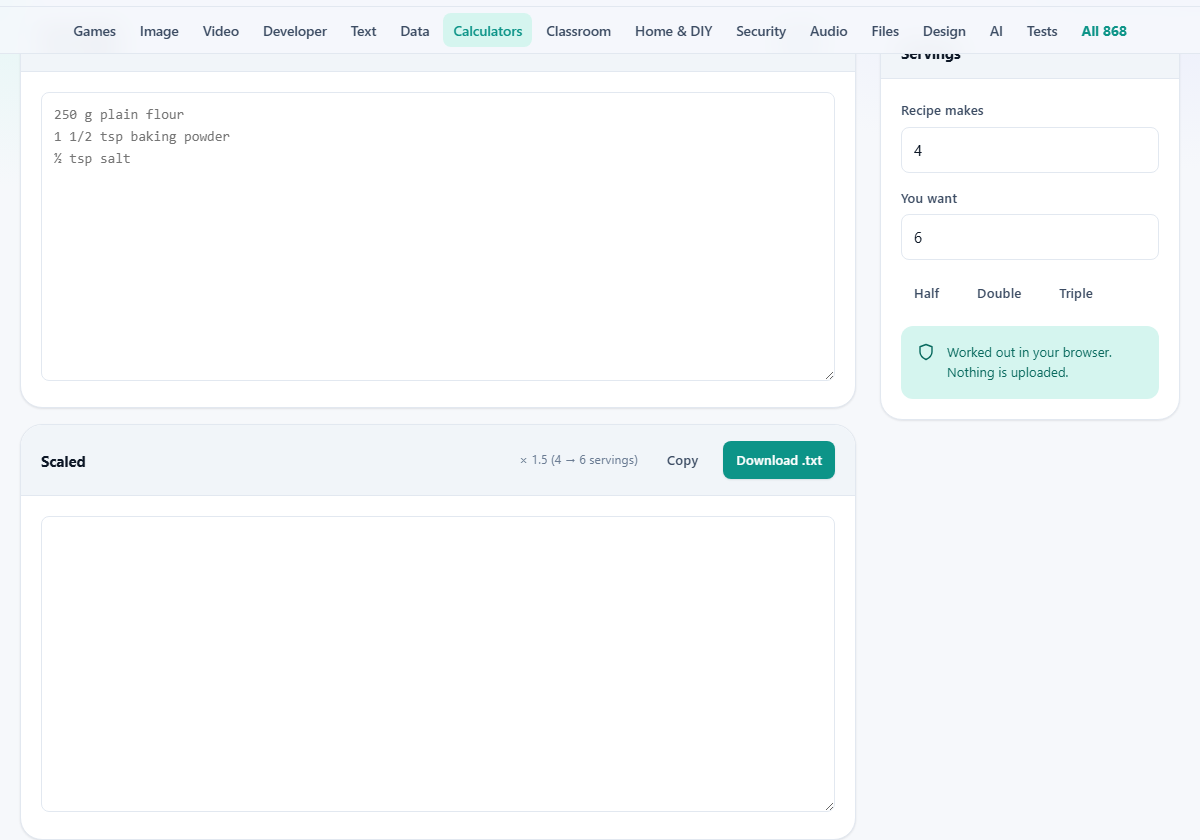
The Servings panel on the right has two fields: Recipe makes and You want. The first is the number of servings the original recipe produces. The second is how many you need. The scale factor is the ratio of the two, and it appears between the panels as a multiplier.
Three shortcut buttons sit below the fields. Half sets the target to half the original. Double sets it to twice. Triple sets it to three times. These save a step when you do not need an odd number of servings.
How the fractions are chosen
After multiplying a quantity by the scale factor, the tool looks at a table of common fractions: eighths, quarters, thirds, three-eighths, halves, five-eighths, two-thirds, three-quarters and seven-eighths. It picks the one closest to the actual result. If the quantity is ten or more, it rounds to a whole number instead, because nobody measures 37 and three-eighths grams.
Very small quantities get special treatment. Anything that would round to less than a sixteenth becomes a pinch rather than rounding to zero. Losing a tiny amount of an ingredient is usually fine, but losing it entirely can change a dish.
Vulgar fraction characters like the single-character half sign are recognised on input and produced on output. Mixed numbers like 1 1/2 are also handled. The goal is that the scaled recipe reads the same way the original did, just with different amounts.
Why cooking times are left alone
Lines that mention minutes, hours, degrees or a gas mark are not scaled. They pass through exactly as they were. A warning appears at the bottom of the output counting how many lines were left untouched and explaining why.
The reason is that doubling a recipe does not double its cooking time. A cake in a tin twice the size takes about a third longer, not twice as long, because heat reaches the centre by distance, not by volume. If the tool blindly doubled every number it found, a 30-minute bake would become 60, and the result would be burnt on the outside and raw in the middle.
Temperatures are left alone for a different reason: they do not scale at all. An oven set to 180 degrees stays at 180 regardless of whether you are baking one cake or four.
Gram counts and whole units
Quantities of 20 or more in whole units stay as round numbers rather than being turned into fractions. The difference matters in practice. Three-eighths of a gram is a fraction nobody wants to measure on a kitchen scale. 38 grams is easy.
This rule applies to any number that was originally a round whole number above 20. It keeps gram and millilitre quantities clean while still allowing small measurements like teaspoons and tablespoons to use fractions. A recipe that calls for 250 grams of flour will scale to 375 grams, not 375 and a fraction, because the gram count was large enough to round.
The egg problem and other things that do not halve
Scale a recipe from four servings down to three and two eggs becomes one and a half. The arithmetic is right, but you cannot crack half an egg in any useful way. This is a genuine problem and there is no clean solution.
The practical answers are to beat one egg, weigh it, and use half by weight. Or round to one or two whole eggs and adjust the liquid in the recipe to compensate. Or scale to a number of servings that keeps the eggs whole. The calculator reports the fraction honestly because hiding it would be worse than showing it.
The same issue appears with items that come in fixed units: sausages, slices of bread, cans of beans. Fractions of these are either wasteful or impossible. The recipe scaler does not know which ingredients can be divided and which cannot, so it gives you the number and trusts you to round where rounding makes sense.
Baking versus cooking and when scaling gets harder
A stew takes almost any scaling factor happily. Double the meat, double the liquid, double the vegetables, and the result tastes the same. Baking is less forgiving.
A cake recipe doubled fills a larger tin, which changes the depth, which changes how long heat takes to reach the centre. The crust-to-crumb ratio shifts. Rising agents may not scale in straight proportion because the weight of batter above them changes. Professional bakers test each size independently rather than trusting multiplication.
For best results, scale baking recipes by whole numbers where you can. Doubling a cake and baking it in two tins of the original size avoids the depth problem entirely. Scaling by odd fractions, say from four to seven servings, is where things get unpredictable.
The sample recipe and trying it out
The Sample button at the top of the recipe panel loads a short test recipe: 250 grams of plain flour, one and a half teaspoons of baking powder, half a teaspoon of salt, 110 grams of butter, two eggs, three-quarters of a cup of milk, and a baking instruction line with a temperature and a time.
Scaling this from 4 to 6 servings shows every rule in action. The 250 grams becomes 375, rounded to a whole number because it started above 20. The one and a half teaspoons becomes two and a quarter, snapped to the nearest quarter. The half teaspoon becomes three-quarters. The baking line stays untouched because it mentions degrees and minutes, and a warning appears to explain why.
Trying half, double and triple on the sample recipe is a quick way to see how the fractions behave at different scales before you paste in your own.
Copying and saving the result
The Scaled panel at the bottom shows the full recipe with all quantities adjusted. Two buttons sit at the top right. Copy puts the text on the clipboard so you can paste it into a note or a message. Download .txt saves the whole scaled recipe as a plain text file.
The text file is useful for keeping a scaled version alongside the original recipe. If you always cook for six and the recipe was written for four, save the scaled version once and you never have to run the calculation again. The file contains nothing except the recipe text: no formatting, no metadata, nothing that ties it to the tool.
The scale factor is printed between the two panels so you can confirm the multiplier before you copy. It shows both the factor and the servings, like times 1.5 from 4 to 6 servings, so there is no ambiguity about what was done.
Privacy and where the recipe stays
Everything runs on your own device. The recipe you paste is processed in your browser and is never sent to a server. There is no account, no upload and no copy sitting on a remote machine.
Family recipes, secret restaurant formulas and unpublished cookbook drafts are all safe to paste in. The scaling happens locally, the result stays local, and closing the tab is the only cleanup needed. You can verify this by disconnecting from the internet and using the tool as normal. It works the same, because there was never anything on the other end.
Nothing is stored between sessions either. The recipe text lives only in the page while it is open. Reloading the page starts with a blank slate, so there is no trace of what you scaled last time. If you want to keep a result, save it with the download button before you leave.