
Projectile motion in a vacuum and why real objects fall short
This article covers the physics behind the projectile calculator, walks through every output it produces, explains why 45 degrees only wins on level ground, and gives an honest account of how badly air resistance wrecks the answer once you step outside a textbook.
The model and its one big lie
The projectile equations taught in every physics class describe a world with gravity and nothing else. No air, no wind, no spin on the ball. In that world the path is a perfect parabola, the math is clean, and the answers are exact. The trouble is that outside a textbook there is always air.
A golf ball struck at 70 metres per second traces a beautiful arc in the vacuum equations and lands about 500 metres away. The real ball, fighting drag the whole way, lands at roughly 250 metres. That is not a small rounding error. It is a factor of two, and the gap only grows at higher speeds.
The calculator gives you the vacuum answer because the vacuum equations are what students need and what most online calculators promise. But it also tells you, plainly, how far off that answer is likely to be at the speed you entered. A tool that hands you 500 metres for a golf shot without a word of warning is worse than no tool at all.
The inputs on the panel
Launch speed is entered in metres per second. Launch angle is in degrees above the horizontal, from minus 90 to plus 90. A negative angle means throwing downward, which only makes sense when there is a launch height above zero.
Launch height is the distance above the landing point, in metres. Throwing from a cliff or a rooftop means the object has farther to fall, which extends both the range and the flight time.
Gravity offers a dropdown with four preset bodies: Earth at 9.81, the Moon at 1.62, Mars at 3.72 and Jupiter at 24.79, all in metres per second squared. A Custom gravity box sits under the dropdown at all times. It is only read when the dropdown is set to Something else, so typing a number there on its own changes nothing until you switch the dropdown across. Changing gravity changes every output, because every formula depends on it.
What the results show
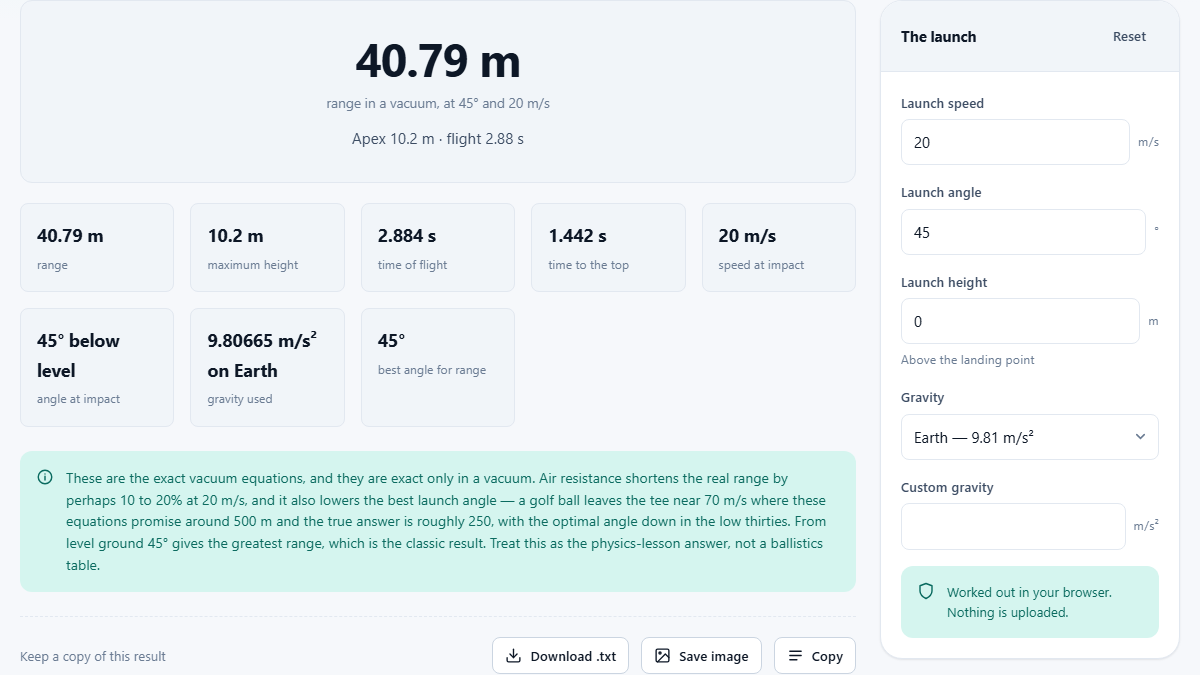
The headline is the range in metres. The line under it names the angle and the speed it came from, and below that sit the apex height and the total flight time. Which body's gravity was used gets its own row further down rather than appearing in the headline.
Eight rows of detail follow. Range is the horizontal distance to where the object lands. Maximum height is the peak of the arc, measured from the landing level. Time of flight is the full journey from launch to landing. Time to the top is how long the upward half takes, which is always shorter than the downward half when there is a launch height. Speed at impact is how fast the object is moving when it hits. Angle at impact tells you how steeply it comes down. Gravity used confirms which body and value were applied. Best angle for range gives the launch angle that would produce the longest throw under these exact conditions.
Below the numbers is a note about air resistance. At low speeds the note is calm. At higher speeds it turns into a warning, because the gap between the vacuum answer and reality grows with speed.
Why 45 degrees is the best angle, and when it is not
From level ground in a vacuum, 45 degrees gives the longest range. The reason is that range depends on the sine of twice the launch angle, and sine peaks at 90 degrees, which means twice the angle must be 90, so the angle itself must be 45. It is a clean, famous result.
It stops being true the moment you add a launch height. Throwing from a cliff, you get free hang time from the extra drop, and a flatter, faster throw exploits that better than a high lofted one. The best angle drops below 45 and keeps dropping as the height increases. The calculator shows this adjusted best angle whenever a launch height is entered.
It also stops being true in air. Drag slows the ball throughout its flight, and the slower half of the arc near the top suffers more. The real optimal angle for a golf ball is somewhere in the low thirties, not 45. The calculator does not model drag, but it warns you about this gap.
Complementary angles and the symmetry of the parabola
On level ground, 30 degrees and 60 degrees give exactly the same range. So do 20 and 70, or 10 and 80. These are called complementary angles because each pair adds to 90. One arc is flat and fast, the other is high and slow, but they land in the same spot.
This symmetry is a genuine result of the equations, not a coincidence. It follows directly from the fact that the sine of twice one angle equals the sine of twice its complement. It breaks the moment there is a launch height, because the high arc gets more benefit from the extra drop than the low one does.
Negative angles and downward throws
Setting a negative launch angle means throwing the object downward rather than upward. The calculator allows this because it is a legitimate scenario when there is a launch height. Throwing a ball downward from a bridge at minus 20 degrees with a 50 metre drop will produce a valid range and flight time.
Without a launch height, a negative angle sends the object straight into the ground. The range will be zero or near zero, and the flight time will be tiny. The equations handle this correctly, but the result is not interesting.
Air resistance and the drag warning
The note at the bottom of the results scales with the speed you entered. Below 10 metres per second, drag subtracts a few percent and the vacuum answer is reasonable. Between 10 and 30, the error climbs to perhaps 10 or 20 percent. Between 30 and 60 it reaches roughly a third. Above 60 it can be half or more.
The reason is that drag force grows with the square of speed. Double the speed and the drag force quadruples. At walking pace this barely matters. At the speed of a tennis serve it dominates the flight. At bullet speeds the vacuum equations are fiction.
Mass also enters the picture in air. Two objects of the same shape but different mass will follow different paths because the heavier one has more momentum to resist the drag force. In a vacuum, mass is irrelevant, which is why these equations do not ask for it. That was Galileo's insight, and it holds perfectly in a world without air.
Gravity on other worlds
Switching the Gravity dropdown is not a gimmick. A ball thrown at 20 metres per second at 45 degrees travels about 41 metres on Earth, 246 metres on the Moon and 108 metres on Mars. The Moon's gravity is roughly a sixth of Earth's, so everything flies six times as far and hangs in the air six times as long. Jupiter's gravity is about two and a half times Earth's, so the range shrinks to match.
These numbers matter in engineering contexts where gravity is different, and they also make the effect of gravity on range immediately tangible. The equations are the same everywhere; only the number plugged in for g changes. The custom gravity option lets you try any value, which is useful for hypothetical problems or for bodies not on the preset list.
A worked example from a cliff
Set the launch speed to 25 metres per second, the angle to 30 degrees and the launch height to 40 metres. Leave gravity on Earth. The result shows a range of about 95 metres, an apex of about 48 metres above the landing point, and a flight time of about 4.4 seconds. The best angle for range drops from 45 to about 34 degrees, because the cliff height gives the flatter throw more time in the air.
Now change the launch height to zero. The range drops to about 55 metres and the best angle goes back to exactly 45 degrees. The jump from 55 to 95 metres comes entirely from the 40-metre drop. Put the 40 metres back and switch gravity to the Moon, and the range grows to roughly 392 metres with a flight time near 18 seconds. That is a little over four times the Earth figures rather than the full six, because the six-fold rule belongs to level ground. Some of the Moon's flight here is spent falling the same 40 metres, and that part gains less.
Privacy and where the work happens
All the arithmetic runs on your own device. The speed, angle and height you enter are processed in your browser and are never sent to a server. There is no account and nothing is stored beyond the current session. The page works offline, because there is nothing on the other end to talk to.
For students and teachers, this means the tool can be used on a school network without concern about data leaving the building. The calculation is instant, repeatable and entirely local. No numbers leave the room and no records are kept once the tab is closed.