
How pregnancy due dates are worked out and what the number actually means
This article walks through the arithmetic behind a due date, explains why cycle length changes the answer, covers all four dating methods the calculator offers, and sets honest expectations about a number that only one baby in twenty-five will hit.
The 280-day rule and where it comes from
A due date starts with a count of 280 days from the first day of the last menstrual period. That is 40 weeks. The convention sounds strange because a person is not pregnant during the first two of those weeks. The period comes first, then ovulation, then conception roughly two weeks in. But the first day of bleeding is something most people can remember with confidence, while the exact day of conception usually is not. Clinics everywhere settled on the period date for that reason, and the 280-day count has stuck for over a century.
The rule is often called Naegele's rule, after a German obstetrician who published it in the early 1800s. It amounts to adding nine months and seven days, or equivalently 40 complete weeks. Every online calculator and every clinic appointment uses this same starting point.
What the four dating methods do
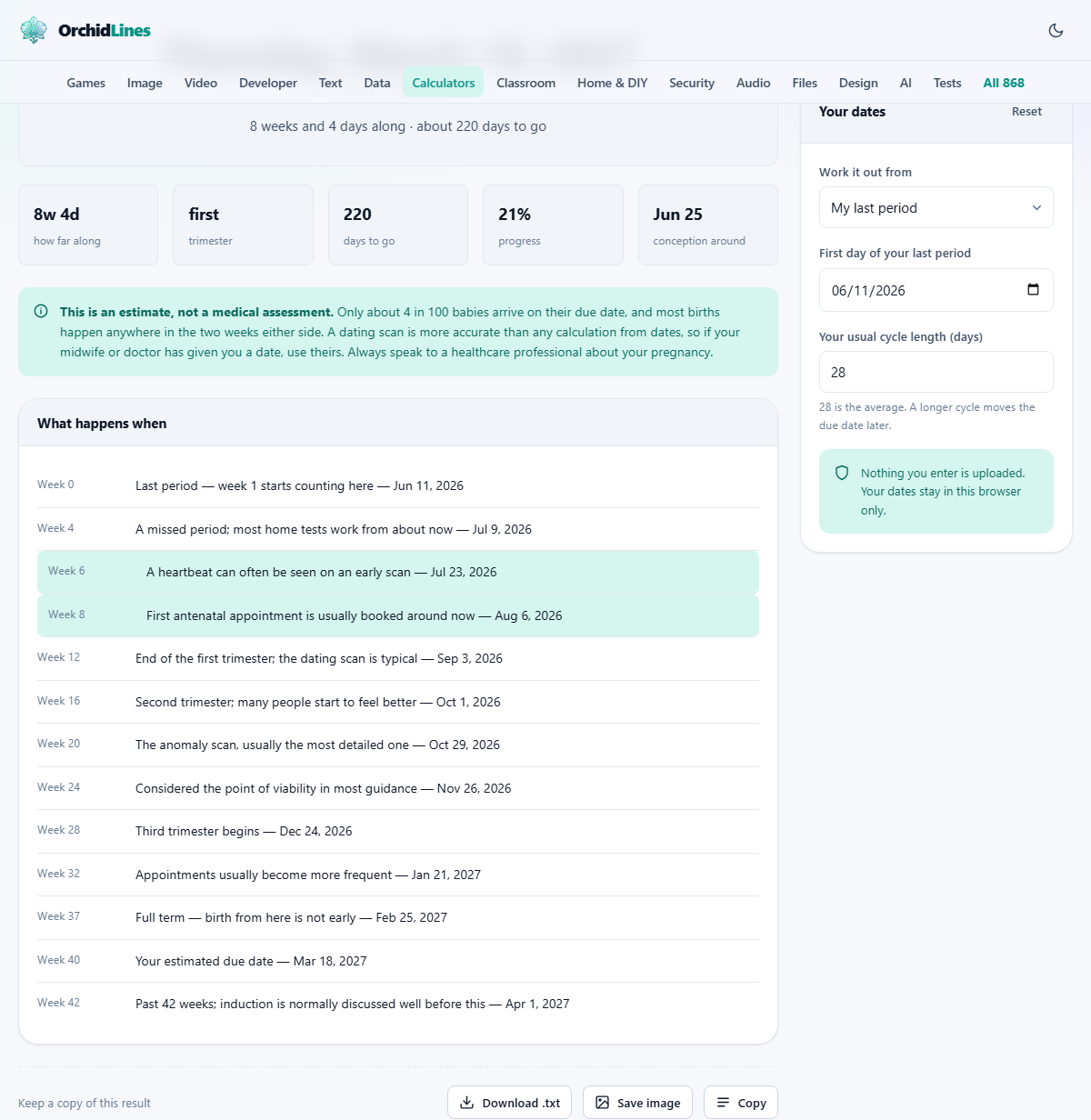
The Work it out from dropdown offers four choices. My last period is the default and uses the standard 280-day count. Conception date counts 266 days instead, because those first two non-pregnant weeks are no longer in the picture. IVF, 5-day transfer counts 261 days, and IVF, 3-day transfer counts 263 days, each accounting for the known age of the embryo at transfer.
When conception or IVF is chosen, the cycle length field disappears because it is no longer relevant. The timing of conception is already known, so there is nothing to adjust. When the period method is chosen, cycle length stays visible because it is the single most important correction.
Why cycle length shifts the due date
The 280-day rule assumes a 28-day cycle with ovulation on day 14. A person whose cycle runs 35 days typically ovulates around day 21 instead. That is a full week later, and the due date should move a week later to match.
Most online due date calculators quietly ignore this. They take the period date, add 280 days, and hand you a number that may be several days off before the calculation even starts. The Your usual cycle length field is there to fix that. A longer cycle pushes the due date forward. A shorter one pulls it back. The adjustment is simple: the difference between the entered cycle length and 28 is added to the 280-day count.
If you are not sure of your cycle length, leave it at 28. That gives the standard answer, which is the same one a clinic would give you before a scan.
Reading the results panel
The headline shows the estimated due date as a full calendar date. Below it, a line tells you how many weeks and days along you are and roughly how many days remain.
Five facts sit beneath that. How far along in weeks and days. Which trimester you are in, first, second or third. Days to go until the due date. A progress percentage across the 40 weeks. And the approximate conception date, which is derived from the period date and cycle length.
Under the facts is a week-by-week timeline. It lists thirteen milestones from week zero through week 42, each one dated to your own calendar. The row closest to where you are now is highlighted. The milestones cover the usual booking appointment, the dating scan, the anomaly scan, the point of viability, the start of the third trimester, full term at 37 weeks, the due date at 40, and post-dates at 42.
Why almost nobody gives birth on the due date
The number is an estimate. Around four percent of babies arrive on the predicted day. The rest come anywhere in a window that stretches from about 37 weeks to 42 weeks, all of which is considered normal. A first baby tends to arrive a little later than a subsequent one, and individual variation is wide.
It is more useful to think of a due month than a due date. The two weeks either side of the headline number is the realistic window. Treating the date as a deadline sets up an unnecessary countdown that causes stress when the day passes without anything happening, which is what happens most of the time.
A dating scan performed in the first trimester is more accurate than any formula based on remembered dates. The scan measures the embryo directly, and the margin of error is about three to five days compared with perhaps a week or more for a period-based calculation. If a midwife or doctor gives a date based on a scan, that is the one to use.
IVF dates and why they are the most precise
In an IVF cycle the moment of conception is known exactly, because embryo creation happens in a laboratory. A 5-day transfer means the embryo was cultured to the blastocyst stage before being placed. A 3-day transfer means it was placed earlier, at the cleavage stage. The calculator counts backward from those known ages to work out what the equivalent period date would have been, and then counts forward 280 days from there.
Because the timing is certain, IVF dates do not need a cycle length correction. There is nothing to estimate. The result is as accurate as a date-based calculation can be, which is still an estimate of when labour will begin, but it starts from a firmer foundation.
Weeks from the period versus weeks from conception
A source of confusion is that gestational age, the number clinics use, counts from the last period, while the actual age of the embryo is about two weeks less. When someone says they are six weeks pregnant, the embryo is roughly four weeks old.
Both numbers appear in the results so the difference is clear. The weeks-and-days figure uses the standard gestational count, and the conception date shows when fertilisation is thought to have happened. Understanding the gap matters because medical references, development charts and scan reports all use gestational weeks, and mixing the two up by a fortnight leads to unnecessary worry.
Trimesters and what changes between them
The trimester label in the results follows the standard split. The first trimester runs from week one to week twelve. The second covers weeks thirteen through twenty-six. The third starts at week twenty-seven and runs to delivery.
Each trimester carries different screening and monitoring schedules. The dating scan and first-trimester screening fall in the first. The anomaly scan, the detailed one that checks physical development, happens around week twenty in the second. In the third, appointment frequency increases and monitoring of growth and position becomes the focus. The timeline on the results panel maps these to your own calendar.
Common mistakes when working out a date
Using the last day of bleeding instead of the first is the most frequent error. The count begins on the first day of the period, not the day it stopped. Getting this wrong by four or five days pushes the due date out by the same amount.
Ignoring cycle length is the second. A cycle that runs 35 days consistently will produce a due date that is a week later than the standard formula suggests, and using the standard answer means expecting the baby a week early.
Relying on this or any calculator instead of a scan is the third. The calculator gives a good starting point, but a dating scan in the first twelve weeks is the accepted standard of care. It measures the embryo directly and catches situations where dates alone would be misleading, such as irregular cycles or uncertain period dates.
Privacy and where the dates are kept
Everything runs on your own device. The dates you enter are processed in your browser and are never sent to any server. There is no account, no login, and no record kept anywhere except on your own machine. Closing the tab is the only cleanup needed.
Pregnancy dates are personal medical information. A tool that handles them should not require them to leave the room, and this one does not. You can verify that by disconnecting from the internet and using the calculator as normal. It still works, because there was never anything on the other end.