
Understanding your pet's age in human years
This article explains how dogs and cats really age compared with people, why the old multiply-by-seven rule fails, how body size changes everything for dogs, and what the life stage labels mean for your pet's care.
Where the times-seven myth came from
The idea that one dog year equals seven human years seems to have appeared in the 1950s. The reasoning was simple: people live about 70 years, dogs live about 10, so divide one by the other. It was never more than a rough rule of thumb, and it gets both ends of a dog's life badly wrong.
A one-year-old dog is not a seven-year-old child. It is fully grown, can reproduce, and is closer in maturity to a fifteen-year-old person. At the other end, a healthy small dog at fourteen is far more vigorous than most centenarians, though seven-times would put it at 98. The formula ignores the most important variable of all: body size.
How dogs actually age
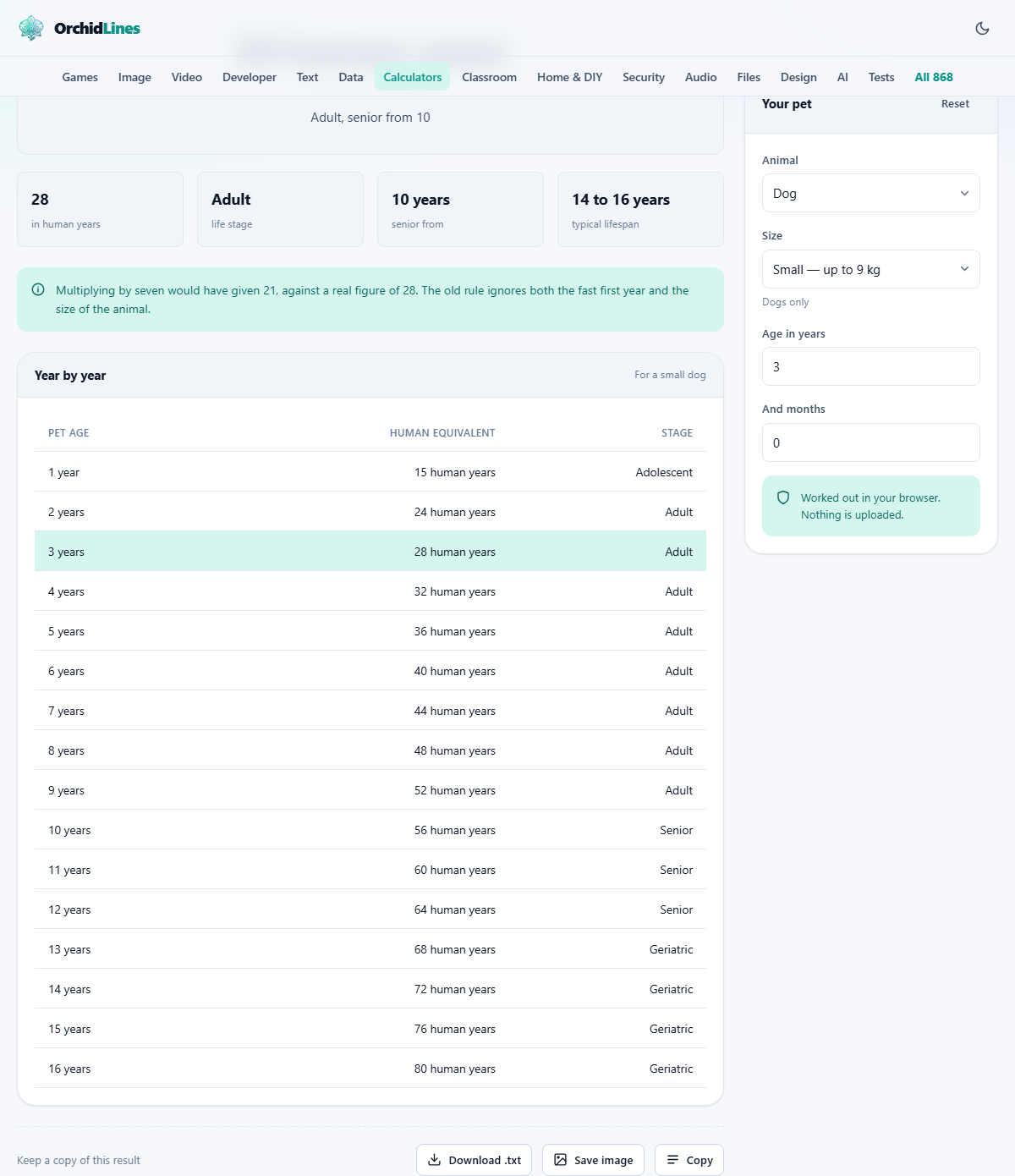
Modern age tables split a dog's life into phases that happen at very different speeds. The first year packs in roughly fifteen human years of development. The second adds about nine more. After that, each year adds between four and seven human years, and the rate depends almost entirely on how big the dog is.
A small dog under about 9 kilograms ages slowly after those first two years. Each calendar year adds around four human years. A giant breed over 45 kilograms, on the other hand, adds about seven per year. That is why a Great Dane at eight can look elderly while a terrier of the same age is still bounding around a park.
Using the calculator for a dog
Set the Animal dropdown to Dog, then pick the size bracket that fits. The four choices are Small (up to 9 kg), Medium (9 to 23 kg), Large (23 to 45 kg) and Giant (over 45 kg). Enter the age in years and months. Months matter a great deal in the first two years, when a single month is worth more than a full human year of development.
The result appears immediately. It gives you the human-equivalent age and the life stage your dog is in. Breeds that sit on the boundary between two size brackets can be entered either way to see the range. The difference is usually only a year or two in human terms, but it can change the life stage label. If you are unsure which bracket fits your dog, weigh it and pick the bracket that contains that weight. For mixed breeds with an unclear adult weight, medium is a reasonable default.
How cats age differently
Cats follow a simpler curve. The first year is worth about fifteen human years, much like a dog. By the end of the second year a cat is roughly 24 in human terms. After that the rate settles to about four human years for every one cat year, regardless of size. A ten-year-old cat is around 56 in human years. A fifteen-year-old is around 76.
The calculator adds a dropdown labelled Kept with two choices: Indoors and Outdoors or both. Indoor cats tend to live longer and face fewer health risks, so the distinction matters when thinking about expected lifespan and when to increase the frequency of vet visits. Outdoor cats are exposed to traffic, fights, parasites and weather, all of which shorten average life expectancy. An indoor cat reaching the equivalent of eighty in human years is not unusual, while an outdoor cat may age somewhat faster due to the accumulated physical demands of life outside.
Life stages and what they mean for care
The calculator does not just give a number. It also labels the life stage: puppy or kitten, adult, mature, and senior. These labels are often more useful than the human-years figure, because each stage carries practical advice about feeding, exercise and health checks.
A puppy or kitten needs vaccinations, socialisation and frequent meals. An adult needs routine annual check-ups and a stable diet. A mature pet benefits from blood work to catch problems early. A senior pet, which for a giant breed dog can start as early as age six, generally needs twice-yearly vet visits, joint support and adjusted portions.
The stage boundaries shift with size. A small dog may not enter the senior stage until ten or eleven. A giant breed arrives there at six. Knowing which stage your pet is in helps you have a better-informed conversation with your vet about what screening and diet changes are appropriate.
Why bigger dogs age faster
Across most of the animal kingdom, larger species live longer than smaller ones. Elephants outlive mice. But within dogs the pattern reverses: large breeds have markedly shorter lives than small ones. The reasons are not completely settled, but the leading explanation is that big dogs grow faster during their first year, and that accelerated growth comes at a cost.
Rapid early growth puts more strain on cells and organs. Studies have found that large breeds show signs of ageing-related disease earlier and that their cells accumulate damage at a higher rate. The practical upshot is that a Labrador and a Chihuahua born on the same day are not the same biological age a few years later, and treating them as if they were leads to missed health checks for the bigger dog.
Breed versus size bracket
The size bracket is a good default, but individual breeds can fall well outside their bracket's average lifespan. Some medium-sized breeds are famously long lived. Others are known for specific health issues that shorten life regardless of weight. A Cavalier King Charles Spaniel faces different risks from a Border Collie, even though both fall in the medium range.
The calculator gives you a solid general figure based on the most widely accepted veterinary age tables. If you want a breed-specific estimate, the number here is the right starting point, and your vet can refine it based on your dog's particular lineage, health history and lifestyle.
Common mistakes when comparing ages
The biggest mistake is still the seven-times rule, but there are others. People sometimes assume that because a one-year-old dog can reproduce, it is the equivalent of an eighteen-year-old person. Biological maturity and social maturity are not the same thing, and the age tables account for overall physiological wear rather than any single milestone.
Another common error is applying dog tables to cats. The two species age on different curves. A five-year-old cat and a five-year-old medium dog are not the same human-equivalent age, even though they share a calendar birthday. Always make sure the Animal dropdown matches your pet before reading the result. Switching between the two is instant, so you can compare a dog and a cat in the same household in seconds.
Planning ahead with the number
The human-years figure is most useful as a planning tool. If your eight-year-old large dog is the equivalent of a sixty-year-old person, it becomes obvious why the vet suggests annual blood panels now rather than waiting until something goes wrong. If your indoor cat is the equivalent of a forty-year-old at age six, it makes sense that it still has decades of life ahead and that a small diet change now can pay off over many years.
Tracking the number year by year also helps you notice the transition points. The jump from adult to mature, and from mature to senior, are the moments when prevention becomes far more cost-effective than treatment. Knowing roughly when those transitions will happen for your breed and size means you can budget for the extra visits and adjust food and exercise before problems appear.
Privacy and how the tool works
Everything is worked out inside your browser on your own device. No information about your pet is sent anywhere. There is no account, no login, and no data stored beyond what you see on the screen. Close the tab and it is gone.
The modern veterinary age tables that the calculator uses are well established and widely cited. They are not a prediction for any individual animal, but they give a far more honest answer than the old times-seven shorthand ever did, and that honesty is worth something when you are making decisions about your pet's health.