
How to work out how many cartons fit on a pallet and in a container
This article explains how the Pallet and Container Loading calculator works, why dividing areas gives a wrong answer, and how to read the results it produces. It covers carton measurement, pallet types, stack height and weight limits, the overhang setting, container loading, and the Ti-Hi shorthand used in warehouses. Every calculation runs on your own device.
Why area division fails
The most common way people estimate how many boxes fit on a pallet is to divide the pallet area by the box footprint. A 1200 by 800 millimetre Euro pallet has an area of 960,000 square millimetres. A 350 by 250 box has a footprint of 87,500 square millimetres. Divide them and you get about 11. But when you actually try to lay those boxes on the pallet, you find you can fit only 9, because a 350 box does not divide evenly into 1200 and the leftover strip is too narrow to hold another box.
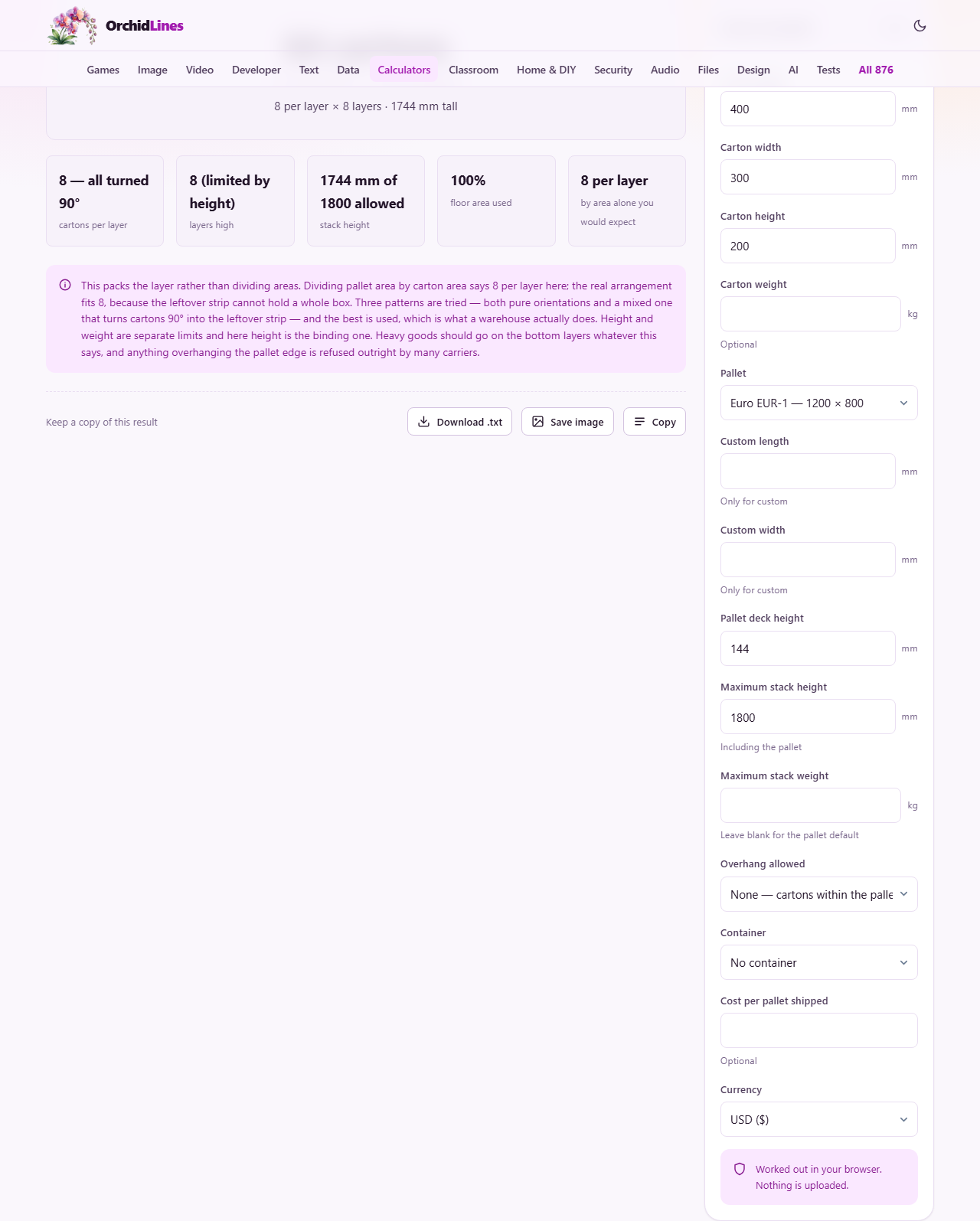
The calculator avoids this trap by packing the layer properly. It tries the boxes in three different patterns, including turning some of them 90 degrees to use the leftover strips, and keeps the layout that fits the most. The result is always a number you can actually achieve on a real pallet, not a number that only works if you could slice a carton in half.
Measuring the carton
Three fields take the carton dimensions: Carton length, Carton width and Carton height, all in millimetres. These should be the outside measurements of the packed carton, not the flat dimensions of the empty box. A carton that measures 400 mm when flat but bulges to 406 mm when fully packed should be entered as 406. Even a few millimetres matter when you are packing a tight layer, because one oversize box can push the last carton off the edge of the pallet.
An optional Carton weight field, in kilograms, lets the calculator check whether the weight limit is reached before the height limit. On dense goods such as canned food or liquids, weight nearly always bites first. Leave the field blank if you only care about the physical fit and do not need a weight check.
Choosing the pallet
The Pallet dropdown offers six standard sizes and a custom option. Euro EUR-1 is 1200 by 800 mm and is the most widely used pallet in Europe. Euro EUR-2 and UK standard are both 1200 by 1000 mm. US GMA is 1219 by 1016 mm, the North American standard. Half Euro is 800 by 600 mm, common in retail display. Quarter is 600 by 400 mm, used for small display units and point-of-sale stacks.
If your pallet does not match any of these, select Custom and fill in the Custom length and Custom width fields. The Pallet deck height field, which defaults to 144 mm, tells the calculator how much of the stack height the pallet itself takes up. Change this if you use thinner or thicker pallets, because every millimetre of deck height is a millimetre less for cartons.
Stack height and weight limits
The Maximum stack height field sets the ceiling for the loaded pallet, including the pallet deck. The default is 1800 mm, which is a common limit in warehouses and on trailers. Some operations allow 2000 mm or even 2400 mm for racking. Enter whatever limit applies to your situation.
The calculator subtracts the deck height from the stack height, then divides by the carton height to find how many layers fit. It rounds down because you cannot stack a partial layer. If you also entered a carton weight, it multiplies the weight per carton by the total count and checks it against the Maximum stack weight. The output tells you which limit was reached first, so you know whether it is height or weight that is stopping you from adding more boxes.
Getting this check right matters for heavy goods. A pallet of bottled water might only stack four layers high before it hits the weight limit, even though eight layers would fit in the height. Without the weight check, you would plan for eight and then find out on the loading dock that the forklift cannot safely handle the stack.
Overhang and why it matters
The Overhang allowed dropdown has three options: None, Up to 20 mm each side, and Up to 50 mm each side. Overhang means the carton sticks out past the edge of the pallet. Even a small overhang can squeeze one extra carton into a layer, which adds up fast across many layers and many pallets.
But overhang comes with risks. A carton hanging over the edge loses the support of the pallet deck beneath it. Its compression strength drops because it is holding itself up rather than resting on a flat surface. Many carriers and warehouses refuse pallets with visible overhang because the outer cartons can be crushed during transport or when pallets are stacked in a rack.
Leave the setting at None unless your supply chain specifically allows overhang. If it does, 20 mm is a common tolerance and 50 mm is the upper end of what most operations will accept.
Ti-Hi: what warehouses call it
In warehouse and logistics shorthand, a pallet configuration is described as Ti by Hi. Ti is the number of cartons per layer and Hi is the number of layers high. A pallet with 8 cartons per layer and 9 layers is an 8 by 9, giving 72 cartons total.
The calculator shows both numbers in its output. The per-layer count is Ti and the layers-high count is Hi. If someone in a warehouse asks for the Ti-Hi of a product, you can read it straight from the result. This shorthand appears on pallet specification sheets, in warehouse management systems, and in purchase orders, so seeing it in the same format the industry uses saves a step when filling in paperwork.
Loading pallets into a shipping container
The Container dropdown adds a second stage to the calculation. Options are 20 ft standard, 40 ft standard, 40 ft high cube and 45 ft high cube, or No container if you only need the pallet count. When you select a container type, the calculator works out how many pallets fit on the container floor and whether the container height allows the pallets to be double stacked.
A standard 40-foot container can hold about 25 Euro pallets on the floor in a single tier. Whether you can stack a second tier depends on the loaded pallet height and the inside height of the container. A high cube container gives roughly 300 mm more headroom, which can be the difference between single and double stacking for many pallet sizes.
An optional Cost per pallet shipped field, combined with the Currency dropdown, multiplies the cost by the number of pallets to give a total shipping estimate. This is a rough guide for comparing loading plans, not a freight quote, but it can show whether fitting one more carton per layer saves enough pallets to make a meaningful difference in transport cost.
Limits of the estimate
The calculator assumes every carton is the same size and stacks squarely on top of the one below. In practice, cartons sag under weight, swell in humidity, and shift during transport. Slip sheets, corner boards and stretch wrap all take up a few millimetres that the arithmetic does not count.
It also does not model stack stability. A column stack, where every layer lines up directly above the one below, carries the most weight because the corrugated walls are in compression. A brick pattern, where layers are offset like brickwork, interlocks better and resists toppling, but the offset puts part of each carton over empty space and can crush the one below. The choice between these patterns depends on the product and the journey, and no simple calculator can make that call for you.
Privacy and where the maths runs
Every calculation runs inside your browser on your own device. No carton dimensions, pallet sizes, weight figures or cost estimates are sent to any server. There is no account to create, no login, and no data stored beyond your own machine.
For logistics teams working on product specifications before a launch, this is a practical benefit. You can run scenarios for different carton sizes, pallet types and container options without uploading anything to a third-party tool or signing up for a trial. The Reset button in the panel header clears all the fields back to their defaults when you want a fresh start.