
How to work out exactly how much paint a room needs
This article walks through the Paint Calculator step by step: measuring the room, accounting for doors and windows, choosing the right coverage figure, and reading the result in litres and tins. It also covers why two coats is always the real minimum, what the calculator leaves out on purpose, and how to avoid the most common mistake people make when buying paint.
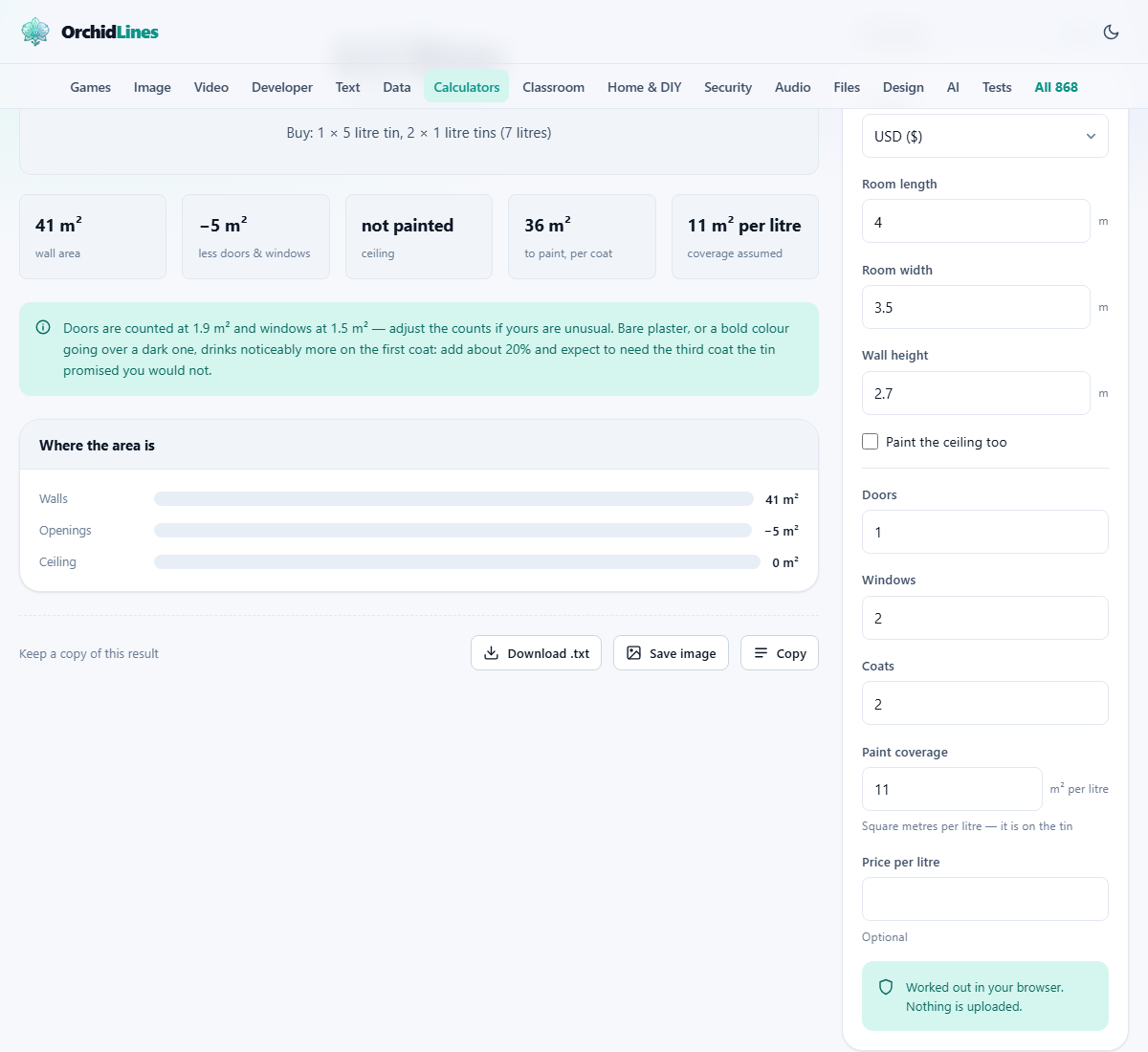
What the calculator works out
The tool takes the length, width and height of a room, subtracts the area taken up by doors and windows, adds the ceiling if you are painting it, multiplies by the number of coats, and divides by the coverage rate of the paint you plan to use. The result is the total number of litres you need, rounded up to whole tins because that is how paint is sold.
The output also tells you which tin sizes to buy. If you need 7 litres, it is cheaper to buy a 5-litre and a 2.5-litre than three 2.5-litre tins. The small surplus from rounding up is not wasted; it becomes your touch-up supply for scuffs and marks over the coming months and years.
Measuring the room
Three fields cover the room itself: Room length, Room width and Wall height, all in metres. The calculator uses these to work out the wall area by adding up the four walls. The formula is simple: two walls are length times height and two are width times height, giving a total perimeter times height.
Exact measurements are nice but not essential. Paint comes in fixed tin sizes, so a few centimetres either way rarely changes the number of tins you need. If a room measures 3.48 metres, calling it 3.5 is fine. The rounding up to whole tins absorbs small measurement errors comfortably. Spending five minutes with a tape measure is plenty; spending thirty chasing centimetres gains you nothing that the tin rounding does not already cover.
Doors, windows and the ceiling
Below the room dimensions are fields for Doors and Windows. The calculator uses standard sizes for each: about 1.9 square metres per door and 1.5 square metres per window. These are close enough for a typical house. If your windows are very large picture windows or your doors are double-wide, you could count each as two.
The checkbox labelled Paint the ceiling too adds the ceiling area to the total. Ceiling paint is usually a different product, formulated to drip less and dry flatter, so even though the calculator includes it in the area, you should buy it as a separate tin. The area figure is still useful because it tells you how much of that separate product you need.
Coats: why two is the real minimum
The Coats field defaults to 2, and that default is honest. One coat of paint is a touch-up, not a paint job. A single coat over bare plaster, over a strong existing colour, or in any light-over-dark situation will look patchy and thin once it dries. The wet coat always looks better than the dry one.
Some premium paints claim full coverage in a single coat. In ideal conditions on a smooth, sealed, primed wall, that claim can be true. In a real room with slightly uneven plaster, slightly different lighting angles, and a roller that does not lay paint with factory precision, the second coat is what makes it look finished. Budget for two coats. If you are covering a bold red or dark green with white, budget for three.
Changing the field from 2 to 3 increases the litres and tins in the output right away. This makes it easy to see what the extra coat costs before you start, rather than finding out halfway through the job when the shop has closed.
Coverage: the number that makes or breaks the estimate
The field labelled Paint coverage asks for the number of square metres one litre of paint will cover. This figure is printed on every tin of paint, usually on the back label. It ranges from about 8 to 14 depending on the brand, the type, and the finish. Matte paints tend to cover more area per litre than gloss paints because they are thinner.
The default value is 11, which sits in the middle of the range and works as a reasonable guess if you have not picked your paint yet. But using the real number from your chosen tin is what turns a rough guess into a reliable estimate. A paint rated at 8 square metres per litre needs nearly 40 per cent more volume than one rated at 11, and that is the difference between two tins and three.
Tin figures assume a smooth, sealed, primed surface applied under ideal conditions. Textured walls, rough plaster and absorbent surfaces all reduce coverage in practice. If you know the walls are rough, shading the coverage number down by one or two is a sensible precaution.
Price per litre and the cost estimate
An optional field labelled Price per litre lets you see the total cost alongside the total volume. The Currency dropdown beside it changes the symbol used in the output. Both fields are optional; leave them blank and the calculator still gives you litres and tins.
The price estimate is especially useful when comparing two paints. A cheaper paint with lower coverage can end up costing more overall because you need more of it. Enter both prices with their matching coverage figures and the bottom-line cost tells you which one is actually cheaper for the job. This comparison is hard to do in a shop aisle but takes a few seconds with the calculator.
What the calculator does not include
The result covers the walls and optionally the ceiling. It does not cover primer, undercoat, woodwork, skirting boards, door frames or window frames. These are separate jobs that use different types of paint and far smaller quantities.
If your walls need a primer coat, run the calculator again with one coat and the coverage figure from the primer tin. That gives you the primer volume separately, which is easier to manage at the paint counter. Woodwork is usually done with a small tin of gloss or satin and a brush rather than a roller, and the quantities are small enough to estimate by eye.
The calculator also does not account for waste. Some paint stays in the roller tray, some gets left on the roller sleeve, and some gets wiped off during masking-tape removal. In practice, the rounding up to the next whole tin size usually covers this waste comfortably. If the numbers land right on a tin boundary, buy the next size up.
Practical tips for buying paint
Buy everything for a room in one trip. Paint is colour-matched by mixing pigment into a base, and two batches mixed a week apart can differ in shade just enough to be visible where they meet on a wall. Buying the full quantity at once avoids that risk.
Keep the leftover paint. Label the tin with the room name and the date, and store it somewhere cool. When a chair scuffs the wall a year from now, having the exact same paint ready means a clean invisible touch-up instead of a full repaint. The small amount left over from rounding up to whole tins is precisely the right quantity for this purpose.
- Use the coverage from your actual tin, not the default.
- Round up rather than down when you are on the boundary between tin sizes.
- Budget for two coats minimum and three when covering bold colours with lighter ones.
- Run the calculator once for the wall paint and once for the primer if the walls need it.
Privacy and where the numbers run
Every calculation runs inside your own browser on your own device. No room dimensions, no paint preferences, and no prices are sent to any server. There is no account, no login, and no data stored beyond your own machine. The Reset button in the panel header clears all values back to their defaults.
A room's dimensions and what you plan to do with it might not sound like sensitive data, but renovation activity is routinely used for marketing profiles and targeted advertising. Here, nothing leaves your browser. You can load the page, go offline, and keep using it without any change in how it works.