
Estimating your ovulation date and fertile window from your cycle
This article explains how the Ovulation Calculator works, why it counts backwards from your expected next period rather than forwards from the last one, and what the fertile window means in practice. It also covers the limits of calendar-based estimates, when to use ovulation test kits instead, and how your data stays private throughout.
What the calculator gives you
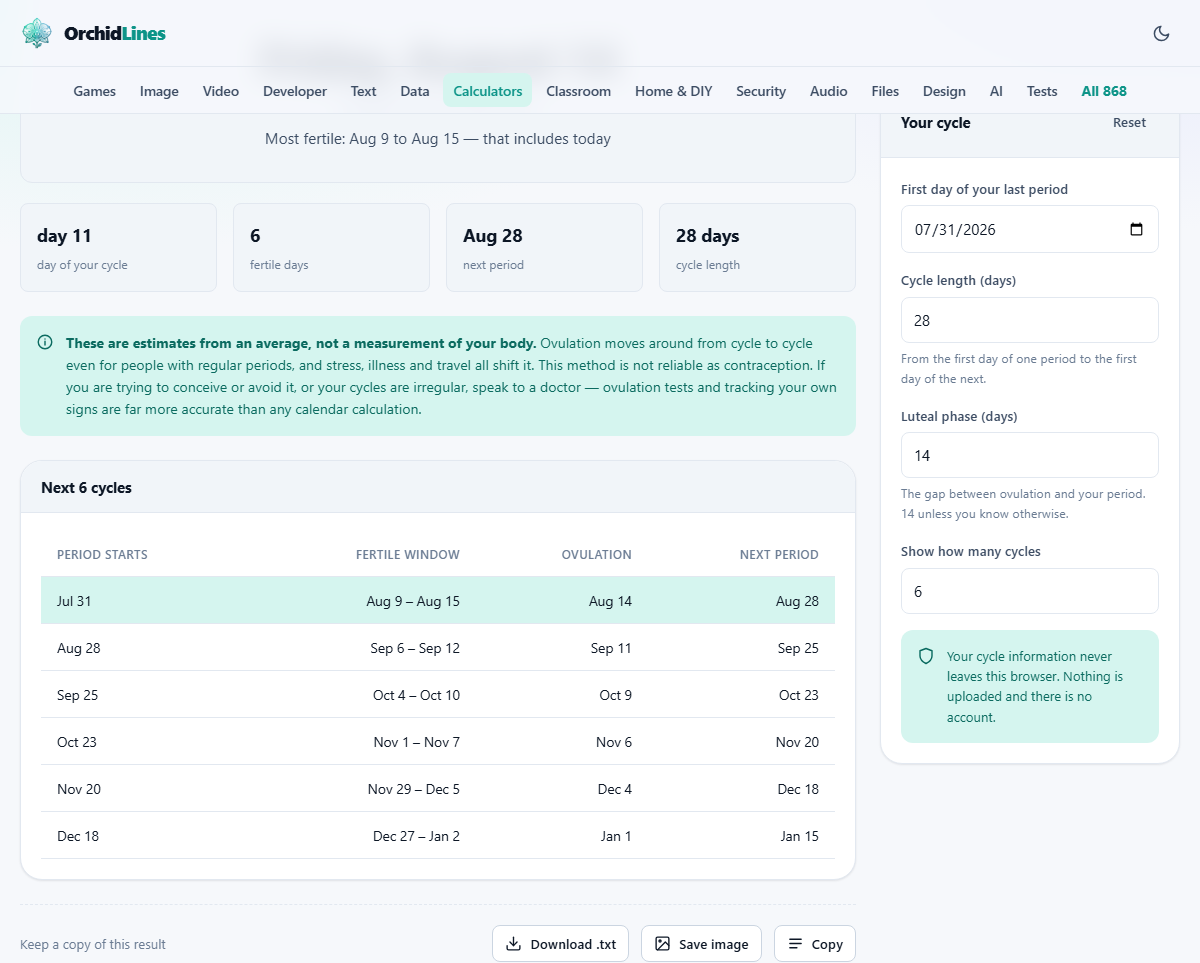
The tool takes three pieces of information: the start date of your most recent period, the usual length of your cycle in days, and the length of your luteal phase. From those three numbers it estimates the day you are most likely to ovulate and marks out a window of about six days around it when conception is possible. It then projects that window forward across several upcoming cycles so you can see the pattern without having to count on a calendar each month.
The output is a table with one row per cycle. Each row shows the estimated ovulation date, the start and end of the fertile window, and the expected date of your next period. If the current date falls inside a fertile window, that row is highlighted so you can see it at a glance.
Why it counts backwards, not forwards
Many older calculators estimate ovulation by adding 14 days to the start of the last period. That only gives the right answer when the cycle is exactly 28 days long. The reason is that a menstrual cycle has two halves, and they behave very differently. The first half, before ovulation, can vary a lot from one cycle to the next and from one person to another. The second half, after ovulation, is called the luteal phase and it stays much more consistent, usually close to 14 days.
Because the luteal phase is the stable part, a better method is to work out when the next period is due and then count backwards. For a person with a 35-day cycle, that puts ovulation around day 21, not day 14. That is a full week of difference, and it explains why a forward-counting method can point to completely the wrong part of the cycle.
The input fields explained
The first field, labelled First day of your last period, wants the date bleeding started, not the date it ended. This is day one of the cycle in medical terms and it is the anchor for every other calculation.
The second field, Cycle length, is the number of days from the first day of one period to the day before the next one starts. If your cycles vary, use your average. A cycle that runs 27 days one month and 31 the next has an average of 29. The field accepts values from 20 to 45 days.
The third field is Luteal phase. Most people should leave this at 14 unless they have been tracking their cycle closely and know their own number. It can range from 9 to 17 days, but 14 is a solid default for most people. The fourth field, Show how many cycles, controls how many future cycles appear in the results table. You can set it from 1 to 12.
What the fertile window actually means
An egg survives for roughly one day after it is released. Sperm can survive inside the body for up to about five days. That overlap creates a window of approximately six days during which conception is possible: the five days before ovulation plus the day of ovulation itself.
The window is not equally fertile throughout. The two or three days leading up to ovulation are generally considered the most likely time for conception. The day after ovulation has a much lower chance because the egg is already aging. But because neither the egg's lifespan nor the sperm's is exact, the wider six-day range is the one most doctors use as a guide.
It is worth keeping in mind that these are averages drawn from large studies. In any given cycle, ovulation might happen a day earlier or later than expected, and sperm survival varies between individuals and between cycles. The window is a best estimate, not a guarantee, and using it alongside other tracking methods gives a more complete picture.
Irregular cycles and when calendars fall short
Calendar-based prediction works best when cycles are regular. If your cycle length varies by more than a few days from one month to the next, the estimate becomes less reliable because the tool cannot know which length this particular cycle will follow.
For people with irregular cycles, ovulation predictor kits are a much better option. These kits detect a surge in luteinising hormone that happens about one to two days before the egg is released. They test what is happening right now rather than what happened on average in the past. The calculator can still be useful as a rough guide for when to start testing, but the kit gives the actual timing.
Basal body temperature tracking is another approach. Your resting temperature rises slightly after ovulation and stays elevated until the next period. Charting it over several months reveals a pattern, though it confirms ovulation after the fact rather than predicting it in advance. Combining temperature data with a calendar estimate gives a more complete picture than either one alone.
This is not a contraceptive method
Calendar-based fertility awareness is among the least reliable ways to avoid pregnancy. Ovulation can shift in response to stress, illness, travel, disrupted sleep, and changes in weight or exercise. A cycle that has been regular for months can produce an early or late ovulation without warning.
If you are trying to avoid pregnancy, use a proven contraceptive method rather than relying on calendar dates. The tool is designed to help people who are trying to conceive or who want to understand their cycle better, not to serve as birth control. The distinction matters because the consequences of a wrong prediction are very different depending on which side of that line you are on.
Combining the calendar with other signs
The body gives several signals around ovulation that a calendar cannot capture. Changes in cervical mucus are one of the most noticeable. In the days leading up to ovulation, mucus tends to become clearer, more slippery, and stretchy, often compared to raw egg white. After ovulation it becomes thicker and less abundant.
A slight rise in basal body temperature, measured first thing in the morning before getting out of bed, confirms that ovulation has happened. Used together, temperature and mucus data create a fuller picture than any single method provides. The calculator's dates can tell you roughly when to start paying attention to these signs, which makes the combination practical even for people who do not want to chart every day of the month.
How the luteal phase shapes the estimate
The luteal phase is the stretch of days between ovulation and the start of the next period. While the first half of the cycle can differ greatly from one cycle to the next, the luteal phase for any given person tends to stay within a day or two of the same length. That consistency is the whole reason the backward-counting method works.
If you know your luteal phase is shorter or longer than 14 days, entering the correct number makes a real difference to the estimate. A person with a 12-day luteal phase and a 28-day cycle ovulates on day 16, not day 14. That two-day shift can matter when you are timing tests or tracking signs. If you do not know your own number, 14 is a safe starting point because it sits in the middle of the normal range.
Privacy and how your data is handled
Cycle data is deeply personal, and the tool is built with that in mind. Every calculation runs inside your own browser on your own device. No dates, cycle lengths, or results are sent to any server. There is no account to create, no login to remember, and no data stored anywhere except on your own machine.
This matters more for a reproductive health tool than for most calculators. Period-tracking apps have faced scrutiny over how they store and share data. Here there is nothing to share because nothing leaves your browser. You can load the page, turn off your internet connection, and it keeps working. The privacy notice on the page states this clearly, and the page's source code confirms it.