
Planning the clock times for a course of medicine
Medicine labels say things like 'three times a day' or 'every eight hours', and those two instructions produce different schedules. This article explains how the Dose Schedule Planner lays out actual clock times, what each control does, and why the distinction between the two types of instruction matters more than most people realise.
Two kinds of instruction that people confuse
A label that says 'four times a day' almost always means four doses spread across your waking hours. A label that says 'every six hours' means every six hours around the clock, including during the night. The first lets you sleep undisturbed. The second does not, and it is written that way on purpose, because the drug needs to stay above a certain level in your blood at all times.
Confusing the two can mean either a lost night of sleep or, more seriously, a missed dose at the wrong time. The distinction is written on the label, but labels are often small and the wording is not always clear, especially when you are unwell and not reading carefully. The planner handles both types. You tell it which instruction you were given, and it produces a list of clock times that matches, removing any ambiguity about when each dose should happen.
What the controls ask for
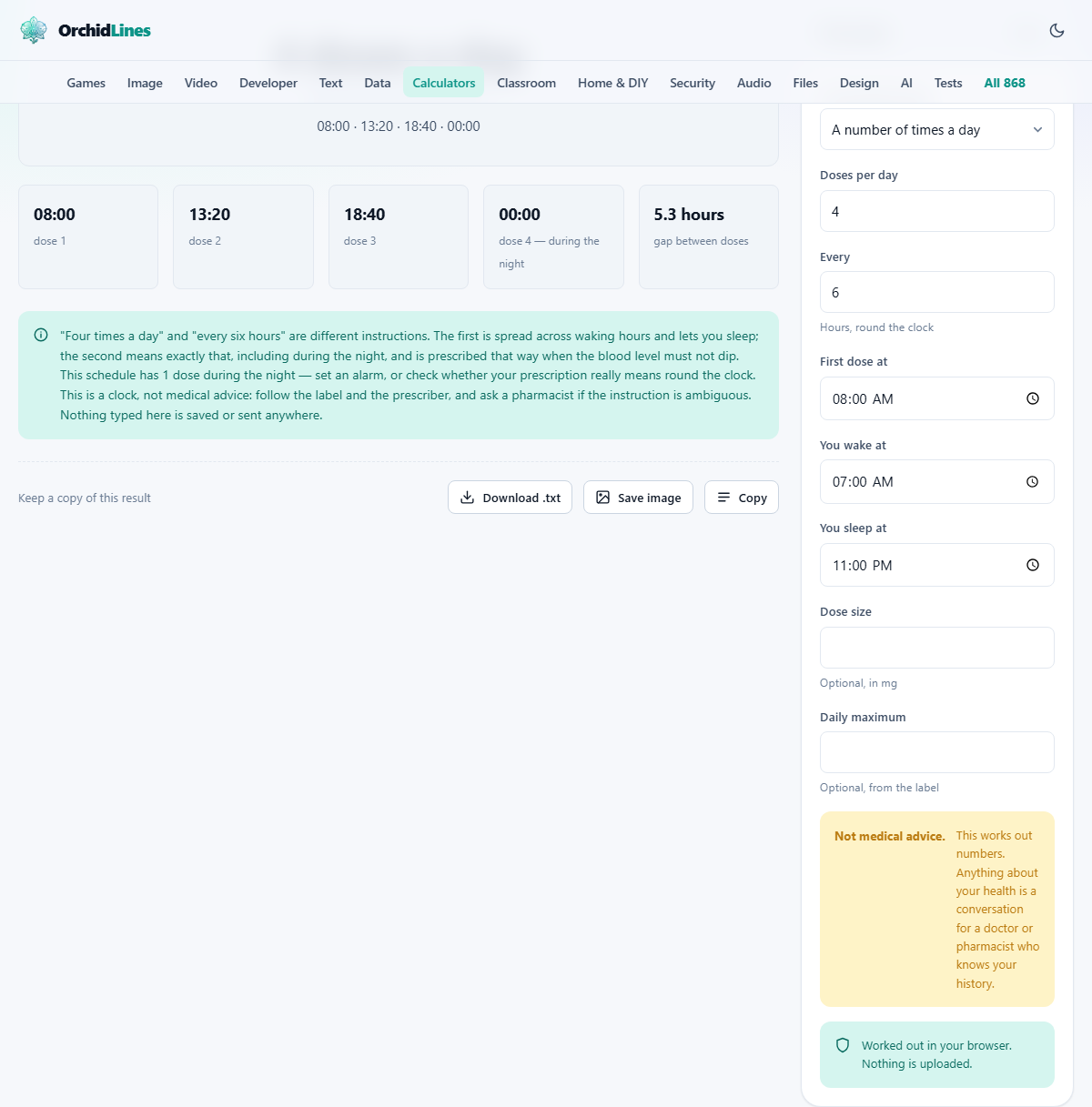
The panel labelled The course starts with a dropdown called The instruction says, where you choose between A number of times a day and Every so many hours. The rest of the fields adjust to suit. For a per-day instruction, the Doses per day field sets how many doses to spread across your waking window. For a strict interval, the Every field sets the gap in hours between each dose, round the clock.
First dose at tells the planner when you take the opening dose, and it builds the rest of the schedule from there. You wake at and You sleep at define the waking window. Per-day doses are spaced evenly inside that window. Interval doses ignore the window entirely, which is why some of them will fall during the night, and the tool marks those clearly so you can set an alarm.
The dose size and daily maximum fields
Both of these are optional, but they add a layer of safety checking when you fill them in. Dose size is the amount in milligrams per individual dose. Daily maximum is the figure from the packaging or the label, usually printed as 'do not exceed' followed by a number of milligrams in twenty-four hours.
When both fields have values, the planner multiplies the dose size by the number of doses in a day and compares the result to the maximum. If the total exceeds the limit, it flags the problem. This check matters most for paracetamol, where the gap between the normal dose and a harmful one is narrower than most people realise. It also matters when you take combination cold remedies that contain paracetamol alongside other ingredients, because the paracetamol adds up across products. Having the daily total displayed next to the maximum removes the mental arithmetic that people skip when they are tired and unwell.
Reading the output
The result is a plain list of clock times, one per dose. Doses that fall during your sleeping hours are marked so you know which ones will need an alarm. The daily total in milligrams is shown alongside the maximum, making it easy to see at a glance whether the course stays within the stated limit.
For a per-day instruction, the times will be evenly spaced across your waking hours. If you wake at seven and sleep at eleven, four doses a day will land at 8:00, 13:20, 18:40 and midnight, and the tool marks that last one as falling during the night so you can see the problem rather than discover it at bedtime. For an interval instruction, the times step forward by the exact gap regardless of when you sleep, so a six-hour interval starting at eight in the morning gives 8:00, 14:00, 20:00, and 02:00. The visual difference between the two schedules is immediate and is often enough to clear up any confusion about which type of instruction you are looking at.
Why even spacing matters
The reason a prescription says a specific number of times per day is to keep the drug at a useful level in your body throughout the waking period. Bunching doses together, taking two in the morning and two in the evening for example, creates peaks and troughs that the prescriber did not intend. The planner spaces them evenly because that is what the instruction assumes. Writing the times down and sticking the list on the fridge is a simple step that makes the schedule easy to follow, especially when there are multiple medicines involved.
For interval-based dosing the stakes are higher. Antibiotics and some pain management regimes use strict intervals precisely because the blood level must not dip below a threshold, even overnight. Missing the 2 a.m. dose or shifting it to a more convenient time can mean the drug drops below the effective level and the infection gets a window to regroup. If the schedule looks inconvenient, ask the prescriber whether the timing can be adjusted rather than adjusting it yourself.
Handling common situations
A few scenarios come up often enough to be worth addressing.
If you miss a dose, the general advice printed in most leaflets is to take it as soon as you remember unless it is nearly time for the next one, in which case you skip it and carry on. Almost never double up to catch up. But the specific rule varies by medication, so check the leaflet that came in the box.
If you take more than one medicine, plan each one separately and look at the resulting schedules together. Check with a pharmacist for interactions, especially when two products both contain the same active ingredient. Combination cold and flu remedies are the most common culprit, because they often contain paracetamol alongside a decongestant, and taking a separate paracetamol tablet on top pushes the daily total past the safe limit.
What this tool is and what it is not
The planner is a clock. It arranges times based on numbers you give it. It does not know what you are taking, why you are taking it, or anything about your medical history. It cannot tell you whether a dose is appropriate, whether two drugs interact, or whether a certain schedule suits your particular situation. Those questions belong to the doctor who prescribed the course or the pharmacist who dispensed it.
The page carries a clear notice to that effect. Pharmacists in most countries will answer dosing questions at no charge, and they are worth asking whenever a label is ambiguous. The difference between 'three times a day' and 'every eight hours' is a real source of confusion, and getting a clear answer from a professional before you start the course is better than guessing halfway through.
Adjusting the schedule for shift workers
If you work nights, the default waking window of seven in the morning to eleven at night will not match your routine. Change the You wake at and You sleep at fields to reflect when you are actually awake, and the per-day spacing will adjust automatically. For interval dosing the waking window does not matter since the doses march around the clock regardless, but the night-time markers will still highlight the ones that fall during your sleeping hours.
The First dose at field is also useful here. If your day starts at three in the afternoon, set the first dose to match and the rest of the schedule will build forward from that point. The planner does not care what time zone you are in or what your definition of morning is; it just needs accurate numbers. The same flexibility applies to anyone whose schedule changes from one day to the next; just update the waking times and the spacing recalculates on the spot.
Privacy and how the tool runs
Nothing you type is stored or sent anywhere. The schedule is worked out entirely in your browser on your own device, with no account, no login, and no record kept. When you close the page, the numbers are gone. You can enter real medication details without concern about where that information might end up. Health information is among the most personal data there is, and keeping it entirely local means you are the only person who ever sees it.