
Working out your daily calories and macro split
Knowing how much to eat is more useful than knowing what to eat, and getting the protein number right matters more than the rest. This article explains how the Macro Calculator arrives at its figures, what each control does, and how to turn the output into a plan you can actually follow.
What a macro split is and why it matters
Your body gets its energy from three large nutrients: protein, carbohydrate and fat. Each gram of protein delivers four calories, each gram of carbohydrate delivers four, and each gram of fat delivers nine. Together these are called macronutrients, or macros for short. A macro split tells you how many grams of each to eat in a day so that the total adds up to a calorie target that matches your goal.
Knowing the total calories is the first step. Whether you gain weight, lose weight, or stay the same depends almost entirely on whether you eat more or less than you burn. The macro split decides how well you keep muscle, how full you feel, and how your energy holds up through the day. Getting the calories right but the split wrong is better than getting both wrong, but getting both right is where real results come from.
The formula behind the number
The calculator uses the Mifflin-St Jeor equation to estimate your resting metabolic rate, which is the energy your body would use in a full day of complete rest. It takes your age, height, weight and whether you select the formula for men or women. The result is a baseline that gets multiplied by an activity factor to estimate your actual daily burn.
Mifflin-St Jeor is generally considered more accurate for modern populations than the older Harris-Benedict equation, though both are estimates. No formula can account for your genetics, your medication, the temperature of your house, or how fidgety you are. Treat the number as a sensible starting point, not a final answer. Two people of the same age, height and weight can differ by several hundred calories in what they actually burn, so the formula gets you into the right neighbourhood rather than to the exact address.
Filling in the panel
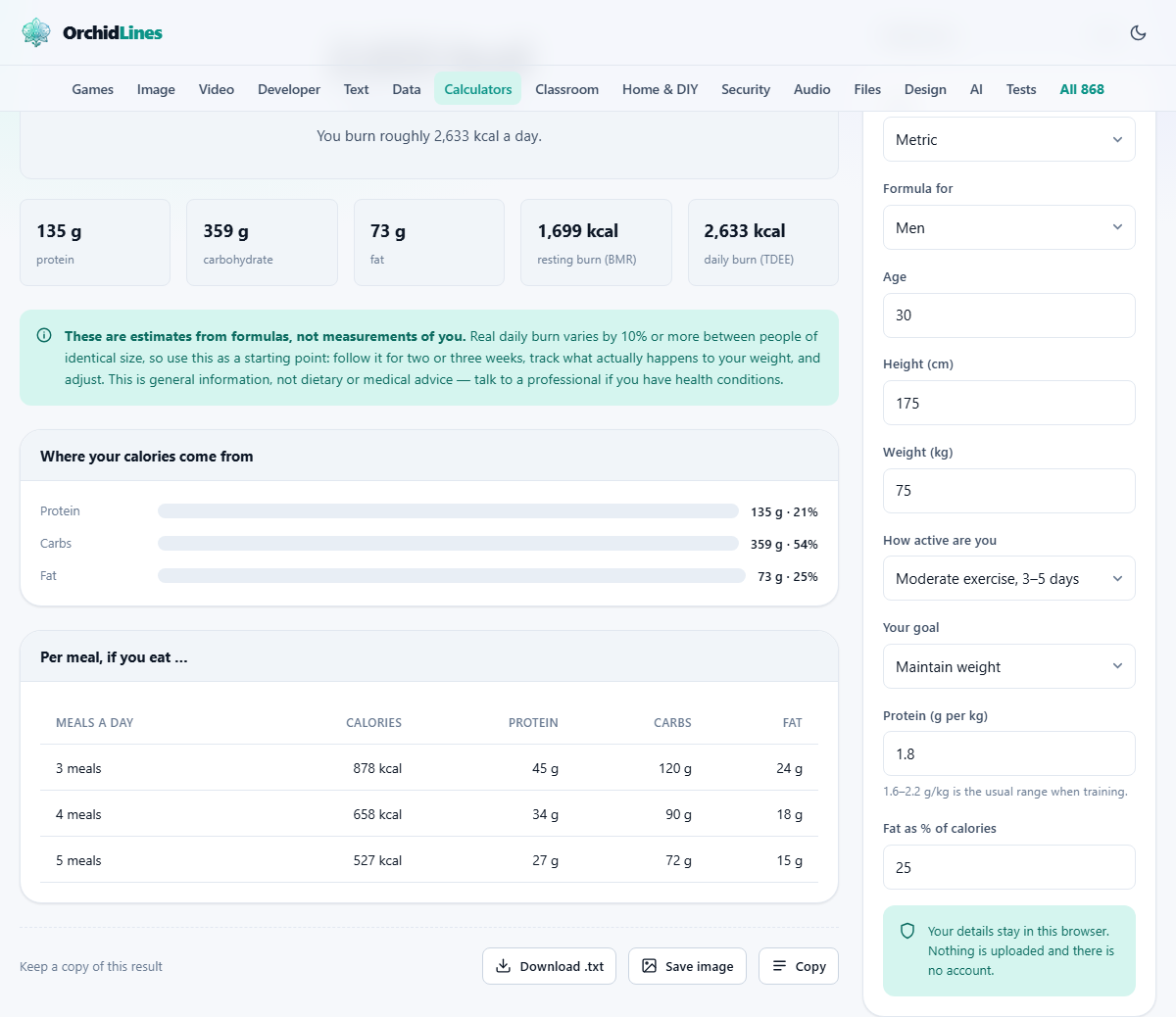
The panel labelled About you collects everything the formula needs. Units switches between metric and imperial, and the height and weight labels update to match. Age, Height, and Weight feed directly into the resting-burn calculation. Formula for selects the men's or women's version of the equation, which differ by a constant because body composition varies on average between the two.
How active are you offers five levels, from a desk job with little exercise up to a physical job or twice-daily training. This is the multiplier that turns a resting burn into a total burn, and it is the field people get wrong most often. If you are not sure which level fits, pick the one below the one you were going to choose. Overestimating activity is the single most common reason a calculated target does not produce the expected result. An hour at the gym three times a week puts most people in the light or moderate range, not the active one, and picking moderate when you deserve light adds several hundred calories to the target.
Choosing a goal
The Your goal dropdown adjusts the calorie target up or down from your estimated daily burn. Lose fat steadily applies a larger deficit, Lose fat slowly a gentler one, Maintain weight keeps the number as it is, Gain muscle slowly adds a small surplus, and Gain weight faster adds more. Each option shifts the calorie figure by a set percentage.
A deficit of around twenty per cent is a steady rate of fat loss that most people can sustain without losing much muscle, provided protein stays high enough. Larger deficits speed things up on paper but they also make hunger worse, energy worse, and muscle loss worse. Going slowly and sticking with it tends to beat going fast and stopping after three weeks. If the resulting calorie target seems low, try selecting a smaller deficit or increasing your activity level and see how the number shifts.
Why protein is set per kilo of bodyweight
Most macro calculators split calories into a fixed ratio like forty per cent protein, thirty per cent carbs, thirty per cent fat. The problem with that approach is that your protein requirement tracks your body size, not how much food you happen to be eating. When you cut calories to lose fat, a percentage-based system automatically cuts your protein at exactly the moment you need it most, because protein is what protects muscle during a calorie deficit.
This calculator fixes that by setting protein in grams per kilogram of bodyweight. The Protein field defaults to a sensible figure in the usual recommended range of 1.6 to 2.2 grams per kilogram for people who train. You can adjust it up or down. Fat is then set as a share of remaining calories using the Fat as % of calories field, and carbohydrate simply takes whatever is left. That ordering is why the final percentages shown will never be a tidy round split, and why they shift when the calorie target changes.
Turning the output into a daily routine
The calculator gives you a calorie target and a gram target for each macro. The practical question is what to eat to hit those numbers. Start with protein, because that is the one worth tracking closely. Learn the protein content of ten or fifteen foods you actually like, and build meals around them. Chicken breast, eggs, Greek yoghurt, lentils and tinned fish are common anchors.
Fat and carbohydrate are more flexible. They can move around by quite a lot day to day without much consequence, as long as the weekly average stays roughly where it should. If you only have the energy to track one thing, track protein. Hit that number consistently and let the rest settle around it, and you will be ahead of most plans that try to pin every gram of every nutrient. A simple approach is to build each meal around a protein source and fill the plate with whatever vegetables, grains and fats sound good that day.
When to adjust the numbers
Follow the calculated target for two to three weeks, then look at what actually happened. Weigh yourself at the same time each day, but compare weekly averages rather than individual readings, because daily weight can swing by a kilogram or more from water, food in your system, and salt intake. If the average is moving in the right direction at a reasonable pace, the numbers are working. If not, adjust by a hundred or two hundred calories and wait another couple of weeks.
The formula can be off by ten per cent in either direction for a given person. That is normal and expected. The value of the calculator is not that it gives you a perfect number on the first try. The value is that it gives you a structured number to start from, so that your adjustments are measured changes to a known baseline rather than random guesses. People who skip this step and eat whatever feels right tend to overeat by a few hundred calories a day without knowing, simply because portions in the modern world are larger than the body expects.
Safety and common sense
Very low calorie targets need professional supervision. Below roughly 1,200 calories for women or 1,500 for men, getting enough vitamins and minerals from food becomes difficult. If the calculator produces a number in that range for your goal, talk to a doctor or registered dietitian before following it. The tool also carries a general disclaimer: it produces estimates from published formulas, not advice tailored to your medical history.
If you have a health condition, take medication that affects appetite or metabolism, or are recovering from disordered eating, a formula on a web page is not the right starting point. A professional who knows your situation will do a better job than any equation.
Privacy and how the tool runs
Your details stay on your own device. Nothing is uploaded, there is no account, and the page does not store your numbers after you leave. You can enter real figures, experiment freely with different goals and activity levels, and close the tab knowing that nothing was recorded or sent anywhere. That privacy is especially important for body measurements and health-related data, which are nobody's business but your own.