
How to calculate late payment interest on an overdue invoice
Getting paid late costs money, and most freelancers and small businesses either do not charge interest or charge far less than they are entitled to. The most common mistake is quoting the margin alone and missing the base rate that sits underneath it. This article walks through every field in the late payment calculator, explains the difference between statutory and contractual interest, and covers the fixed compensation that many people do not know they can claim. All calculations run on your own device.
What statutory late payment interest actually is
In most business-to-business dealings, the law gives you the right to charge interest on an invoice that is paid late. You do not need to have mentioned it in your terms. You do not need the client to have agreed to it. The right exists by statute, and it applies the moment the payment is overdue.
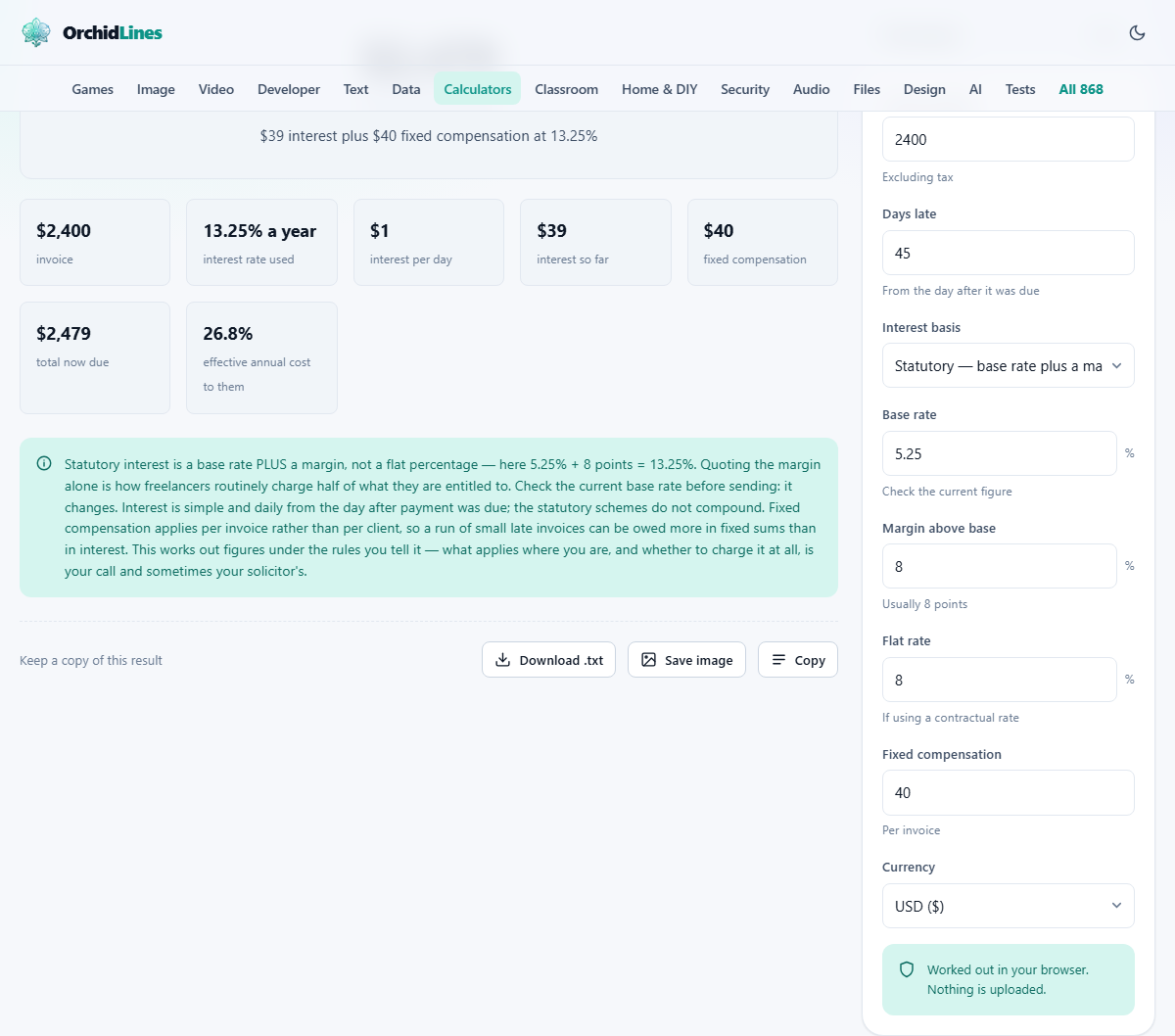
The rate is not a single flat number. It is built from two parts: a base rate set by the central bank and a margin added on top. In many regimes the margin is eight percentage points. If the base rate is 5.25 per cent, the total statutory rate is 13.25 per cent a year, not eight. That distinction matters because quoting the margin alone gives away roughly forty per cent of what you are owed.
The calculator starts with the statutory method selected. Two fields set the rate: Base rate, which you should check against the current central bank figure, and Margin above base, which defaults to eight per cent. The total is the sum of the two, applied as a simple annual rate divided down to a daily figure.
Filling in the invoice details
The panel is headed The invoice. The first field, Invoice amount, takes the value of the invoice excluding tax. A hint reminds you of this. Whether interest applies to the gross figure including tax depends on your local rules, so the calculator keeps it simple by working from the net amount. You can enter the gross figure if your regime allows it.
Days late counts from the day after payment was due, not from the invoice date. If the invoice gave a due date of the first of the month and it is now the fifteenth, the payment is fourteen days late. If no due date was agreed, many regimes default to thirty days after delivery or the invoice date, whichever comes later.
The Currency dropdown changes the symbol shown on the result. It has no effect on the arithmetic.
Statutory interest versus a flat contractual rate
A dropdown labelled Interest basis offers two choices. The default is Statutory, which uses the base rate plus margin method described above. The second is A flat contractual rate, which applies a single annual percentage that you have explicitly agreed with the client in your accepted terms.
The flat rate option is there for contracts that specify their own late payment clause. If your terms say interest will be charged at eight per cent a year, enter eight in the Flat rate field and select the flat option. Note that an agreed rate lower than the statutory one may not be enforceable in some regimes, because the law in many places does not allow a contract to reduce the statutory entitlement.
If you never discussed interest with the client at all, use the statutory option. A rate that was never agreed is not enforceable as a contract term, but the statutory right stands regardless.
How the daily interest is worked out
The statutory schemes use simple interest, not compound. The annual rate is divided by 365 to get a daily rate, and that daily rate is multiplied by the invoice amount and the number of late days. The result is the interest owed so far.
For a quick example, take an invoice of 2,400 at a total rate of 13.25 per cent, forty-five days late. The daily rate is 13.25 divided by 365, which is about 0.0363 per cent. Multiply that by 2,400 and then by 45 days, and the interest comes to roughly 39.21. That is not a trivial sum, and on a larger invoice or a longer delay it climbs quickly.
Because the interest is simple rather than compound, it grows in a straight line. Double the days and you double the interest. This makes the calculation predictable and easy to verify by hand if you want to check the tool.
Fixed compensation on top of interest
Many statutory schemes also provide a fixed sum of compensation for each late invoice, separate from the interest. In several regimes this is 40 for invoices under a certain threshold, 70 for medium invoices, and 100 for large ones. The calculator has a field labelled Fixed compensation where you enter the figure that applies to your invoice.
The fixed sum applies per invoice, not per payment. If a client owes you five small invoices and all five are late, you are entitled to five times the fixed amount. For a run of modest invoices, the fixed compensation can exceed the interest itself.
This sum is owed on top of the interest, so the total the calculator shows is the invoice amount plus the interest plus the fixed compensation. That total is what you can claim in a letter or, if it comes to it, in a court.
The effective annual cost of the delay
The calculator also reports what the delay effectively costs the client as an annual rate. This figure includes both the interest and the fixed compensation rolled together, expressed as though they were a single annual percentage on the invoice amount.
On a short delay with a small invoice, the fixed compensation pushes this effective rate very high, because a flat sum of 40 on a 500 invoice for ten days works out to a large annualised figure. That is not a mistake. It reflects the fact that the fixed compensation is meant to cover the administrative cost of chasing the payment, which is the same whether the invoice is for 500 or 50,000.
Showing this rate can be useful in a polite letter to a late-paying client. It makes the cost of their delay concrete in a way that a raw interest figure does not.
When to charge and when to hold back
Having the right to charge interest does not mean you must use it every time. For a client who is usually prompt and has a genuine cash flow problem once, waving the interest may be the better commercial decision. For a client who is routinely late, the letter is often more effective than the money. Invoices have a way of getting paid once interest is formally mentioned.
If you do decide to enforce, the calculator gives you the figures to put in the letter. State the invoice number, the original amount, the due date, the days late, the interest rate you are applying, the interest accrued, the fixed compensation, and the total now owed. Keep the tone professional. The numbers do the talking.
Be aware that statutory late payment schemes are generally limited to business-to-business transactions. Consumer contracts have their own rules, which are usually less generous. If your client is a private individual rather than a company, check the rules that apply before sending a claim.
Checking the base rate and keeping it current
The base rate changes. Central banks adjust it in response to economic conditions, and the statutory interest rate moves with it. The calculator defaults to 5.25 per cent, but you should check the current figure before relying on the result for a real claim.
In most regimes, the base rate that applies is the one in force on the date the payment became overdue, not the rate on the date you send the letter. If the payment was due in January and you are writing in July, use the January rate. Some regimes update the reference rate every six months, others more frequently. Your local business support agency or government website will have the current figure.
The margin, by contrast, rarely changes. Eight percentage points above base has been the standard in several major regimes for years. But local rules vary, and a quick check is worth the minute it takes.
All of this runs entirely in your browser. The invoice amount, the rate, and every other field you fill in stays on your device. Nothing is sent to a server, and the page works even when you are offline. The calculation itself is straightforward arithmetic, and the tool shows every step clearly so you can verify it before putting the numbers in a letter.