
How to find your five heart rate training zones and use the Karvonen method
Training by heart rate only works if the zones are set correctly for your body, not copied from a generic poster on the gym wall. This article explains what the five zones are, why the Karvonen reserve method is more accurate than raw percentages, how to get the inputs right, and how to apply the numbers to real sessions. Everything is worked out on your own device with nothing sent anywhere.
What training zones are and why they exist
Your body does not switch cleanly from one fuel source to another as effort goes up, but it does shift the balance. At low effort, fat provides most of the energy and you can keep going for hours. At high effort, carbohydrate takes over and you tire in minutes. Between those ends lies a gradient, and training zones are a way of dividing that gradient into useful bands.
Five zones have become the standard. Zone 1 is very light, the kind of effort you could sustain all day. Zone 2 is the aerobic base, easy enough to hold a conversation but hard enough that your cardiovascular system is doing real work. Zone 3 is moderate. Zone 4 is hard, where talking drops to single words. Zone 5 is maximum, sustainable for only short bursts.
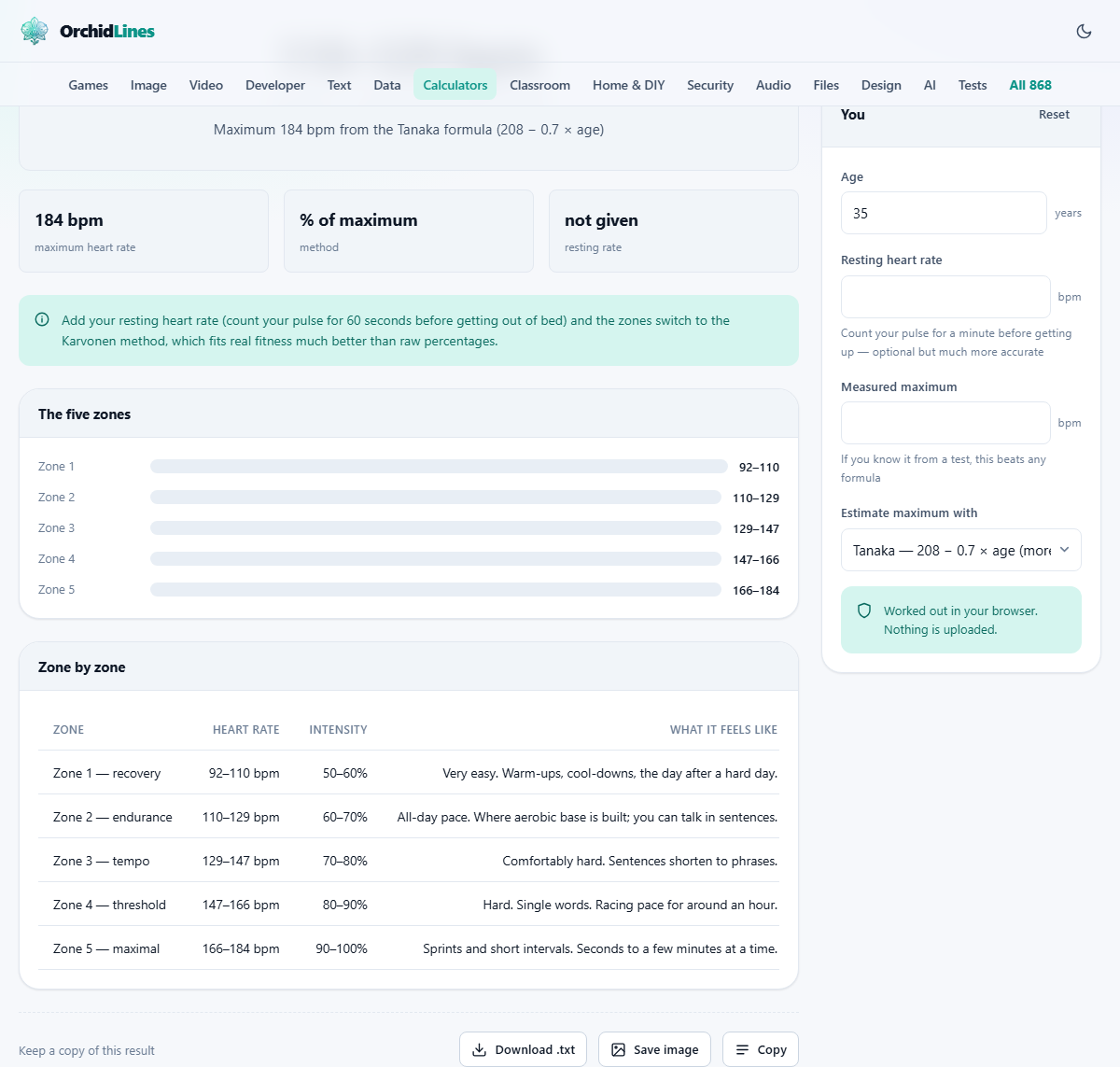
The calculator takes your age and, optionally, your resting heart rate and your measured maximum, and turns them into five bands expressed as beats per minute. Each band has a lower and upper limit, so during a workout you can glance at your monitor and know which zone you are in.
How maximum heart rate is estimated from age
The classic formula is 220 minus your age. It has been taught for decades and it is easy to remember. It is also not very good. It tends to overestimate the maximum for young people and underestimate it for older ones, because the real relationship between age and maximum heart rate is not a straight line with a slope of exactly one.
The Tanaka formula, 208 minus 0.7 times your age, fits the research data better, especially for people over forty. A dropdown labelled Estimate maximum with lets you choose between the two. Tanaka is selected by default.
Both formulas are population averages. The spread around them is wide, roughly ten to twelve beats in either direction. Two healthy people of the same age can have maximums that differ by twenty beats. That is why a measured maximum from a supervised graded exercise test is always the better option when you can get one. A field labelled Measured maximum lets you enter it, and doing so overrides whatever the formula would have said.
The Karvonen method and why it matters
The simple way to set zones is to take percentages of your maximum heart rate. Zone 2 might be 60 to 70 per cent of maximum. The problem is that this ignores where your heart rate starts from. A trained runner whose heart beats 48 times a minute at rest is in a very different place at 130 beats per minute than a beginner whose resting pulse is 78.
The Karvonen method fixes this by working from heart rate reserve instead of the raw maximum. Reserve is your maximum minus your resting rate. The zone boundaries are then calculated as percentages of that reserve, added back onto your resting rate. The formula for a given percentage is: resting plus the percentage times the reserve.
This shifts the zones upward for fit people and downward for less fit ones, which matches how those groups actually feel at a given heart rate. The difference can be fifteen beats or more, which is enough to put a planned easy run into the wrong zone entirely.
To switch to the Karvonen method, fill in the Resting heart rate field. Count your pulse for a full minute first thing in the morning, before you sit up. Do it on a few mornings and use the lowest reading. If you leave the field empty, the calculator uses plain percentages of maximum instead.
What each zone does to your body
Zone 1 is recovery. It is walking pace or very gentle cycling. The main use is active recovery between hard sessions, where light movement clears metabolic waste faster than sitting still.
Zone 2 is where most endurance training should live. It builds the aerobic engine: more capillaries, more mitochondria, a stronger heart. It feels too easy, and that is exactly the point. The adaptations take time but they are deep and lasting. Endurance athletes routinely spend 80 per cent of their training time here.
Zone 3 is the uncomfortable middle. It is too hard to hold for long and too easy to produce the sharp adaptations that come from going truly hard. Spending too much time here is the most common training error, because it feels like real work but delivers less than either side.
Zone 4 is threshold work. Intervals here improve the point at which lactate accumulates faster than the body can clear it. Sessions are short and structured, typically repeated efforts of a few minutes with recovery between them.
Zone 5 is peak effort. It trains the neuromuscular system and the anaerobic pathways. Efforts are measured in seconds, not minutes, and the recovery between them is long. Most people need very little of this, and beginners need none of it at all.
Getting accurate inputs
The age field is straightforward. Enter your age in years and the formula does the rest.
The resting heart rate needs a proper morning reading. Sit still for a minute before reaching for your phone and count your pulse at the wrist or throat. A chest strap or a medical pulse oximeter is more accurate than a wrist-based smartwatch for this. Caffeine, poor sleep and illness all raise the resting rate, so take the reading on a normal morning.
If you have a measured maximum from a graded exercise test, enter it in the Measured maximum field. This is a test done under supervision, usually on a treadmill or a cycle trainer, where the intensity is raised in steps until you cannot go further. The do-it-yourself versions exist but carry risk, especially for anyone new to hard exercise, over forty, or with any history of heart problems.
Any field you leave empty is simply skipped. The calculator works with just your age, improves with a resting rate, and is most accurate with a measured maximum on top.
Applying the zones to your training week
A common split for someone building endurance is three or four easy runs in Zone 2, one session with intervals in Zone 4, and one longer run that stays in Zone 2 but covers more ground. The rest days are genuine rest or Zone 1 activity.
The temptation is to push every easy session into Zone 3 because it feels more productive. It is not. The easy days are where the aerobic base grows, and they only work if they are easy enough. A heart rate monitor keeps you honest in a way that perceived effort alone often does not.
Hard days should be genuinely hard. If your intervals are supposed to be at Zone 4 and your monitor reads Zone 3, the recovery between efforts was too short or the effort itself was too soft. The zones give you a target range, and staying inside it is the whole point of wearing a monitor.
When the numbers and your body disagree
Heart rate monitors are not perfect. Wrist-based optical sensors can lag behind sudden changes by several seconds and sometimes lose the signal during fast arm movements. Chest straps are more reliable but can give wild spikes if the contact patches dry out.
More importantly, a formula is a population average applied to one person. If your Zone 2 feels like a hard run and you cannot hold a conversation, the zone is set too high for you, regardless of what the formula says. The talk test is the oldest guide to intensity and it still works: full sentences mean Zone 2, short phrases mean Zone 3, single words mean Zone 4.
Heat, humidity, altitude, dehydration and fatigue all raise heart rate for the same effort. A Zone 2 run on a cool morning can read Zone 3 on a hot afternoon. Adjust for conditions rather than forcing the pace down to hit a number.
A note before starting any hard training
This calculator produces numbers based on general formulas. It does not know your medical history, your medications, or your current condition. Anyone new to exercise, returning after a long break, over forty, or living with a heart condition should talk to a doctor before doing high-intensity work. The zones are a guide, not a prescription, and no calculator replaces a conversation with someone who knows your health.