
Working out what a drive actually costs in fuel
Fuel is one of those costs that people guess at rather than calculate, partly because the units are confusing and partly because nobody wants to do the division at a petrol station. This article walks through the Fuel Cost Calculator mode by mode, explains the differences between the mileage units the world cannot agree on, and shows how to measure your car's real fuel economy instead of trusting the number on the sticker.
Three modes for three different questions
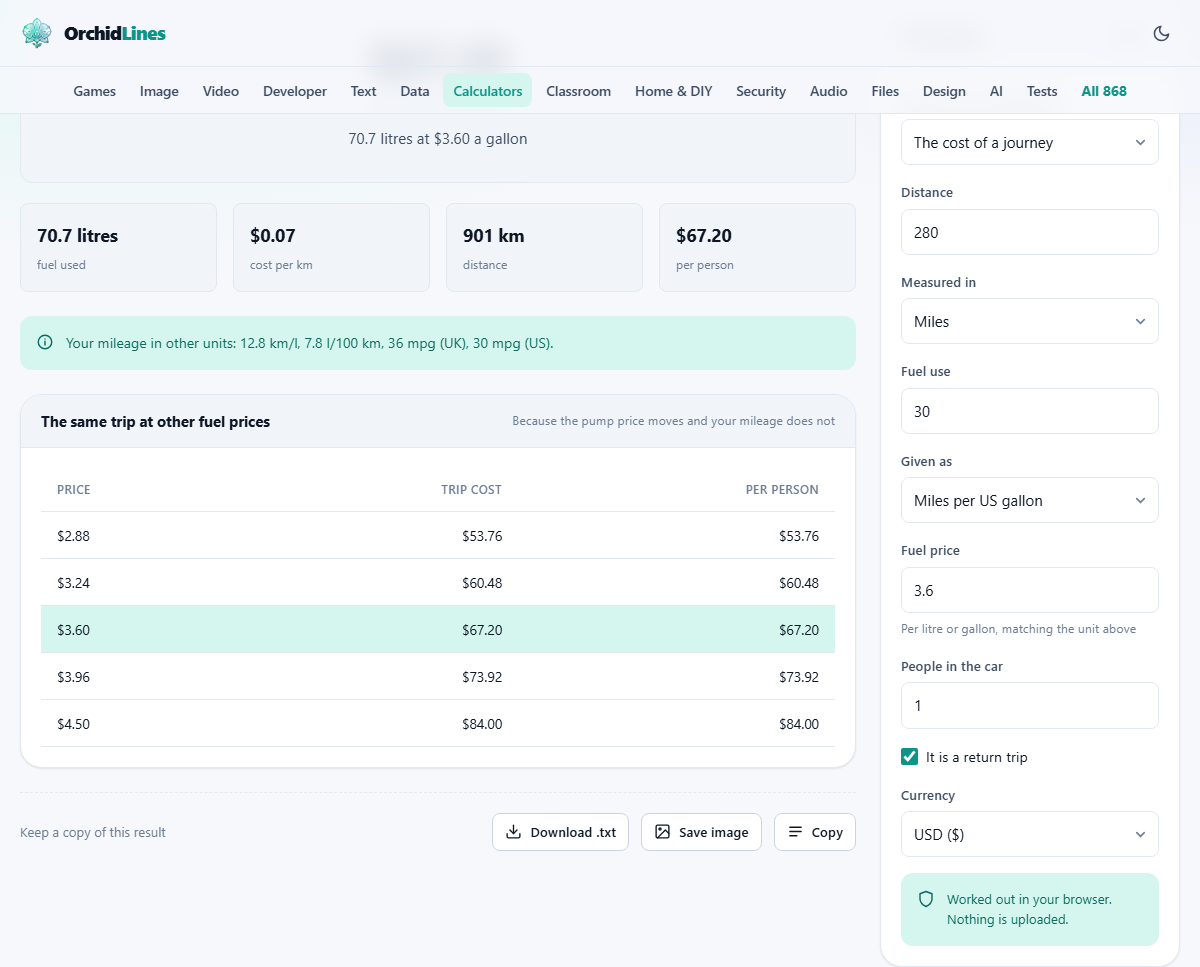
The What are you working out dropdown offers three modes. The cost of a journey takes a distance, your fuel economy and the pump price, and tells you what the trip will cost. A regular commute does the same thing but multiplies by the number of working days in a month so you can see the monthly total. My real mileage from a fill-up works backwards: you give it a distance and the fuel it took, and it tells you what your car is actually doing.
Each mode shows and hides the fields it needs. In trip mode, the fuel input is hidden because the tool calculates the fuel from distance and economy. In mileage mode, the economy field disappears because that is what you are trying to find out, and the fuel field shows up in its place so you can enter how much fuel you used. The page rearranges itself each time you switch modes, so you only ever see the fields that matter for the question you are asking.
Distance, return trips and the commute multiplier
The Distance field takes a one-way distance. Below it, a checkbox labelled It is a return trip doubles the figure automatically. This saves you from doing mental arithmetic or entering the wrong number because you forgot to double it.
In commute mode, a Days a month field appears with a default of twenty-two, which is a typical count of working days. The total cost is multiplied by this number, so you see what the drive to work costs over a full month. Change it to match your schedule if you work fewer or more days. The per-person cost is shown separately if you set People in the car to more than one, which is useful when colleagues share a regular commute and want to split the petrol fairly.
Making sense of the mileage units
The Given as dropdown offers five ways to express fuel economy: kilometres per litre, litres per 100 km, miles per US gallon, miles per UK gallon, and miles per litre. The world has never settled on one standard, and car manufacturers, travel websites and fuel pump stickers all use different ones depending on the country.
The critical thing to understand is that some of these run in opposite directions. Kilometres per litre and miles per gallon are higher-is-better figures. A car doing 20 km/l is more efficient than one doing 15. Litres per 100 km works the other way: 5 is better than 8, because a lower number means less fuel for the same distance. Mixing these up when comparing two cars will reverse your conclusion entirely.
The real-mileage mode reports all five side by side, so you can enter what you know and read the answer in whatever form you prefer. On a journey costing you get the same conversion in the note below the result, so long as you are travelling alone: with passengers that note gives the split instead.
The two gallons and why they cause trouble
A US gallon is 3.785 litres. A UK gallon is 4.546 litres. That is a twenty percent difference, which means a car doing 40 miles per UK gallon is doing only about 33 per US gallon. Same car, same road, two very different-looking numbers.
This trips people up constantly when reading reviews or forum posts written on the other side of the Atlantic. A car described as doing 50 mpg in a British magazine sounds impressive until you realise the US equivalent is around 42. Both are the same efficiency; they are just measured in different-sized containers. The dropdown includes both gallon types specifically to prevent this confusion.
The historical reason for the difference is that the US adopted the old English wine gallon while the UK later standardised on the larger imperial gallon. Knowing the reason does not make the confusion less common, but at least you know why two countries that share a language ended up with incompatible measuring jugs.
Measuring your real mileage the honest way
The number printed in your car's handbook or on the dealer's website is measured under test conditions that bear little resemblance to your daily driving. Real-world fuel economy is typically ten to twenty percent worse, and sometimes more for short trips or heavy motorway use.
To find out what your car actually does, fill the tank completely, reset the trip meter to zero, and drive normally for a few hundred kilometres. At the next fill, note the trip meter reading and fill the tank again. The number of litres or gallons it takes to refill is the fuel you used over that distance. Switch to My real mileage from a fill-up mode, enter the distance and the fuel, and the tool calculates your actual efficiency. One measurement is better than the sticker. Three or four measurements spread across different seasons and a mix of city and motorway driving will give you a genuinely reliable average.
Fuel price and splitting the cost
The Fuel price field takes the cost per litre or per gallon, and it is the mileage unit in Given as that decides which. Pick miles per gallon and the price is read per gallon; pick anything else and it is per litre. In most of the world, pump prices are posted per litre. In the US, they are per US gallon. Enter the number exactly as you see it at the station and the tool handles the unit conversion along with the rest of the arithmetic.
The People in the car field divides the total cost by the number of passengers. The per-person figure is a fair starting point when splitting fuel on a shared road trip, though it does not include wear and tear, tolls or parking. For longer journeys, adding a small amount on top of the raw fuel share is reasonable and widely accepted.
Motorway speed and other things that change the answer
Air resistance rises sharply with speed. Most cars are noticeably thirstier above about 100 km/h, and fuel economy at 130 km/h can be thirty percent worse than at 90. If your entire trip is motorway driving, using your average fuel economy figure will underestimate the cost. Dial the economy down a few points for those journeys.
Other factors that eat fuel include heavy loads, roof boxes, underinflated tyres, hilly terrain and strong headwinds. None of these are built into the calculator because they vary too much to predict. A car with a full boot and a roof box can use twenty percent more fuel than the same car empty on the same road. The best defence is to measure your own mileage under the conditions you typically drive, using the fill-up method described above, and enter that measured figure rather than the theoretical one.
Fuel cost is not the whole cost of driving
The number this tool gives you is the fuel bill and nothing else. It does not include depreciation, insurance, road tax, servicing, maintenance, tyres, parking or tolls. For a typical privately owned car, those additional costs can double the real per-kilometre price compared to fuel alone.
The fuel figure is the right one to use when deciding whether a particular trip is worth driving. The full ownership cost matters when you are choosing whether to own a car at all. These are different decisions, and using the wrong cost for the wrong question leads to bad answers in both directions.
All calculations stay on your device
The page does all its arithmetic in your browser. No journey distances, fuel prices or results are sent anywhere. You can load the page, disconnect from the internet, and the calculator continues working exactly as before. There is no server behind it, just the formula running in your own browser tab.
There is no account and no saved history. If you want to keep a record of your trips or fuel costs over time, copy the results somewhere else. The tool is designed to answer one question at a time, clearly and privately, without building a profile of where you drive or what you spend. That simplicity is deliberate. A trip cost is a quick question with a short answer, and the tool treats it that way.