
Safe defrosting times and how long thawed food keeps
Thawing food on the worktop feels faster, but the outside reaches room temperature hours before the centre is even soft. That warm outer layer is where bacteria grow fastest, and it sits there the whole time you are waiting for the middle. This article explains what the Defrosting Time and Storage Calculator works out, why the fridge method takes so long, and the food safety rules that sit behind the numbers.
Why the worktop is the worst place to thaw
Bacteria that cause food poisoning multiply fastest between about 5 and 60 degrees Celsius. A frozen chicken breast left on the counter hits that range on its surface within an hour, while the core stays frozen solid for several more. The surface is warm, wet and full of nutrients for the entire thaw, which is exactly what harmful bacteria need.
A fridge holds the air at around 4 degrees, which is below the danger zone. The surface thaws slowly and never gets warm enough for rapid bacterial growth. The trade-off is time. A whole turkey can take two or three days in the fridge, and that means planning backwards from the meal, not pulling it out the morning of. The calculator exists because most people underestimate just how long the safe method takes, and overestimate how safe the fast methods are.
Picking the food and entering the weight
The What is it dropdown covers the foods people freeze most often: whole chicken or turkey, chicken pieces, beef or lamb joint, pork joint, mince, fish, prawns or shellfish, cooked leftovers and bread. Each one carries a different thawing rate and a different safe storage time once thawed.
The Weight field takes kilograms. Thawing time scales with size, but not in a straight line for large items. Heat reaches the centre by distance, not by mass, so a very heavy whole bird takes proportionally longer than a small one. The calculator accounts for this with a curve rather than a simple multiplication. For small items like chicken pieces or fish fillets, the difference between a linear estimate and the real curve is small. For a large turkey, it can be half a day.
Fridge thawing versus cold water
The How are you thawing it selector offers three choices. The fridge is the safest. Put the food on a plate or tray on the lowest shelf, so drips do not land on other food, and leave it for however long the calculator says. You do not need to do anything else.
Cold water is several times faster. Seal the food in a watertight bag, submerge it in cold tap water, and change the water every thirty minutes as it warms up. The running clock and the water changes make it more work, and you must cook the food straight away once it has thawed. You cannot put it back in the fridge raw.
Room temperature is listed as well, because people do it. The calculator shows the time, but it also flags the safety risk. If you choose this method, the outer layer spends hours in the temperature range where bacteria double every twenty minutes.
What the result tells you
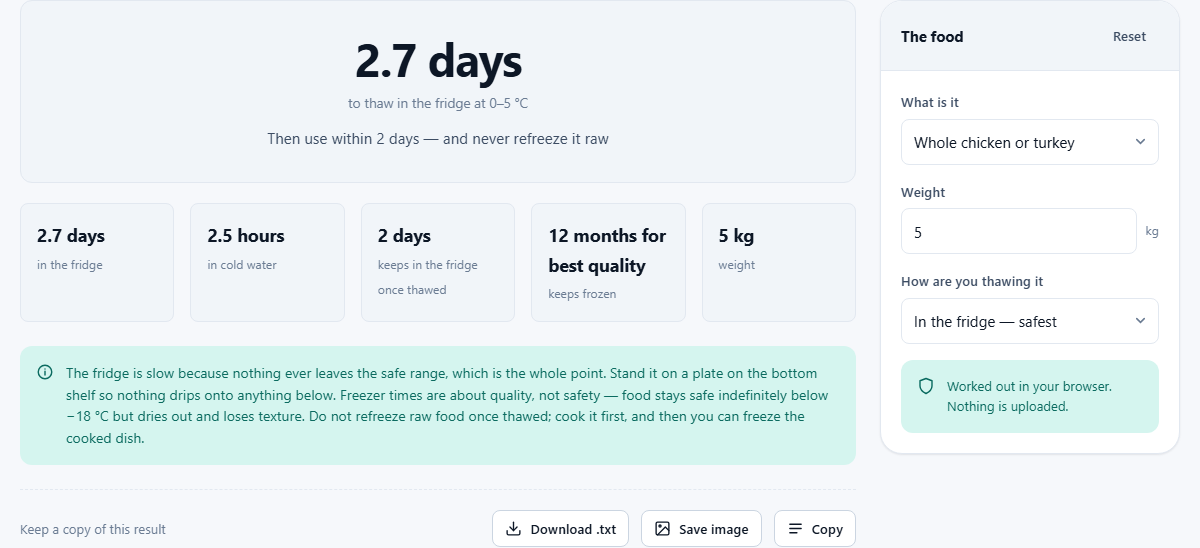
The output card shows the estimated thawing time in hours or days, a note on how long the thawed food keeps in the fridge before you must cook or discard it, and any method-specific warnings. Raw poultry and fish are typically safe for one to two days after thawing. A red meat joint lasts three to four days. Cooked leftovers sit somewhere in between.
There is also a freezer time figure. This is not a safety limit. Food stays safe below minus eighteen degrees indefinitely. The months given are a quality window: how long before the texture and flavour start to suffer from freezer burn and drying.
Read the warnings carefully, because they change with the method. Cold water thawing comes with a reminder to cook immediately once the food is soft. Room temperature thawing flags the bacterial risk explicitly. The fridge method is the only one where you can thaw the food and then keep it for another day or two before cooking.
The big bird problem
A five-kilogram turkey takes about two and three-quarter days in the fridge. A seven-kilogram bird needs four full days. These are the numbers that catch people out every holiday season. The bird goes into the fridge on Thursday, the meal is on Friday, and the middle is still solid at dinner time.
Plan backwards from the meal. If you are cooking Sunday lunch, count back the number of days the calculator shows and move the bird from the freezer to the fridge on that day. Write the date on a note and stick it to the freezer door. Nobody remembers to do this reliably, which is exactly why it needs to be written down in a place you will see it.
Cooking from frozen and the microwave question
Small items can often be cooked from frozen if you add roughly half the cooking time again. Thin fish fillets, burgers and sausages are common examples, and most packaging for these products says so. A whole bird cannot go straight from the freezer to the oven. The outside will dry out and overcook long before the centre reaches a safe internal temperature.
The microwave defrost setting works by pulsing power so that ice melts without the food cooking. In practice, patches warm above the danger threshold while other areas are still frozen. If you use the microwave to defrost, cook the food immediately afterwards. Do not thaw in the microwave and then leave the food sitting on the worktop while you prepare other things.
Never refreeze raw thawed meat
Once meat has thawed, bacteria that were dormant during freezing wake up and start growing. Refreezing slows them down again, but the count is now higher than it was before. The next time you thaw it, the population picks up from that higher baseline and continues from there.
The safe alternative is to cook the thawed meat first, then freeze the cooked dish. Cooking kills the bacteria that grew during thawing, and the cooked result freezes and thaws perfectly well. A batch of chilli made from thawed mince is safe to freeze, even though the raw mince that went into it was not safe to refreeze.
The same rule applies to fish and shellfish. Once thawed, use it within the storage window the calculator shows and do not put it back in the freezer raw. Shellfish in particular spoils quickly and the window is short. When in doubt, cook it and then decide what to do with the cooked result.
Internal temperature beats guesswork
No visual check reliably tells you whether a piece of meat is cooked through. Colour varies with the cut, the breed and the cooking method. The only sure test is a probe thermometer pushed into the thickest part. Poultry needs to reach 74 degrees Celsius in the centre. Beef and pork joints are safe at 63 to 71 degrees depending on the result you want.
A food thermometer costs very little, lasts for years and removes all doubt. If you are defrosting a large item specifically because you plan to cook it to a safe temperature, the thermometer is the tool that closes the loop at the other end. Without it, you are relying on guesswork at the most important step.
All the maths stays on your device
The thawing times are calculated in your browser using published food-safety guidelines built into the page. Nothing about what you are cooking, how much it weighs, or when you plan to eat it is sent anywhere. You can verify this by loading the page once and then disconnecting from the internet. The calculator keeps working.
There is no account and no history. Each visit starts fresh. If you want to keep a note of when you moved the turkey into the fridge, write it down yourself or set a reminder on your phone. The tool answers the timing question; remembering the answer is on you.
This is a planning tool, not a substitute for official guidance from your local food safety authority. The numbers are conservative estimates based on standard fridge temperatures and typical food densities. If your fridge runs warmer than average or the food was partially thawed before you started timing, allow extra margin.