
Setting an emergency fund target that is reachable, not just round
Most emergency fund advice picks a number of months -- three, or six -- and tells everyone the same thing. This calculator starts from the other end: what you actually spend on things you cannot cut, how stable your income is, and how many people depend on it. The result is a target built on your own situation and a timeline for reaching it. This article explains every input, works through a real scenario, and covers the thinking behind the recommendation.
Why spending, not salary, is the right base
The standard advice is to save three to six months of take-home pay. That sounds simple, but it overstates the target for most people by a wide margin. Your take-home pay includes restaurant meals, streaming services, gym memberships, and everything else that stops the moment income stops. An emergency fund only needs to cover what you must pay: rent or mortgage, utilities, groceries, transport to work, insurance, minimum debt payments, and childcare.
Basing the target on essential spending instead of salary typically cuts it by a third. That makes the goal feel reachable rather than impossible, and reachable goals are the ones people actually follow through on. A fund that exists at two months of essentials beats a plan for six months of salary that never gets started.
The inputs: describing your situation
The panel is headed Your situation and contains seven controls. Essential spending is the monthly total of bills you cannot avoid. Add up your rent or mortgage payment, electricity, water, gas, internet, groceries, transport costs, insurance premiums, minimum loan or credit card payments, and any childcare fees. Leave out anything you would cancel the day income stopped.
Your work is a dropdown with four options: Salaried and secure, Fixed-term contract, Salaried but insecure sector, and Freelance or self-employed. Each moves the recommended number of months in a different direction. A salaried person in a stable company can recover faster than a freelancer whose next invoice might not come for weeks. The calculator reflects that difference rather than treating everyone the same.
Incomes in the household asks whether there is one earner or two or more. Two incomes lower the risk because both are unlikely to stop at the same time. Dependants is a count of people who rely on that income -- children, elderly parents, anyone who adds to the spending that cannot stop. More dependants push the recommendation up because the consequences of running out are worse.
Tracking progress: what you have saved and what you save each month
Below the household questions are two money fields. Saved so far is whatever you have already set aside in a savings account or equivalent. Saving each month is how much you can put away going forward. The calculator uses both to show how many months of cover you already have and how long it will take to close the gap.
The Currency dropdown sets the symbol used in the output. It does not convert between currencies; it only changes the label. Use whichever currency your spending and savings are denominated in.
A worked example: a single-income household
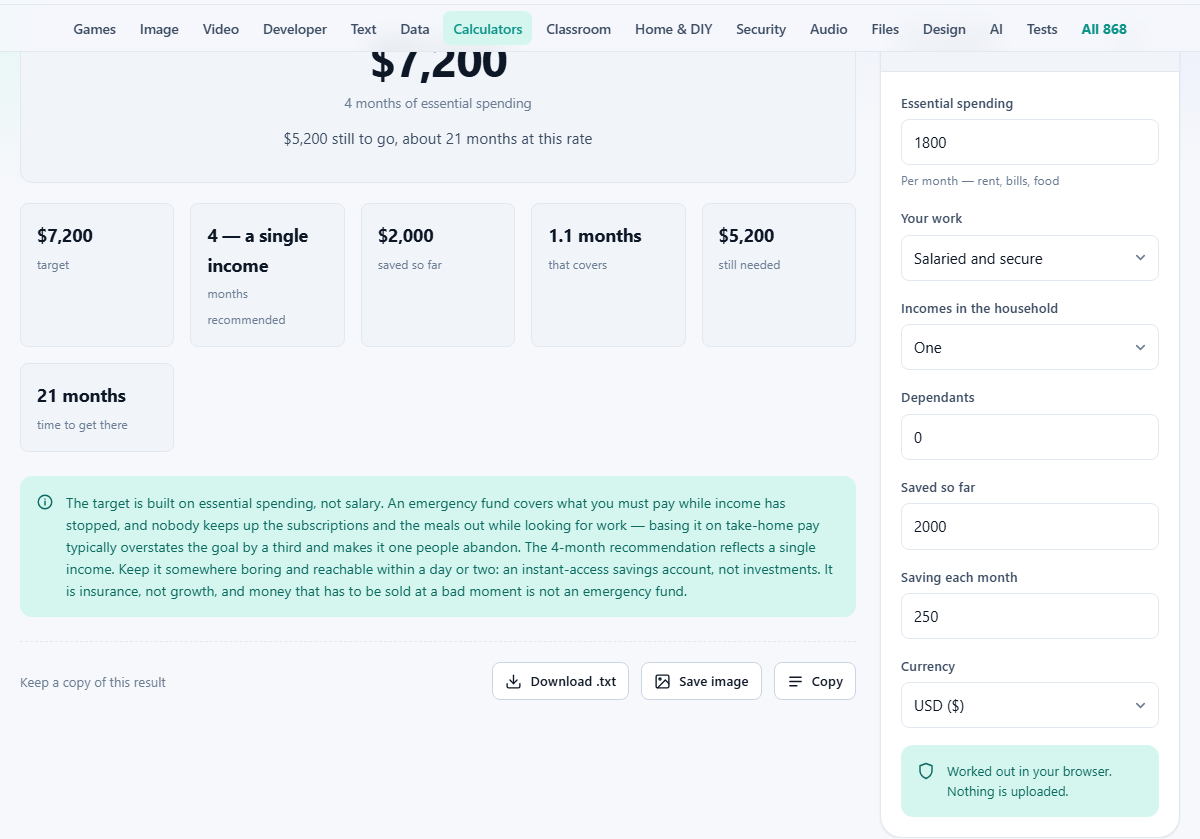
Take a salaried worker in a stable job with one income, no dependants, essential spending of 1,800 per month, 2,000 already saved, and 250 going aside each month. With these inputs the calculator recommends roughly four months of cover, which is about 7,200.
The existing savings of 2,000 cover just over one month. The gap is about 5,200. At 250 per month, the fund reaches the target in roughly 21 months. That is not fast, but it is concrete: a date on a calendar rather than an open-ended wish.
Now change the work type to Freelance or self-employed. The recommended months climb, perhaps to seven or eight, because irregular income and lumpy invoicing mean a longer wait between bad news and money arriving. The target rises and the timeline stretches, which is exactly the trade-off a freelancer needs to see before deciding how aggressively to save.
How the recommendation moves with your answers
The number of months is not fixed at three or six. It responds to every input. A dual-income household with secure jobs and no dependants lands near the low end. A single-income freelancer with two children lands near the high end. The idea is that risk drives the target, and risk is not the same for everyone.
Adding a dependant raises the figure because the cost of running out is higher when someone else cannot fend for themselves. Switching from two incomes to one raises it because there is no backup earner. Changing from salaried to contract or freelance raises it because replacement income takes longer to arrange. Each of these shifts is visible in real time as you change the dropdowns and fields.
The first month matters most
If you are starting from nothing, the most valuable move is getting from zero to one month of essential spending. That single month of cover is what stands between an ordinary setback -- a car repair, a broken appliance, a medical bill -- and borrowing at the worst possible moment. Credit card interest on an emergency you could not cover compounds long after the emergency itself is forgotten.
The advice about paying off debt versus building a fund is usually this: save a small buffer first, perhaps one month, then attack high-interest debt, then finish the fund. Without any buffer at all, the next surprise goes straight onto the card and the debt grows faster than you can pay it down. A modest fund interrupts that cycle even before the debt is fully cleared.
Where to keep the money
An emergency fund belongs in something boring and instantly accessible: a savings account, a money-market fund, or whatever lets you pull cash the same day you need it. It does not belong in stocks, property, or anything that has to be sold. The whole point of the fund is that it is there when everything else goes wrong, and a bad market day is exactly the moment you might need it.
A credit card is not an emergency fund either. It is borrowing at the worst possible moment, with an interest rate set by someone else, and the limit can be reduced or withdrawn at exactly the time things go wrong. The fund needs to be money you own, sitting somewhere you can reach it immediately.
Common mistakes in emergency fund planning
The most common mistake is setting the target too high and then never starting. A goal of 30,000 can feel so distant that people do not bother with the first 500. The calculator helps here by tying the target to actual spending rather than to a round number or a salary multiple.
Another mistake is counting non-essential spending as essential. Streaming services, takeaway meals, a gym membership, and a new-phone upgrade plan are all costs that stop the day you decide they should. Including them inflates the target and delays the date you reach it.
A third mistake is treating the fund as an investment opportunity. Moving it into a higher-yield account that locks the money for six months defeats the purpose. The return on an emergency fund is not interest; it is the avoided cost of borrowing at high rates when something goes wrong.
When this calculator does not apply
This tool gives a savings target and a timeline. It does not offer investment advice, tax advice, or a strategy for paying down debt. It does not account for government benefits, redundancy payouts, or insurance coverage that might reduce the gap. If you have access to any of those, the real amount you need may be lower than what the calculator shows, but having the full fund anyway is never a bad position to be in.
The calculator also assumes a fixed monthly saving rate. If your income is irregular, as it is for many freelancers, the real timeline will jump around. In that case, treat the monthly figure as an average over several months rather than a hard commitment for every single one.
Privacy and where the calculation runs
Every number you enter stays on your own device. The calculation runs entirely in your browser, and nothing is sent to any server at any point. There is no account, no login, and no record of your financial situation stored anywhere outside your own machine.
Financial details -- how much you spend, how much you earn, how much you have saved -- are among the most sensitive pieces of personal information there are. Running this calculation locally means that picture never leaves your hands, and nobody else can see how close or how far from the target you are.