
Calculating depreciation four ways with a year-by-year schedule
An asset loses value over time, and accounting needs that loss spread across the years the asset earns money. The Depreciation Calculator handles four standard methods, builds a full schedule showing each year's charge and closing book value, and trims the final year so reducing balance actually lands on the residual. This article walks through every input, works a vehicle example, and explains when each method fits.
What depreciation is and why it matters
When a business buys a machine, a vehicle or a piece of furniture, the cash leaves on day one. But the item keeps working for years, and matching that entire cost against a single year's income would make the accounts misleading. Depreciation spreads the cost across the useful life of the asset, giving each year its fair share of the expense.
Depreciation is not a cash cost. The money was already spent when the asset was purchased. It is a bookkeeping entry that moves part of the original price into the expense column each period. That is why depreciation gets added back in a cash flow statement. The cash never left again; it left once, and the books are catching up.
The four methods and when to pick each one
The Method dropdown at the top of the settings panel offers four choices. Straight line divides the depreciable amount evenly across every year. It is the simplest approach and the one most small businesses choose when they have no strong reason to do otherwise.
Reducing balance takes a fixed percentage of whatever book value remains at the start of each year. The charges are heavy in the early years and taper off. This pattern matches assets like vehicles and computers that genuinely lose most of their value soon after purchase.
Sum of years' digits is another front-loaded method. For a five-year life, the digits one through five add up to fifteen. Year one takes five fifteenths of the depreciable amount, year two takes four fifteenths, and so on. It reaches the residual value exactly at the end, unlike reducing balance which approaches it without ever arriving.
Units of production ties the write-down to use rather than to the calendar. A printing press that sits idle half the year should not carry the same annual charge as one running around the clock. This method charges per unit produced, per hour run, or per kilometre driven, depending on how you measure use.
The input fields explained one by one
Cost is the purchase price of the asset, including delivery and any setup costs that were needed to get it working. Residual value is what you expect the asset to be worth at the end of its useful life, sometimes called salvage value. The difference between cost and residual is the total amount that will be written off over the asset's life.
Useful life is measured in years and accepts whole numbers from one to fifty. Rate is a percentage and only applies to the reducing balance method; for the other three methods this field is ignored. A common starting point for vehicles and IT equipment is 25 to 40 percent, roughly twice the straight-line rate.
Total lifetime units and Units used so far are only relevant when the method is set to units of production. Enter the total expected output of the asset in whatever unit makes sense, and then the amount produced or used so far. The Currency dropdown at the bottom changes the symbol on the output but does not affect the arithmetic.
A worked example: depreciating a delivery van
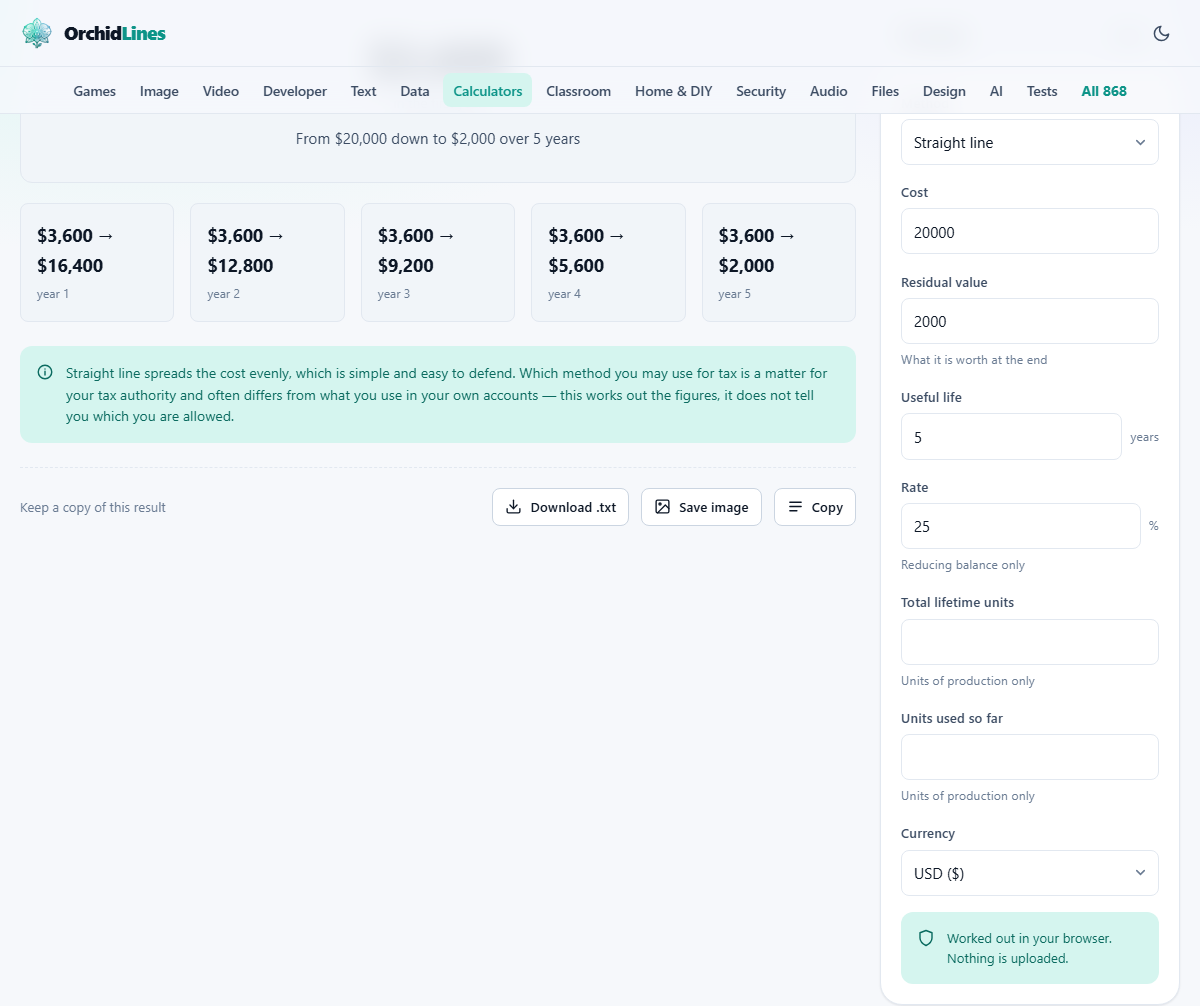
Suppose you buy a van for 20,000 in your local currency. You expect to sell it after five years for about 2,000. The depreciable amount is 18,000. Set Cost to 20,000, Residual value to 2,000, and Useful life to 5.
With Method set to Straight line, each year's charge is 18,000 divided by 5, which is 3,600. The schedule shows the book value dropping by 3,600 every year, starting at 20,000 and landing on 2,000 at the end of year five. Clean and predictable.
Switch the Method to Reducing balance and set the Rate to 40 percent. Year one charges 40 percent of 20,000, which is 8,000, leaving a book value of 12,000. Year two charges 40 percent of 12,000, which is 4,800, leaving 7,200. Each year the charge shrinks because the base shrinks. Left unchecked, reducing balance would never actually reach 2,000. The calculator handles this by trimming the final year so the book value lands exactly on the residual, just as a real accountant would.
The final-year trim for reducing balance
This is the detail that most online calculators get wrong or ignore. When you take a fixed percentage of a shrinking number, the result gets smaller forever but never reaches zero. A 25 percent rate on a 20,000 asset goes 15,000, 11,250, 8,437, 6,328, and so on, never arriving at the target.
In practice, accountants adjust the final year so the closing book value matches the residual. This calculator does the same thing automatically. The schedule shows the trim as a smaller charge in the last year, exactly enough to bridge the gap. If you are checking the schedule against a textbook example that does not do this, the early years will match perfectly but the final year will differ.
Sum of years' digits in more detail
For a five-year life, the digits are 5, 4, 3, 2 and 1. Their sum is 15. Year one gets five fifteenths of the depreciable amount, year two gets four fifteenths, and the pattern continues down to one fifteenth in the last year. The charges are front-loaded, like reducing balance, but they follow a fixed schedule rather than a percentage of a moving target.
One advantage of this method is that it always reaches the residual value at the end of the stated life. There is no asymptotic creep and no final-year trim needed. The schedule is fully determined the moment you enter the cost, residual and life. For assets where front-loading is desired but a clean endpoint is important, sum of years' digits sits between straight line and reducing balance in both complexity and effect.
Units of production and when time is the wrong measure
A factory machine that runs two shifts a day wears out faster than an identical machine that sits mostly idle. Depreciating both on a calendar basis charges the same amount each year regardless of use, which misrepresents the cost of the busy machine and overstates the expense of the quiet one.
The units of production method fixes this. Set Total lifetime units to the expected total output, say 500,000 parts, and enter how many have been produced so far in Units used so far. The charge for the period is the depreciable amount multiplied by the fraction of lifetime units consumed. If 50,000 parts were made this year out of 500,000 total, the charge is one tenth of the depreciable amount. This method requires good production records, but for capital-intensive manufacturing it gives a far more honest picture than any time-based method.
Tax depreciation is a separate question
What you may claim against tax is set by your tax authority and often differs from the depreciation in your own management accounts. Many jurisdictions prescribe specific rates, methods and asset classes that do not line up with the useful life you see in practice. This calculator gives you the accounting figures. It does not know your tax rules and cannot tell you what is allowable.
If you are preparing a tax return, check your local rules before relying on any depreciation schedule. The numbers from this tool are a useful starting point for understanding the pattern, but the rate your tax office publishes is the one that matters on the form.
Mistakes that show up in the schedule
Setting the residual value higher than the cost produces a negative depreciable amount, which makes no sense. If the asset will be worth more than you paid for it, there is nothing to depreciate. Setting the residual to zero is perfectly valid and simply means the entire cost is written off.
Choosing a reducing-balance rate that is too low stretches the schedule out so far that the book value is still well above the residual at the end of the useful life, leading to a large final-year adjustment. If the trim looks suspiciously big, try a higher rate. A rough guide is to double the straight-line rate: a five-year life gives a 20 percent straight-line rate, so start with 40 percent for reducing balance and adjust from there.
Privacy and where the calculation runs
All four methods are calculated inside your browser. The cost, residual value, life span and rate you enter are never sent to any server. Your figures are kept in local browser storage so they persist between visits, but that storage sits on your own device and is not accessible to anyone else.
Asset values and depreciation schedules can be commercially sensitive, especially for businesses preparing accounts or planning capital expenditure. Running the arithmetic locally means those figures stay under your control from start to finish, with no account needed and no data leaving your machine.