
Turning cups into grams without ruining the cake
A cup of flour and a cup of honey do not weigh the same thing, and that single fact trips up more home bakers than any oven setting. This article explains every mode of the cooking converter, shows how each control works, walks through real conversions with real numbers, and covers the pitfalls that make cup-based recipes unreliable when precision counts.
Why cups and grams do not translate one to one
A cup is a measure of space. A gram is a measure of weight. How many grams fit in a cup depends entirely on what you are measuring. Water is the one ingredient where the numbers happen to line up: a US cup holds 240 ml, and 240 ml of water weighs 240 grams. Almost nothing else in the kitchen behaves that way.
A cup of plain flour weighs about 120 grams. A cup of white sugar is about 200 grams. A cup of honey is around 340 grams. A cup of cocoa powder barely reaches 85 grams. If you search for a single cups-to-grams figure and use it for everything, every recipe that is not water will be wrong. The converter on this page knows the usual weight for each common ingredient, so the answer comes out right rather than roughly right.
The three jobs in one tool
The Job selector at the top of the panel offers three modes. An ingredient measurement is the default and handles all volume-to-weight and weight-to-volume conversions. Scale a recipe works out a multiplier when you want to cook for more or fewer people. Oven temperature converts between Celsius, Fahrenheit, and gas marks.
Switching the mode shows and hides the controls that belong to it, so the panel never feels crowded. Each mode stands on its own, and you can jump between them as often as you like. A Reset button at the top of the panel clears everything back to the defaults if you want a fresh start.
Converting an ingredient measurement
In measurement mode, four fields matter. Amount is the number you want to convert. From and To are the units. The From list includes Cups, Tablespoons, Teaspoons, Millilitres, Litres, Fluid ounces, Grams, Kilograms, Ounces, and Pounds. The To list mirrors it with the same set minus the unit you already chose.
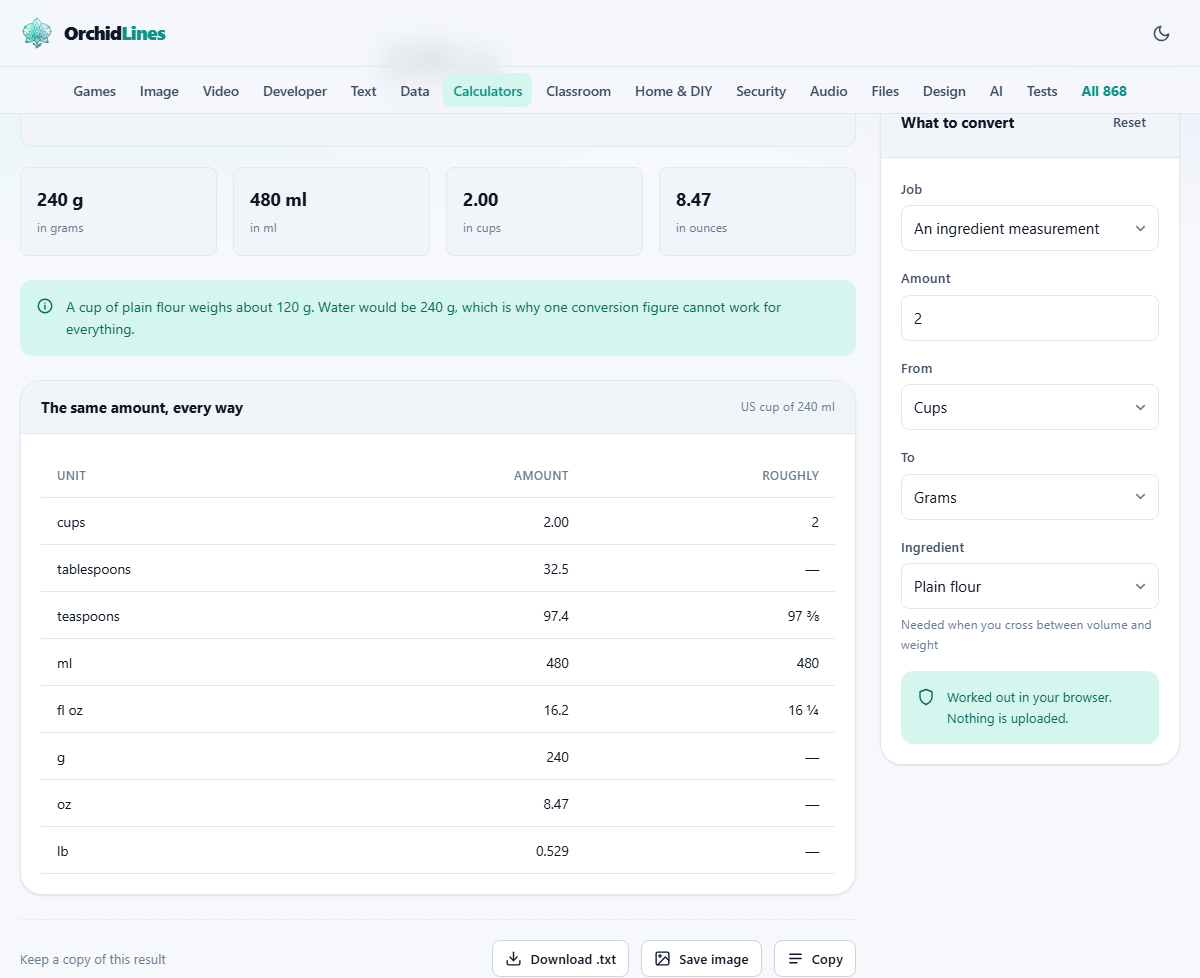
Below those sits the Ingredient dropdown. This only matters when you are crossing between volume and weight, for example cups to grams. If both units are volumes, like cups to tablespoons, or both are weights, like grams to ounces, the ingredient is irrelevant because the ratio is the same for everything. The tool shows a hint to that effect.
The result appears immediately and is accompanied by a table showing the same amount in every other unit. That table often saves a second trip back to the converter, because you can read off grams, ounces, tablespoons, and millilitres all at once.
A worked example: two cups of flour
An American recipe calls for two cups of all-purpose flour. You own a kitchen scale and want grams. Set Amount to 2, From to Cups, To to Grams, and pick flour from the Ingredient list. The answer is about 240 grams. If the recipe also calls for one cup of sugar, change the ingredient to sugar and the amount to 1. The result is about 200 grams. Notice that the same cup holds nearly twice as much sugar by weight as flour. That gap is exactly why guessing at a flat conversion fails.
Scaling a recipe up or down
Switch the Job to Scale a recipe and two new fields appear: Recipe serves and You want to serve. If the recipe feeds four and you need dinner for six, enter 4 and 6. The tool shows the multiplier, in this case 1.5, which you apply to every ingredient line.
Scaling is simple multiplication, but doing it in your head for twelve ingredients while the onions are already in the pan is where mistakes happen. One important warning: scaling does not scale the cooking time. A doubled cake takes longer, but not twice as long. It usually needs about a quarter more time in a tin of a different depth. Scale the ingredients here, then judge the time by eye and by testing.
Ingredients that resist scaling
Not everything in a recipe scales in a straight line. Salt and strong spices go non-linear: doubling a recipe does not always mean doubling the chilli. Start with one and a half times the amount and taste before adding more.
Raising agents like baking powder and bicarbonate of soda also need caution. Too much and the cake rises too fast and then collapses. The classic problem is halving a recipe that calls for one egg. The answer is to beat the egg, weigh it, and use half by weight. No one enjoys that step, but the alternative is a lopsided sponge.
Converting oven temperatures
Switch the Job to Oven temperature. The Temperature field takes a number, and the In dropdown lets you choose Celsius, Fahrenheit, or Gas mark. The result shows the same heat in all three scales at once.
Below the main result sits a checkbox labelled My oven is a fan oven. Tick it and the tool drops the Celsius figure by 20 degrees, which is the standard adjustment for a recipe written for a conventional oven. Most modern ovens are fan-assisted, and running them at the stated temperature without this correction often overcooks the outside before the middle is done. If your recipe was written for a fan oven already, leave the box unticked. As a quick reference: 180 degrees Celsius is 350 degrees Fahrenheit and gas mark 4, one of the most common baking temperatures you will see.
Cup sizes around the world
A US cup is 240 ml. An Australian cup is 250 ml. An old British cup, the kind found in recipe books from the mid-twentieth century, can be 284 ml. This converter uses the US cup, which is what most online recipes mean when they say a cup.
If you are working from an Australian cookbook and the difference matters, the easiest workaround is to convert the cup measurement to millilitres using the Australian definition, then enter that figure as the starting amount in millilitres here. For most cooking, the 10 ml gap between a US and an Australian cup barely changes the result. For baking, it can.
Why weighing beats measuring by volume
Even with the right per-ingredient conversion, cups have a deeper problem. How you fill the cup changes the amount. Scooping flour straight from the bag packs it down and can give you 20 percent more than spooning it in gently and levelling the top. That variation alone is enough to make the difference between a light cake and a dense one.
Professional bakers weigh everything for exactly this reason. If a recipe matters to you, weigh the ingredients. If you are following a recipe that only gives cup measures, use this converter to translate once and write the gram figures in the margin for next time. From then on you have a reliable recipe.
When this tool is not enough
The converter covers the common ingredients that have a well-known weight per cup. If you are working with something unusual, a speciality flour or an exotic syrup, the weight may differ from what any general list can offer. In those cases, the best approach is to weigh one cup yourself and note the result.
It also does not handle nutritional calculations. Knowing that two cups of flour weigh 240 grams does not tell you the calorie count, the protein content, or the allergen profile. For that kind of work, you need a nutrition database, not a unit converter.
Your recipes stay on your own device
The converter runs entirely in your browser. No ingredient amounts, no serving counts, and no temperatures are sent to any server. There is no account to create and nothing to sign up for. The page works just as well with no internet connection, because the conversion tables are built into the page itself.
That makes it safe to use mid-cook, on a flour-dusted phone, without worrying about where your data goes. It goes nowhere. Use it as many times as you need, across as many recipes as you like, with no limits and no ads asking you to create an account first.