
How compound interest builds wealth while you sleep
This article explains the compound interest calculator, walks through every control it offers, and shows with real numbers why the last few years of a savings plan add more than the first fifteen. You will also learn the common mistakes people make when estimating returns, when this calculator is not the right choice, and why the whole thing runs safely inside your own browser.
The idea behind the numbers
Simple interest pays you once, on the original amount you deposited. Compound interest pays you on the original amount plus every bit of interest already added. That sounds like a small difference at first, because in year one it is a small difference. But each year the base grows, so the interest grows, and the gap between the two methods widens until it becomes the main story.
Over twenty or thirty years, compound growth can double or triple what simple interest would have produced from the same starting deposit. The calculator on this page makes that visible with a year-by-year table, so you can watch the acceleration happen row by row instead of taking it on trust.
Who needs this calculator
Students learning about finance use it to see the curve take shape. Parents saving for education want to know how a monthly deposit grows over eighteen years. People comparing savings accounts need a fast way to test different rates side by side. Retirement planners use it to answer the question that keeps them awake: is this enough?
It also serves anyone who simply wants to settle an argument at the dinner table about whether starting early or saving more matters more. Spoiler: starting early almost always wins, and the table proves it. A person who puts away a modest amount from age 25 to 35 and then stops can end up ahead of someone who waits until 35 and saves diligently for thirty years. The difference is time, not discipline, and the calculator makes it plain.
Every control on the page
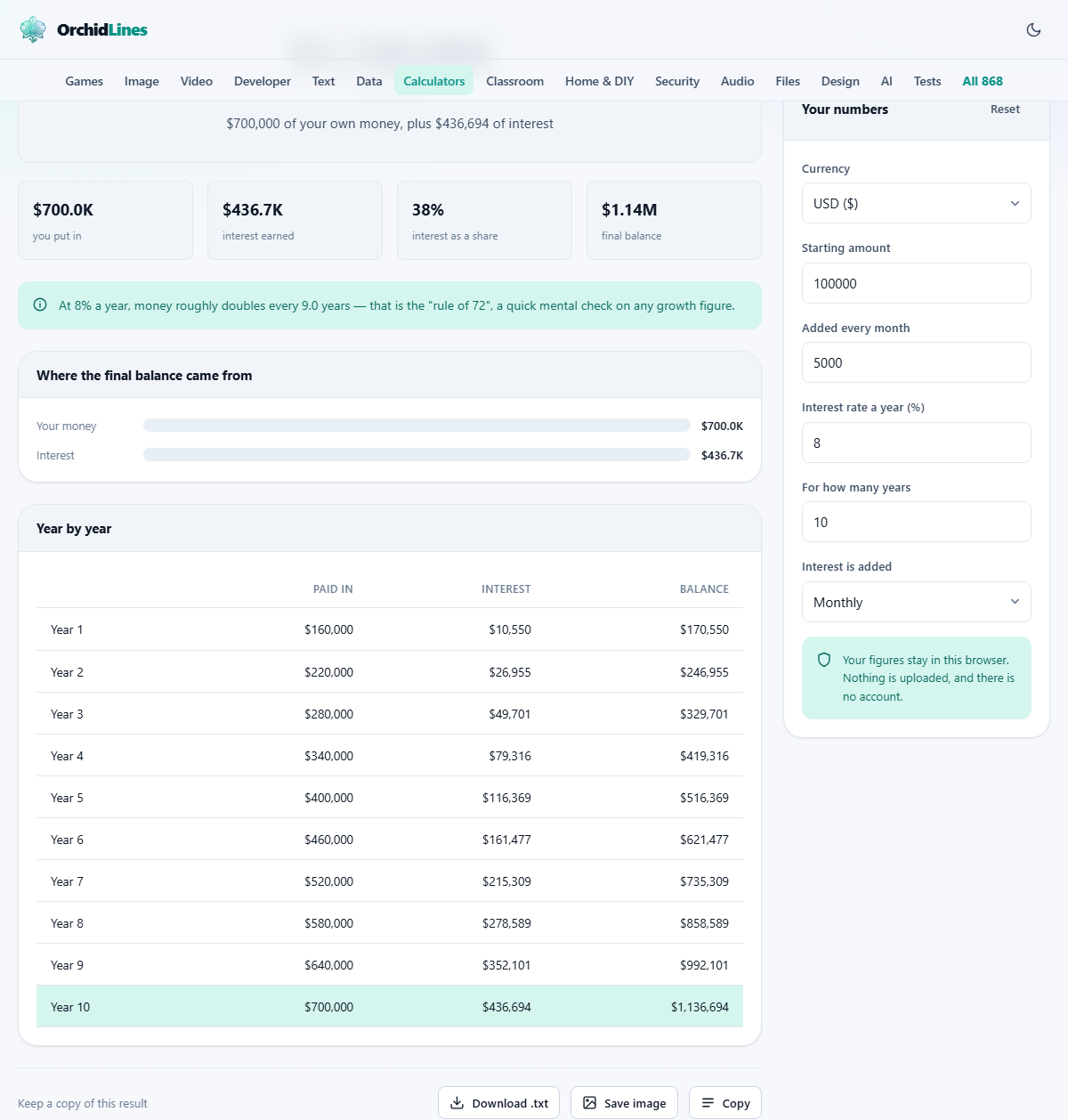
The panel on the right is headed Your numbers. At the top sits a Currency selector that sets the symbol shown in the results. Below it, the Starting amount field takes the lump sum you already have or plan to begin with. Leave this at zero if you are starting from scratch and relying on monthly deposits alone.
Added every month is the regular contribution. Even a modest figure here often makes a bigger difference than a large starting amount, because each deposit has its own years of compounding ahead of it. Interest rate a year (%) takes the annual figure your bank or account quotes, often labelled AER on savings products.
For how many years sets the time horizon. The field accepts anything from 1 to 100. Finally, Interest is added lets you choose how often the interest compounds: Monthly, Quarterly, Twice a year, Once a year, or Daily. Monthly is selected by default and is the most common for bank accounts.
Reading the output
Once the inputs have values, the results panel updates on its own. The headline figure is the final balance. Below it you will see how much of that total came from deposits you actually made and how much is pure interest. That split is often surprising: in a long plan, the interest can outweigh the deposits several times over.
Underneath sits a year-by-year table. Each row shows the balance at the end of that year, how much interest was earned during the year, and how much you had paid in by that point. Watch the interest column: it starts small, climbs slowly, and then begins adding more in a single year than you contributed over several. That is the compounding effect, and seeing it row by row is the best way to understand it.
A worked example with real figures
Suppose you start with 5,000 in a savings account, add 200 every month, earn 5% a year compounded monthly, and leave it alone for 25 years. By the end, the balance is roughly 136,500. You paid in 65,000 of that: the starting 5,000 plus 200 every month for 300 months. The remaining 71,500 is interest.
Now change one thing. Drop the starting amount to zero but keep everything else the same. The final balance falls to about 119,000, a reduction of around 6,300. That is less than the 5,000 you removed, because removing the starting lump also removes all the interest it would have earned. Next, try cutting the term from 25 years to 20 while keeping the 5,000 start. The balance drops to about 87,600. Five fewer years cost almost 38,000 in this example, which shows how heavily the result depends on time.
How compounding frequency changes the answer
The Interest is added dropdown offers five frequencies. Daily compounding beats yearly compounding, but the gap is usually small. At 5% on 10,000 over ten years with no extra deposits, yearly compounding gives about 16,289 and daily gives about 16,487. The difference is under 200 on a balance above 16,000.
The rate and the time are what actually move the number. Changing the frequency from yearly to daily is worth less than raising the rate by a tenth of a percent. That said, if your account does compound daily, there is no reason not to enter Daily here so the estimate matches reality.
The rule of 72 as a sanity check
Before you trust any calculator, including this one, it helps to have a rough answer in mind. The rule of 72 gives you one: divide 72 by the annual interest rate and you get the approximate number of years for money to double. At 6%, that is twelve years. At 8%, nine years.
If the calculator says your money doubles at 6% in eight years, something is wrong with your inputs. The rule is not precise, but it catches the big errors, and it works in your head at the dinner table where no calculator is welcome.
Common mistakes and their fixes
The most frequent error is confusing the nominal rate with the real rate. If your account pays 5% but inflation runs at 3%, your purchasing power grows at roughly 2%. This calculator does not subtract inflation for you. To get a figure in today's money, enter the rate minus your expected inflation instead.
- Using the gross rate when tax applies. Interest is often taxable, so the rate that reaches your account may be lower than the headline figure.
- Forgetting that rates change. A 5% rate today may not last 25 years. Run the calculation at a few different rates to see the range of outcomes.
- Entering a monthly rate in the yearly field. If your statement says 0.4% per month, the annual figure is roughly 4.8%, not 0.4%.
- Expecting the early years to feel exciting. They will not. The visible acceleration comes later, and the table is there to show you it is still working.
When this is the wrong tool
This calculator assumes a fixed rate for the whole period, deposits that never change, and no withdrawals. Real investments with variable returns, such as stocks and funds, do not behave this way. If you need to model a portfolio with changing allocations, shifting contributions, or periodic withdrawals, this tool is too simple for the job.
It also does not handle loan repayments. A mortgage charges compound interest too, but the monthly payment is structured to clear the balance by a set date, which is a different calculation entirely. And it says nothing about risk. A savings account with a guaranteed rate is not the same thing as an investment that might lose value in any given year. Use the result here as a rough guide for fixed-rate savings, not as a prediction of what a stock market portfolio will do over the next two decades.
Privacy and where your figures go
Every calculation runs inside your own browser. The page does not send your numbers to any server, does not require an account, and does not store anything beyond the inputs you leave on screen. Those inputs are saved in your browser's local storage so they are still there next time you visit, but they never leave your device. You could disconnect from the internet entirely and the calculator would still work.
That matters for a financial calculator. People type in their real savings balances and real deposit amounts, and those are exactly the figures that should stay private. Here, they do. There is no sign-up, no watermark, and no limit on how many times you run the numbers.